
The Philippines’ Connector-State Strategy In The Indo-Pacific – OpEd
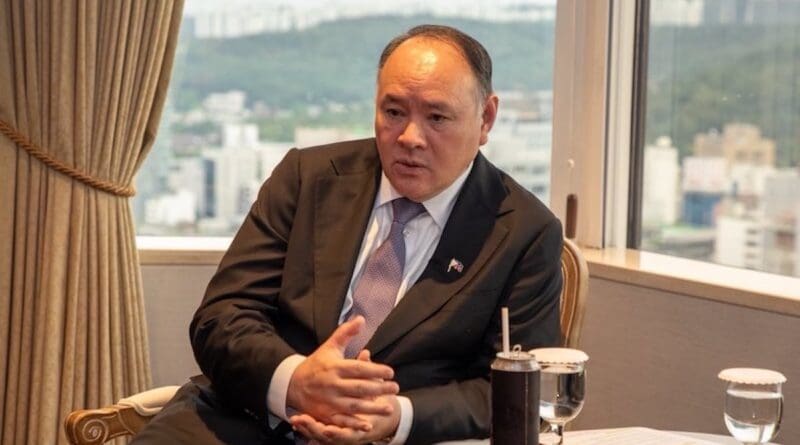
The strategic position of the Philippines has undergone a deliberate shift, according to Philippine Defence Secretary Gilberto Teodoro Jr., during his visit to Seoul and his participation in the Seoul Defence Dialogue. The Philippines, under Teodoro’s leadership, has actively worked to establish itself as a connector state in the Indo-Pacific through his diplomatic efforts and public declarations, which aim to unite the region through historical ties and new defence alliances and multilateral partnerships.
Teodoro employs the term “resilient partner” to describe South Korea through language which exceeds typical diplomatic communication. The Philippines uses its Korean War participation to create a shared history of cooperation, which enables domestic support for enhanced defence relations without forcing the country to choose between specific powers. The discussions in Seoul moved past procurement to focus on logistics and maintenance, training and technology transfer and co-development, which help reduce supply chain risks and create lasting capability growth.
Defence diplomacy includes cultural and educational exchange as a strategic component. Security relationships that last require two essential elements, which are social bonds and strong operational systems. The political environment for cooperation receives its direction from both public opinion and expert knowledge. The development of trust between administrations depends on Manila and Seoul through their combined efforts to expand scholarships, professional military education, and civilian disaster-response training.
The meeting between Teodoro and Johan Berggren at the Seoul forum demonstrated how Manila was expanding its defence partnerships through its diversification strategy. The discussions focused on civil-defence and crisis-response cooperation, as well as expanded training and defence education and protection of underwater critical infrastructure, cybersecurity and maritime domain awareness collaboration. The civil-defence expertise of Sweden, together with its current defence industry partnerships in Manila, offers functional paths for building capacity which enhance the industrial capabilities of Seoul.
The different interactions show a single hedging strategy. The Philippines seeks to unite Northeast Asia with Southeast Asia and Europe through partnerships that will enable the country to access different capabilities from South Korea’s manufacturing and logistics, Sweden’s specialised technologies and civil defence expertise and ASEAN’s diplomatic capabilities. Manila employs diversification to reduce its strategic dependence while obtaining more policy choices because regional alliances tend to change frequently.
The accomplishment of this goal encounters multiple major obstacles. The first major challenge that stands in the way of this project is the lack of resources. The armed forces need sustained long-term funding to achieve modernisation and build sustainment capabilities for procurement, training, and institutional development. The Philippines has raised its defence spending, but the country faces difficult decisions because of its limited budget and many social requirements. The lack of extended financial backing and weak institutional capacity requires bilateral agreements to serve political needs, but these agreements fail to deliver operational results.
Major powers’ increasing competition restricts nations from making necessary foreign policy adjustments. Smaller states must exercise careful diplomacy in their international relations because forming strong bonds with one nation could lead other countries to view them as adversaries of that nation. The principles of freedom of navigation and international law, which Manila uses to describe its involvement, do not provide sufficient protection when competing interests lead to disputes in the South China Sea region. External cooperation that supports the Philippines in this situation would lead to stronger diplomatic and economic responses.
The third point shows that Manila’s foreign and defence institutions lack strong connections between them. The political cycle decides which policies get top priority, but interoperability and joint doctrine development and training programs require enduring bureaucratic backing to achieve success. The sustainability of Teodoro’s connector-state vision depends on achieving bipartisan backing and creating stable administrative systems which can resist changes in government leadership.
Fourth, the regional architecture remains unfinished. ASEAN functions as an essential platform for dialogue, but its consensus-based approach, combined with weak enforcement capabilities, restricts its ability to establish unified security measures. The Philippine government needs to support its subregional connections through actual investments in institutions which will improve transparency and information exchange and crisis response systems.
The length of these partnerships and the level of public acceptance will depend on the current domestic political situation. The continuation of defence cooperation depends on citizens experiencing direct advantages from their defence partnership through faster disaster response, improved effectiveness, technology transfer, jobs and protected economic infrastructure. The lack of evidence showing defence engagement leads to everyday security and prosperity makes these initiatives seem to serve elite interests instead of solving fundamental citizen needs.
Manila needs to convert Memoranda of Understanding into concrete programs, which should include joint maintenance facilities, shared logistics centres and collaborative development projects. The current agreements with South Korea through the 2015 MOU and European memoranda need operational roadmaps that include specific funded targets. Regular joint exercises and logistics drills will demonstrate practical interoperability and reassure both domestic constituencies and external partners. The program must include continuous funding for maintenance facilities, repair shops, overhaul facilities, training programs and industry collaboration to create civilian job opportunities. A transparent procurement process and measurable milestones will help mitigate perceptions that defence spending disproportionately benefits narrow interests rather than enhancing national resilience.
The Philippines shows its transition from alliance-based defence to independent Indo-Pacific engagement through Teodoro’s activities in Seoul and Sweden. The strategy uses a structured method to develop South Korean technological and logistical connections while merging European non-traditional security capabilities into a unified regional system. The connector-state model will provide stability to Philippine security and regional stability through the following years as Manila secures stable funding sources and institutional stability and demonstrates how defence cooperation generates public value.
The opinions expressed in this article are the author’s own.
References
- Basu, P. (2025). Strategic Diplomacy in the Indo-Pacific: The Case of Japan and the Philippines. Observer Research Foundation.
- Heydarian, R. J. (2025). Middle-Power Diplomacy in the Age of Great-Power Competition: Japan, the Philippines, and the South China Sea Disputes. Journal of Indo-Pacific Affairs, Summer 2025.
- International Crisis Group. (2025, August 12). Riding Unruly Waves: The Philippines’ Military Modernisation Effort. Crisis Group Asia Report No. 349

Like what you read?
Please consider supporting Eurasia Review. Thank you for your consideration!
