
Chinese Military Drills: Prospects For Cross-Strait Stability – OpEd
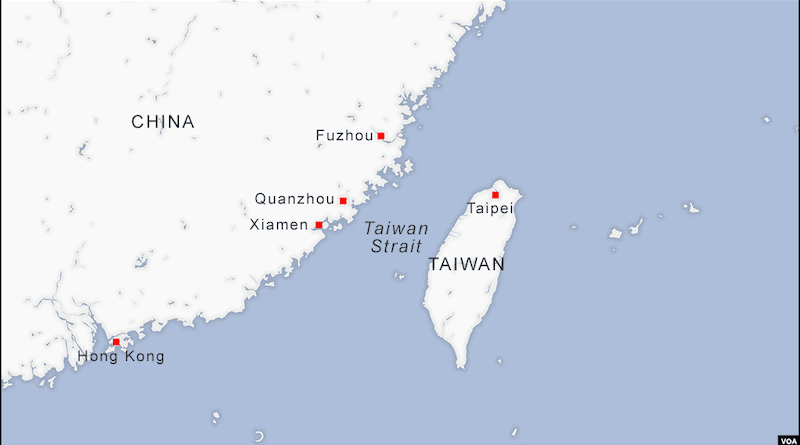
China conducted military drills around the Taiwan Strait on October 14. As reported, these actions came in response to the ‘separatist’ statements given by Taiwanese President Lai Ching-te in his first National Day speech.
In a thinly veiled reference to the Chinese claims over the island, the President stated that he would stand by the commitment to resist any external invasion or encroachment upon the territory. With a strong resolve, Lai promised the nation to maintain peace and stability across the strait and vowed to strengthen cooperation with Beijing on climate change and regional security.
While this speech boosted the morale of the Taiwanese, the Chinese counterparts became more vigilant. In response to President Lai’s statements on October 10, the Ministry of Foreign Affairs of China expressed its deep concern stating that “it reveals his intransigent position” on Taiwan’s sovereignty. President Xi Jinping of China is firmly determined to integrate both sides of the Strait under the broader National Rejuvenation mantra which is to be achieved by 2049. The repeated Chinese aggression against Taiwan is a logical consequence of this plan.
According to the Chinese military’s Eastern Theatre Command, the latest military drills named “Joint Sword-2024B” took place in the Taiwan Strait, and the north, south, and eastern parts surrounding Taiwan. Prior to the drills, a roughly one-minute propaganda video was released by the Eastern Theater Command on social media which demonstrates fighter jets in the air, amphibious assault vessels and warships at sea, and movable missile launchers being deployed on land. The short clip was also accompanied by a text that reads “prepared for battle at all times and can fight anytime.” This was a clear indication that China was up to something.
One report from Taiwan showed that 34 naval vessels and 125 aircraft were detected manoeuvring around the island. The Chinese state media published several maps showing its forces were placed in the vicinity of the entire island. China’s People’s Liberation Army (PLA) maintained that the exercises involved all wings of the military and were intended to pretend that Taiwan was attacked by sea, land, and air. In another statement, the spokesman of PLA Eastern Theater Command Li Xi said the drills “illustrated the joint operation capabilities” of its forces.
At home, the exercises received a lot of appraisals; however, they were met with strong condemnation from abroad. Taiwan’s Ministry of Defence criticised Chinese actions in strong words citing them as “provocative and irrational” and adding that the ministry has “prepared specific forces to respond to actions and ensure freedom, democracy, and sovereignty” of the island. In addition, the United States, one of Taiwan’s major supporters, also expressed deep concern towards the latest drills, stating that “military response to a routine speech is very provocative and escalatory in nature.” On another account, the State Department spokesperson Matthew Miller said, “We call the People’s Republic of China (PRC) to act responsibly and avoid any aggression that might compromise the stability in the region.”
The leadership in Beijing surely do not want Taiwan to formalize its independence given their historical claims of the island. The drills were not one of a kind, instead, the Chinese coast guards carried out a similar exercise in May this year, soon after the inauguration of President Lai who is denounced as a ‘dangerous separatist’ by Beijing. The war games dubbed “Joint Sword-2024A” held in the second quarter reportedly consisted of 91 Chinese warship sailings in about 2,200 hours, which cost approximately 12.7 million US dollars. In addition, China spent about $47.8 million on jets making 111 flights around Taiwan.
A very eminent African aphorism, “Two lions cannot live in the same valley,” suits the situation across the Taiwan Strait. The difference in ideologies persists between China and Taiwan. The two sides are doomed for war – given the repeated Chinese aggression and growing tensions on both sides. Though the majority of world powers recognize mainland China as the sole legitimate government and support the “One China Policy,” the leadership in both Beijing and Taipei has opposite views on running a system. China is a one-party communist state under the system of people’s congress, while Taiwan is a democratic state with a semi-presidential system.
As the situation shapes, prospects for peace and stability are apparently dim. President Lai’s strong tenacity for an independent nation is seen as a threat by the Xi administration – in fact, any action that might lead to the cessation of Taiwan from the mainland is deemed a danger to the National Rejuvenation plan of China. In the last few years, particularly in the first quarter of this year, Chinese diplomats held rounds of meetings with Taiwanese counterparts, however, the two sides could not meet on the same page. Adding further, the Western’s support for Taiwan adds complexity to the situation, as it threatens China that other powers might join Taipei’s independence movement. Given the failure of long-standing diplomatic efforts and lack of consensus from both sides, inadvertent war looms over the Taiwan Strait.

Like what you read?
Please consider supporting Eurasia Review. Thank you for your consideration!
