
Uzbekistan Joins Inaugural Peace Council As Washington Visit Deepens Strategic U.S. Ties – OpEd
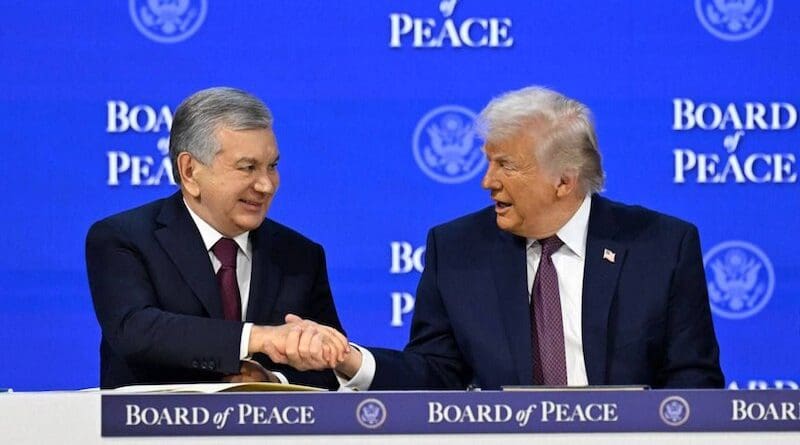
At the invitation of the U.S. President Donald Trump, President of Uzbekistan Shavkat Mirziyoyev will visit Washington, D.C., from February 17 to 19 to participate in the inaugural meeting of the Peace Council and to sign a broad package of economic agreements with leading American companies and financial institutions. The visit brings together two parallel priorities which includes Uzbekistan’s participation in a new international peace initiative and the deepening of its strategic partnership with the United States.
The Board of Peace, established at the initiative of President Trump, will hold its first summit at the United States Institute of Peace. The meeting is expected to focus primarily on reconstruction and humanitarian assistance for the Gaza Strip, as well as longer-term mechanisms for regional stability. Uzbekistan joined the Council as a founding member in January during the signing of its Charter in Davos, Switzerland, demonstrating Tashkent’s readiness to engage more directly in multilateral conflict-resolution efforts.
In Davos, President Mirziyoyev formally endorsed the initiative alongside a wide range of participating states. Uzbek officials have described the Council as an evolving platform, initially centered on Gaza but with a broader mandate to address other conflicts over time. Uzbekistan’s decision to join reflects its support for peaceful settlement of disputes and advocacy for a two-state solution to the Israeli–Palestinian conflict. In 2024, Tashkent also facilitated humanitarian assistance, including the evacuation of injured Palestinian civilians and the President has been advocating for peace in the region and the end of military action.
The Washington visit builds on a year of intensified political dialogue between Tashkent and Washington. In September, Presidents Mirziyoyev and Trump met on the sidelines of the 80th session of the UN General Assembly in New York, where they reviewed progress on bilateral agreements and discussed expanding cooperation in strategic sectors. Both sides publicly characterized the talks as constructive and forward-looking.
That dialogue continued during the Central Asia–United States summit in the “C5+1” format, hosted at the White House. Alongside the leaders of Kazakhstan, Kyrgyzstan, Tajikistan, and Turkmenistan, President Mirziyoyev proposed institutional reforms aimed at strengthening the format, including the creation of a permanent Secretariat and a ministerial-level Coordinating Council on Investment and Trade. He also advocated for a Central Asian Investment Partnership Fund and closer cooperation on transport corridors, energy connectivity, and critical minerals supply chains.
A central component of the current visit is the presentation and signing of strategic projects in sectors ranging from energy and mining to aviation and digital technology. Uzbekistan has set a target to generate more than half of its electricity from renewable sources by 2030, with a planned capacity of 18–20 gigawatts in solar and wind energy. Cooperation with American firms is expected to play a role in meeting these goals.
Critical minerals have also emerged as a focal point. Uzbek authorities have outlined plans to expand extraction and deep processing of uranium, copper, tungsten, molybdenum, and graphite, aiming to integrate more fully into global supply chains. Discussions with U.S. companies have included the application of advanced processing technologies and the establishment of reliable logistics networks.
Transport modernization represents another priority. Tashkent plans to invest more than $12 billion to modernize its roads, railways, terminals, and airports by 2030, a program intended to strengthen Uzbekistan’s position as a regional transit hub linking Central Asia with the South Caucasus and Europe.
Digital cooperation is expanding as well. Engagement with major American technology companies has included initiatives in fintech, startup development, and digital education. The creation of a Digital Academy and the expansion of digital payment systems such as Apple Pay and Google Pay have been highlighted as symbols of Uzbekistan’s technological modernization drive.
Agriculture and interregional partnerships have also featured prominently. Recent discussions with U.S. officials and state-level delegations have covered soybean and cotton supply contracts, drip irrigation technologies, and cooperation in innovation and inclusive education. Engagement with the U.S. state of Utah, for example, has produced projects in digitalization and social protection, with plans for further delegation exchanges.
Taken together, these developments suggest that the Washington visit is not only a diplomatic event but part of a broader repositioning. Uzbekistan is seeking to combine regional leadership within Central Asia, deeper economic integration with the United States, and a more visible role in international peace initiatives.
Participation in the inaugural Peace Council summit illustrates Uzbekistan’s ambition to contribute to conflict resolution beyond its Central Asia. Simultaneously, the signing of economic agreements in Washington is expected to bring long-term partnerships with global investors, technology leaders, and financial institutions that contribute to sustained modernization in the country.

Like what you read?
Please consider supporting Eurasia Review. Thank you for your consideration!
