
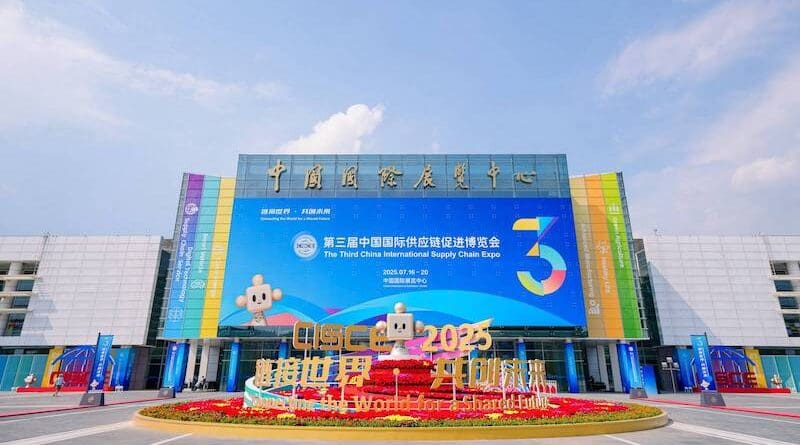
Amid US Tariff Escalation, China’s Supply Chain Expo Charts A Different Course – OpEd
As the Trump administration prepares to finalize imposing new tariffs on August 1, Beijing is hosting the third China International Supply Chain Expo (CISCE) from July 16 to 20.
Against a backdrop of rising protectionism, this gathering is under the theme of “connecting the world for a shared future.” It has attracted a record number of over 650 global participants, with approximately 35 percent from overseas across 75 countries, regions, and international organizations. Notably, half of the international participants are from Europe and the United States, including a remarkable year-on-year increase of 15 percent in U.S. exhibitors, as released by the China Council for the Promotion of International Trade (CCPIT).
A Trade Fair Beyond Trading KPI
Much like Milton Friedman’s humble pencil in his timeless parable—whose existence relies on global cooperation—modern supply chains transcend political boundaries through their very design. This economic reality remains steadfast even as rhetoric surrounding decoupling intensifies.
In contrast to traditional trade fairs that primarily evaluated by goods or services volumes, CISCE introduces an innovative “chain-centric” model that illustrates comprehensive industrial collaboration along the entire value chain. Within each exhibition hall, companies from upstream, midstream, and downstream sectors are arranged in adjacent booths to visually convey their interdependence and synergistic relationships.
This year’s expo goes beyond the scope of conventional trade exhibitions by highlighting next-generation supply chain solutions. With over 230 first-time exhibitors—including advanced AI-driven enterprises such as Unitree Robotics—the event showcases cutting-edge developments in automation, green energy technologies, and intelligent logistics systems.
A Vote of Confidence in the Expo and China’s Economy
In an era marked by escalating geopolitical tensions and fragmentation, robust overseas participation sends a clear message: the business world votes with their feet. And it prioritizes stability over ideology.
The presence of Nvidia is particularly noteworthy. Despite U.S. chip export controls, the company is deepening its engagement with Chinese partners and is expected to showcase cutting-edge robots powered by Nvidia chips. CEO Jensen Huang met with CCPIT Chairman Ren Hongbin before the expo and emphasized that Nvidia relies on technology providers from every corner of the globe. It takes 200 different technology companies to build one of Nvidia’s AI computers—an endeavor made possible only through a sophisticated supply chain. “That’s why I am here to celebrate the miracle of Chinese supply chains.” said Nvidia CEO Jensen Huang.
The success of the expo reflects China’s strong economic resilience in the face of challenges. Even amid external pressures, the country achieved a GDP growth of 5.3% in the first half of 2025—an encouraging result that exceeded expectations shared by many international observers. According to the National Bureau of Statistics, industrial output also saw steady progress, rising by 6.4 percent compared to the same period last year. Notably, the equipment manufacturing and high-tech manufacturing sectors continued to lead the way, with value-added output in high-tech manufacturing growing by an impressive 9.5 percent.
China has placed a strong emphasis on boosting domestic demand, introducing a series of initiatives aimed at stimulating consumption during the first half of 2025. In preparation for the second half of the year, relevant authorities are actively accelerating the rollout of new policy measures that will continue to support and stabilize economic growth. Several leading global financial institutions—including Goldman Sachs, Deutsche Bank, and Morgan Stanley—have recently upgraded their projections for China’s economic growth in 2025.
While some western politicians voice concerns about supply chain security and advocated for reshoring, this situation actually highlights a broader truth: China remains a vital driver and stabilizing force for the global economy. Business world is eager to foster global supply chain stability and resilience. And resilience stems from diversification rather than isolation. Where one erects barriers, another builds bridges.
The Path Forward: Cooperation or Confrontation
History warns against fragmentation—seen clearly in the Cold War. Blocking others ultimately hurts all. Today’s stagnation begs the question: Will leaders embrace business pragmatism or cling to zero-sum games?
China’s role in hosting this event goes beyond defending globalization—it’s redefining it. Markets drive both efficiency and peace, as Friedman’s “price system miracle” shows. By championing openness, China replaces barriers with bridges: real progress comes through connection, not confrontation.

Like what you read?
Please consider supporting Eurasia Review. Thank you for your consideration!
