
Bhutan Marketing Unique City Plan To Global Investors – OpEd
Tiny Bhutan, which enshrined “Gross National Happiness” in its Constitution as national goal rather than as mere aspiration, has planned to develop a unique environment friendly city based on unique Bhutanese Buddhist values.
A city with enough investment and growth potential that can meet the kingdom’s need for urban space without compromising on environment.
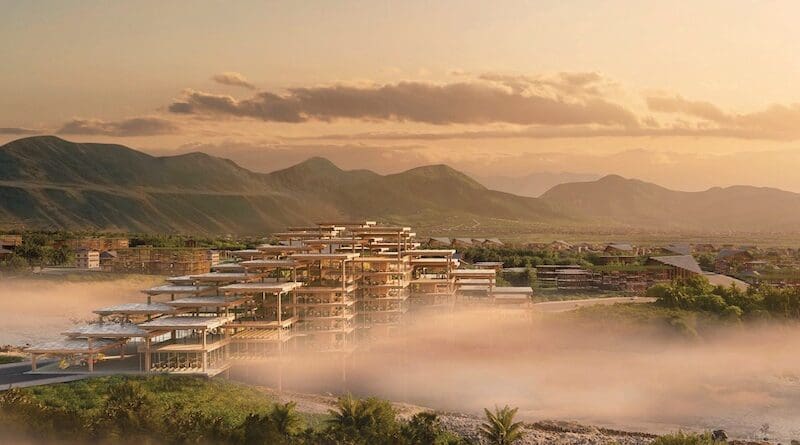
The brainchild of its current King Jigme Khesar Namgyel Wangchuk, the Gelephu Mindfulness City (GMC), on the foothills of the mighty Himalayas, is conceived as a vast new urban project designed to provide jobs, foster innovation, and offer a sustainable, Bhutanese model of modern development.
“Without urbanisation and big-time job opportunities, we cannot hold back our educated youth from migrating abroad nor can we bring back those who have. All our existing cities are bursting at the seams. So we needed a new city but our King wants it to conform to Bhutanese values,” says Kinley Paydon Dorji, Director of GMC affairs.
Talking to Eurasia Review on the sidelines of a roadshow in Calcutta to attract Indian investors for the Gelephu Mindfulness City, she said: “The city will consist of a network of townships linked by striking bridges that serve both symbolic and practical functions. Some bridges will house temples and medical centres, while the largest will contain an international airport constructed over a flowing river—designed so the water and fish below remain undisturbed.”
She said the GMC will be governed as a self-administered zone on the principle of “one country, two systems”. Spread over 1000 sq.kms, about the size of Hong Kong, the city will focus on seven sectors for investment — health and wellness, spirituality, education and knowledge,finance and digital services, agri-tech and forestry, logistics and aviation.
A presentation made for potential investors was screened at the Bengal Chamber of Commerce.
Bhutanese officials said the kingdom can set up traditional wellness hubs offering Sowa Rigpa treatment packages using healers called ‘amchis’ which could be an instant hit for stressed professionals all over the world. Tourists can also go for meditation and Buddhist learning.
Bhutan also has great potential for quality herbal medicine because it produced quality cordyceps and other herbs valued for physical rejuvenation.
It has great climate and pollution free environment for setting up quality schools and colleges as well as hi-tech research institutes .
“The potential is enormous. We are looking at a 40-year plan for giving complete shape to the City but the first ten years (2025-2035) should be good enough to make GMC up and running,” Kinley Dorji said.
Bhutan has long exercised great caution in pursuing economic growth and development. It practises restrictive niche high value tourism unlike neighbouring Nepal’s mass tourism and continues to maintain tough environmental protections that require 60% of its land to remain forested. Abattoirs are banned, fishing is largely prohibited, and even in the capital Thimphu, construction cannot deviate from traditional architecture.
“This conservatism has helped preserve Bhutan’s culture and environment, but it has also constrained economic diversification. Much of the economy is still agrarian, and employment opportunities for an increasingly educated younger generation remain limited,” says Ian Parkin, who calls Gelephu Mindfulness City the “anti Dubai”.
No skyscrapers, buildings no taller than trees, minimum concrete and steel. “The design prioritises harmony with nature, aiming to preserve the area’s rivers, forests and wildlife,” says Parkin.
He says Gelephu is being planned with significant attention to environmental risk. Located at the foot of the Himalayas, the region is prone to flooding during the monsoon. Instead of building extensive drainage systems lined with concrete, designers plan to create agricultural buffer zones of paddy fields around rivers. These fields will absorb excess water, effectively turning the city into a sponge during heavy rains.
“Permeable paving, green corridors, and extensive landscaping will further reduce the need for hard infrastructure, aiming to minimise the city’s environmental footprint,” says Parkin.
Kinley Dorji feels Gelephu Mindfulness City will not just be another city, but offer the world “an entirely new perspective in urbanisation.”
“If we are succesful in executing the project as planned, we can show the world how to build cities in fragile mountain regions which are sustainable,” she said.

Like what you read?
Please consider supporting Eurasia Review. Thank you for your consideration!
