
The Horn Of Africa States: Political Settlement – OpEd
Leadership in the Horn of Africa States region seems to be more of a problem for the region. Instead of leading the region to peace, development and normalization, there appears to be this push on personal agendas involving mostly personal enrichment, elimination of all types of opposition by all means possible, and busying the populations on tribal/can conflicts, which seem to have no end. This is, indeed, good news for the marauding foreigners who exploit the resources of the region.
It seems to be political instability that is the goal of these leaders as agents for known and not so well-known foreign forces, who wish the region to remain conflicted and unstable, knowing that the region is a major gateway of international trade and that it is, itself, resource rich. The way it is, the region is far from achieving neither long-term peace nor prosperity despite the claims of the leadership of the region.
Environmental degradation and climate change is another major factor which adversely affects the region and the ill-effects of these climatic issues seem to be driven by the political conflicts. The region’s agriculture, which used to be the food producer of the region, is kept underdeveloped through the inability of subsistence farmers to work on their lands. International NGOs, emptying the warehouses in food producing countries from old harvests to make space for new harvests, have taken the place of the traditional farmers of the region to supply food to the region. This is a direct affront to the region to deprive people of the ability to produce their own foods. They have created so many camps in the countryside of the region to collect people and make them dependent on their old and perhaps expired foods from elsewhere.
Because of the instability of the region, its economic infrastructures have not moved well for so many years. Many of the old roads and bridges and ports of the region have become structurally deficient, although the Chinese may have added some new infrastructures in terms of rail and roads for Ethiopia and Djibouti. But these benefit only the Chinese business and not the region. They are manned and managed by Chinese and do not create employment for the region. The economic growth of the region appears to be mostly driven by the private sector but in a haphazard way without any particular plans. Most of the economic outlay and trade in the region appears to be dependent on donor monies and on remittances from the region’s diaspora.
Organized direct foreign investments in the region seems to be lacking except perhaps for adventurer exploiters of the administrative weaknesses of the region. No major investments from organized investment firms in the world is present in the region. No wonder many of the youth of the region are on the run and fill the refugees camps of the world.
The region’s continued conflicts, economic hardships and the inability to tend to one’s own plots of land to produce food for oneself is what is driving the continuous migration out of the region. This is, indeed, a loss of human capital for the region and a burden of the host countries to which they run to. It is another wall confronting the development process of the region.
Many of the issues are often described or presented with respect to social matters that are a direct result of the imposed political conflicts under the imposed local leaderships, who use money and corruption to reach the pinnacle of authority in the region. The region could have prodded on its path to development had it not been underdeveloped by others who have interests in it. Bribing and corruption appears to be the main tool used to reach power in the region and the funds are supplied by the others – known and unknown. How can a region’s development be based on funds and aid?
The geostrategic location of the region appears to be the main attraction of the so-called international community for it is, clearly, the interests of a few foreign countries who are involved in the Horn of Africa States region and not the total international community. The interests of these few countries have only exasperated the situation of this conflict prone region. There is the Chinese, the West, the Turks, the Persians, the Arabs of the Gulf, and others who are involved in the region for their own ends and not for the interests of the region. Unfortunately the leadership of the region have become proxies for these differing interests who are competing for the resources of the region.
This has weakened governance in the region, disrupted the interconnectedness of the region and have stood in the way of cooperation among the countries of the region. It is where it is necessary for the peoples of the region to forge relations among themselves through educational institutions, through the chambers of commerce and industries, through agricultural organizations and through the healthcare and health service institutions and many more. The region can strive and move ahead towards stability and prosperity and show the leaderships that there is another way better than being agents for foreigners who provide with them uno pocco di dolari or a fistful of dollars to sell of their countries and people.
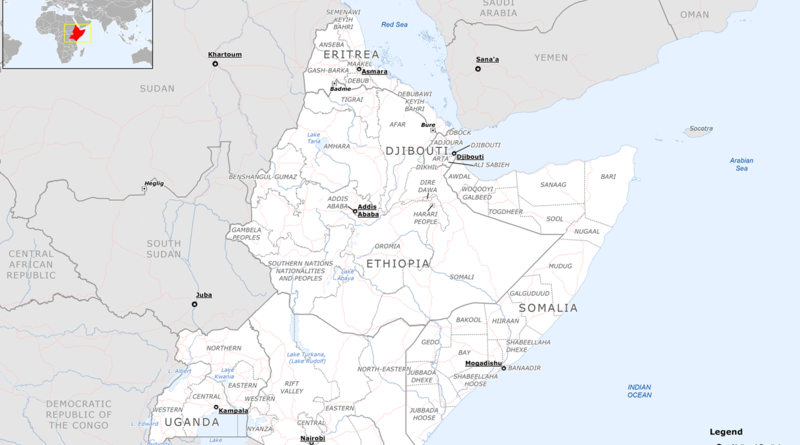
The Horn of Africa is a big region of circa 2 million square kilometers with a maritime space of some one million square kilometres, and rivers and lakes, mountains and long coasts. It is a region which has generally a good climate to produce its own food both as plants, livestock, and fish. It should never be hungry, yet it is! It is a region which connects Asia, Africa and Europe and overlooks one of the main trade routes of the world – the Suez Canal/Indian Ocean waterway.
It is a region which has deep historical connections, which should be cooperating and working together instead of aggressively competing against each other. It is a region, which should be on the vanguard of nations and not on the butt of nations as seems to be the case today. And leadership is key. The people of the region should be working on its leadership to make them work for them and not for others.

Like what you read?
Please consider supporting Eurasia Review. Thank you for your consideration!
