
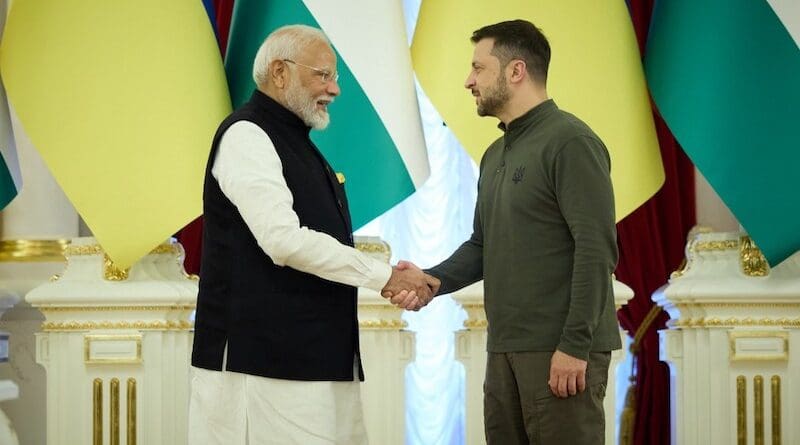
Russia Or The West? India’s Hard Choices In The Ukraine Conflict – OpEd
India has long prided itself on a foreign policy defined by strategic autonomy, balancing competing regional and global interests. However, recent developments—most notably, India’s decision to provide ammunition to Ukraine amid the ongoing war with Russia—suggest a shifting paradigm in its diplomatic calculus, one that is increasingly putting its relationship with its long-time ally, Russia, to the test.
For decades, India and Russia have been linked by a robust partnership, forged during the Cold War. Russia, once the Soviet Union, stood as a counterbalance to Western influence, offering India military support, particularly in defense technology. In return, India aligned itself with Russia’s interests in international forums. This “all-weather” alliance has stood the test of time, characterized by mutual respect, economic ties, and shared concerns over the balance of power in Asia.
However, as the war in Ukraine grinds on, India’s increasingly delicate balancing act is under scrutiny. The government, under Prime Minister Narendra Modi, has maintained a stance of neutrality in the conflict—calling for diplomacy and dialogue, refraining from condemning Russia outright, and maintaining strong ties with Moscow on energy and defense issues. Yet, despite these diplomatic overtures, India has found itself facing increasing pressure from the West, particularly the United States and the European Union, to take a firmer stand on the war.
The decision to supply ammunition to Ukraine, though not widely publicized, is a notable departure from India’s traditionally cautious stance. It signals a potential shift in India’s position on the Russia-Ukraine war and highlights the complexities of its international relationships. The move has raised eyebrows in Moscow, where the perception of India’s neutrality is now being questioned. For Russia, India’s role as a military partner in recent years has been a source of strategic stability, especially in a world increasingly polarized by great power rivalry. Now, supplying arms to Ukraine—albeit in the form of ammunition—appears to be a betrayal of that trust.
This shift poses a difficult question for India: Can it truly balance its regional and global alliances without compromising its strategic autonomy?
India’s calculations are clear, albeit complex. On the one hand, the country’s relationship with the United States and the West is undeniably important. As China’s geopolitical ambitions continue to rise, India and the West share growing security concerns in the Indo-Pacific, particularly in the face of China’s assertive posture in the region. The United States, India’s largest trading partner, has been an essential counterbalance to China’s increasing influence. With these economic and security considerations at play, India is acutely aware that closer ties with Ukraine may help solidify its position in the West’s strategic framework.
On the other hand, India’s decision to maintain its relationship with Russia is driven by more than just military hardware. Russia has long been a critical partner in terms of defense and energy security. India is dependent on Russian arms and technology to modernize its military forces. Moreover, Russia remains a key player in the United Nations Security Council, where India has aspirations of securing a permanent seat. For India to continue benefiting from these alliances, its relationship with Russia must remain strong, despite the complicated politics surrounding Ukraine.
This dilemma is further complicated by India’s regional interests. South Asia remains a focal point of India’s foreign policy, with its longstanding rivalry with Pakistan and its growing concerns about China’s presence in the Indian Ocean and beyond. Aligning too closely with the West could alienate Russia and provoke deeper military cooperation between Moscow and Beijing, something India is desperate to avoid. India must thus navigate this tricky terrain with care, knowing that any shift in its foreign policy could have profound repercussions on its regional security calculus.
The ongoing war in Ukraine presents India with a stark choice: Continue with a policy of neutrality and risk alienating Russia, or make a decisive pivot toward the West and jeopardize its relationship with a key historical ally. Yet, by supplying ammunition to Ukraine, India seems to have made a subtle but important departure from neutrality. This action may not be a full-throated endorsement of Ukraine’s war effort, but it does signal an important shift in the way India views the conflict.
In light of this, India must carefully recalibrate its foreign policy to preserve its strategic autonomy while maintaining the balance between competing global and regional alliances. Its efforts to play both sides of the fence in the Russia-Ukraine conflict could well have long-term consequences for its standing in both the East and the West. For now, India may continue to walk the line, but how long it can maintain this balancing act is uncertain. What is clear is that India’s foreign policy in the coming years will be defined not only by its response to Russia and Ukraine but also by its ability to chart a course that accommodates both its regional aspirations and global ambitions.
In the end, India’s response to the Russia-Ukraine war will not just be about ammunition—it will be about the future of its global alliances and its place on the world stage.

Like what you read?
Please consider supporting Eurasia Review. Thank you for your consideration!
