
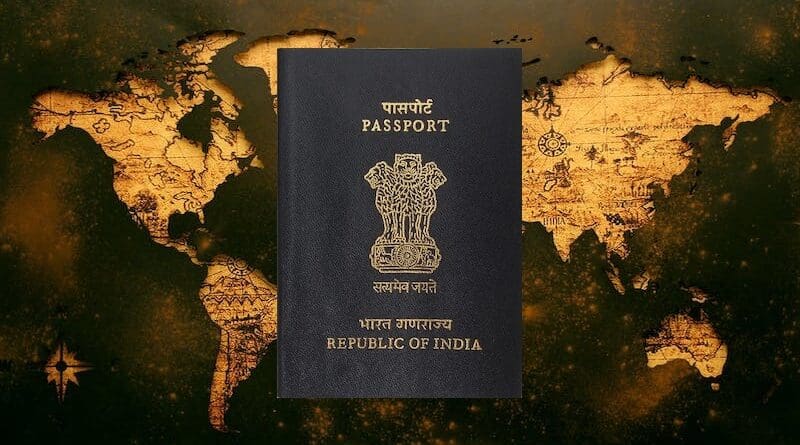
Trump’s $100,000 H-1B Fee: Redefining U.S. Priorities, Exposing India’s Dependence – OpEd
‘The announcement by President Donald Trump of a $100,000 annual fee for every H-1B visa was communicated, and spread almost immediately amongst corporations, universities, technology sites, and the political establishment in Washington, D.C.
For some, the announcement was a jarring wakeup call that there have been major changes in the global technology and immigration landscape. For others, it was simply a predictable continuation of his “America First” promise in terms of prioritizing American jobs, workforce development, domestic innovation, and economic policy. The announcement immediately generated a dialogue about its ramifications for talent, jobs, and global competitiveness amongst companies, students, and policymakers.
The H-1B visa was never just an immigration form. It is the backbone of the U.S. tech industry, a way for tens of thousands of foreign engineers, scientists, and professionals to migrate, and an example of globalization linking human capital to opportunity. Each year, there is a lottery that grants an additional 85,000 new visas. For almost four decades, India was the largest lottery winner. Over 70–75% of all new H-1B visas issued in recent years have gone to Indian citizens, while Chinese citizens received approximately another 10%. That asymmetry reflects an important reality: the system is not simply an American program, but a major part of India’s economy and society.
Adding a six-figure fee makes all the difference. For corporations, hiring foreign workers will become very expensive. Companies will second-guess submitting thousands of bids for mid-level positions. Firms will refrain from hiring and will instead seek and retain only the very best and highly specialized professionals who are worth the cost. For universities, students who perceive the H-1B as an automatic ticket to permanent residence will be deterred. Small IT companies, particularly those outsourcing work to Indian technicians, may find the fee prohibitive.
Others complain about sacrificing U.S. competitiveness. They argue that innovation is based on openness, and more barriers will push global talent to Canada, Germany, or Australia. They note that Silicon Valley’s growth was, in part, based on immigration, and that the high fees risk reversing that advantage. These are all legitimate concerns. However, the policy also reflects a reality that had been taken for granted: a visa system designed to address skill gaps as necessary had become a dependence for companies and even foreign governments.
India’s case is the clearest example. The H-1B visa became not just a work permit but a pillar of India’s soft power. Success stories of Indian engineers, CEOs, and tech professionals in the United States were celebrated as symbols of national pride. But this pride was also a weakness, because it depended entirely on Washington’s choices. With one announcement, Trump has shown that this soft power can be reduced, limited, or redirected at will. For Indian graduates, the message is stark: America cannot be the default career plan.
Indian commentators, and even some opposition leaders, argue that relying too much on U.S. visa options exposes holes in employment policies at home, even challenging Prime Minister Narendra Modi’s job-generation policies. The coin has dropped for New Delhi: sustainable economic power cannot be created through the export of skills, but through generating opportunities at home. While historically 70-75 % of the H-1B visas went toIndian citizens, India will be the hardest hit, both financially and socially.
This policy is not to discourage global talent, but to reset priorities to better meet U.S. interests. The U.S. is still available to highly skilled workers, but only those whose skills are irreplaceable (meaning the skills cannot be fulfilled satisfactorily by workers in the domestic labor market). The “gold card” for one million investors demonstrates this recalibration, which also demonstrates the U.S. is open to talent, wealth, and innovation—but only on the U.S.’s terms. The updated immigration policy is, in its process, intentional, selective, and transactional, allowing the U.S. to prioritize economic, technological, and national goals while retaining its control over who is admitted to the U.S.
From an American point of view, the political logic is compelling. The American middle class has long been alienated by globalization. Campaigning promises of training American graduates and favoring American workers resonate strongly in a nation where college debt is extensive and wages are stagnant. By forcing the cost of employing foreigners up, Trump creates incentives for corporations to invest in training homegrown talent. Whether this immediately changes the job market is uncertain, yet the symbolic value is considerable. It reinforces a perception of a president prepared to take bold action, even if unpopular with corporate leaders.
Worldwide, the change has created vulnerabilities. In India, it exposes the degree to which the country is vulnerable due to overreliance on U.S. visa policy. The impact on China, which has fewer H-1Bs, will be smaller. For Europe and Canada, this may even be an opportunity to attract talented professionals who are now reconsidering U.S. opportunities. Around the world, professional talent is becoming more competitive, and the U.S. is rewriting the rules of entry.
There are, of course, risks. Legal commentators argue that a fee so enormous may exceed the government’s authority, since visa fees are routinely capped at administrative costs. Courts may be required to intervene. Some economists warn that long-term innovation could suffer if the best and brightest overseas seek alternatives. These concerns are valid, but they do not erase the fact that the system was unsustainable. No policy of this scale is without cost.
The broader message is that Trump has chosen to prioritize sovereignty and national interest over inertia and habit. For decades, the H-1B functioned in a way that served India’s needs as much as America’s. That arrangement is now being rewritten. Whether other countries follow this path remains to be seen, but the debate has changed permanently.
Finally, the $100,000 fee is not only an immigration reform; it is a statement of where the United States stands in a new era of competition. It is a wake-up call against excessive dependence on external opportunities for Indian workers and policymakers. It is a guarantee that American skills will not be replaced with cheaper foreign labor. And for Trump, it is a political victory: bold, controversial, but undeniably effective in placing American interests’ front and center in the immigration debate.

Like what you read?
Please consider supporting Eurasia Review. Thank you for your consideration!
