
From Coexistence To Strategic Partnership: Morocco–Israel Relations In Historical And Contemporary Perspective – Analysis
This article examines the evolution of Morocco–Israel relations from their deep historical and civilizational roots, spanning more than two and a half millennia of Jewish presence on Moroccan soil, to the post-2020 strategic partnership inaugurated by the Abraham Accords. Drawing on diplomatic history, international relations theory, and the sociology of religion and identity, the analysis demonstrates that the normalization agreement of December 2020 did not constitute a rupture but rather the institutionalization of a long-standing pattern of cultural affinity, commercial exchange, and security cooperation. The article further situates Moroccan-Israeli rapprochement within the evolving regional architecture of the Middle East and North Africa, attending to the role of the United States, the shifting threat perceptions generated by Iran, and the structural pressures of economic modernization. It concludes that Morocco and Israel have constructed a multidimensional partnership that increasingly resembles a strategic alliance, while acknowledging the constraints imposed by Moroccan domestic opinion, Palestinian solidarity, and Arab League dynamics.
1. Introduction
The Abraham Accords signed on 13 August 2020 between Israel and the United Arab Emirates, and subsequently extended to Bahrain, Sudan, and Morocco, represented the most consequential reconfiguration of Middle Eastern diplomacy since the Egypt–Israel Peace Treaty of 1979 (Freilich, 2021; Muasher & Yousef, 2021). For Morocco, however, the accord of 22 December 2020 possessed a distinctive genealogy rooted not merely in geopolitical calculation but in a civilizational history of Jewish–Muslim coexistence that scholars have long identified as singular in the Islamicate world (Gottreich, 2007; Howe, 2005; Kenbib, 1994). King Mohammed VI, Commandeur des Croyants and custodian of the Alaouite tradition of religious pluralism, framed normalization not as a concession to external pressure but as the reactivation of bonds severed by the upheavals of the twentieth century (Embassy of Morocco, 2020; Zisenwine, 2021).
Scholars of Moroccan foreign policy have noted that Rabat has long maintained a distinctive posture in Arab–Israeli affairs: officially committed to the Palestinian cause while preserving back-channel ties with Jerusalem, participating in Arab League consensus while refusing the maximalist positions of rejectionist states (Hamid, 2020; Layachi, 1998; Willis, 2012). The normalization agreement, from this perspective, brought into the open a subterranean relationship already dense with cultural, commercial, and security threads. The present essay argues that the transformation of this relationship into an emerging strategic alliance is intelligible only through the convergence of three analytically distinct but empirically intertwined dynamics: the long historical memory of Jewish–Moroccan coexistence that furnishes the cultural substrate of normalization; the structural incentives of security and economic modernization that render alignment rational for both parties; and the regional and global geopolitical reconfigurations, above all the Iranian threat and American sponsorship, that created the permissive conditions for the accord (Chtatou, 2023 ; 2022, December 29).
The essay proceeds through six substantive sections. Section 2 surveys the millennial history of Jewish presence in Morocco and the distinctive tradition of convivencia it produced. Section 3 analyses the ruptures and continuities of the twentieth century, from Zionist emigration and decolonization to the clandestine diplomacy of the post-1967 decades. Section 4 examines the Abraham Accords in their regional and international context. Section 5 maps the sectors of post-2020 cooperation: trade, technology, defense, tourism, and culture. Section 6 assesses the structural constraints on the partnership. A concluding section draws the analytical threads together.
2. Deep Roots: Jewish Morocco and the Tradition of Coexistence
The Jewish presence in Morocco is among the oldest and most continuous in the Diaspora. Archaeological and literary evidence positions the earliest Israelite settlers in the Maghreb as contemporaries of the Second Temple period, and rabbinic sources attest to established communities in the Roman province of Mauretania Tingitana by the first centuries of the Common Era (Hirschberg, 1974; Slouschz, 1927). The Arabization and Islamization of North Africa from the seventh century onward did not extinguish Jewish communal life; rather, the dhimma framework, whatever its formal inequalities, permitted Jews to retain communal autonomy, practise their faith, and participate in the commercial and scholarly life of Moroccan cities (Cohen, 1994; Stillman, 1979).
The expulsion of Jews from the Iberian Peninsula in 1492 brought a massive wave of Sephardic refugees to Morocco, enriching existing Berber–speaking and Arabic–speaking Jewish communities with the cultural and intellectual capital of Castilian Jewry (Benbassa & Rodrigue, 2000; Kenbib, 1994). Moroccan sultans, and subsequently Alaouite monarchs, adopted a generally protective stance toward their Jewish subjects, issuing dahirs of protection and employing Jewish scholars, financiers, and diplomats in royal service (Schroeter, 2008; Zafrani, 2000). The concept of dhimma was, in Moroccan practice, frequently transcended by a more pragmatic tradition of royal patronage that transformed prominent Jewish families into institutional pillars of the makhzen (Gottreich, 2007).
The mellah, the Jewish urban quarter that became a characteristic feature of Moroccan cities from the fourteenth century onward, has been misread by some scholarship as a site of enforced segregation analogous to the European ghetto. Revisionist historiography, drawing on the work of Gottreich (2007) and Schroeter (2008), has demonstrated that the mellah was equally an expression of communal self-organization, a locus of religious authority, craft specialization, and commercial networking that allowed Jewish communities to thrive within the Moroccan urban fabric while maintaining boundaries essential to the reproduction of halakhic life. The material culture of the mellah—its synagogues, cemeteries, shrines of saintly figures revered by Jews and Muslims alike—constitutes an archive of shared Moroccan civilization (Ben-Ami, 1998; Flamand, 1959).
Particularly significant for the subsequent trajectory of Moroccan-Israeli relations is the phenomenon of moussem devotion to shared saints. The shrines of figures such as Rabbi Amram Ben Diwan in Ouëzzane and Rabbi David u-Moshe in Agouni attract Jewish pilgrims from Israel, France, and North America alongside Muslim devotees, enacting a form of popular ecumenism that the Moroccan state has increasingly mobilized as a diplomatic and touristic resource (Ben-Ami, 1998; Boum, 2013). King Mohammed V’s refusal to implement Vichy anti-Jewish legislation during the French Protectorate, subsequently mythologized in collective memory on both sides of the Mediterranean, further consolidated the image of the Moroccan monarchy as a protector of its Jewish subjects (Miller, 2013; Zisenwine, 2021). Historians have subjected this narrative to critical scrutiny—Laskier (1983) notes the partial implementation of racial laws under Protectorate pressure—but the symbolic capital of Mohammed V’s resistance to Vichy racism has retained its potency in Moroccan-Israeli diplomatic discourse (Chtatou, 2023 ; 2022, December 29).
3. Rupture and Continuity: The Twentieth Century and Clandestine Diplomacy
The first Arab-Israeli War of 1948 and the establishment of the State of Israel inaugurated a period of acute tension between Jewish communal identity and Moroccan national belonging that had not previously been experienced with such intensity (Laskier, 1994). The pan-Arab nationalist discourse that suffused the independence movement associated Zionism with imperialism and placed Moroccan Jews in a structurally ambiguous position: citizens of an emerging nation-state whose solidarity obligations were formally directed toward Arab Palestine (Layachi, 1998; Waterbury, 1970). The resulting emigration, channeled through the clandestine Operation Yakhin (1961–1964) and related Mossad-coordinated networks, transferred the majority of Morocco’s Jewish population—estimated at approximately 280,000 at independence in 1956—to Israel, with substantial communities settling also in France, Canada, and Spain (Laskier, 1994; Tsur, 2001).
The Israeli government’s covert cooperation with the Moroccan security services in facilitating Jewish emigration, and subsequently in intelligence-sharing arrangements targeting radical Palestinian factions, established the structural template of clandestine Morocco-Israel relations that would persist through the following decades (Hamid, 2020; Levey, 2007). The Moroccan intelligence service, the Direction Générale de la Surveillance du Territoire (DGST), and its Israeli counterpart, Mossad, sustained a working relationship under successive Moroccan kings, a relationship whose existence was known to senior officials in Washington and Paris but carefully managed so as to avoid public exposure that might have inflamed Arab League sensibilities (Freilich, 2021; Zisenwine, 2021).
King Hassan II cultivated a particular form of discreet diplomacy toward Israel that reflected his self-understanding as a moderate interlocutor capable of bridging Arab and Israeli positions. His role in facilitating back-channel communications between Egyptian President Anwar Sadat and Israeli officials in the months preceding Sadat’s historic visit to Jerusalem in November 1977 has been documented by both Moroccan and Israeli sources (Levey, 2007; Sela, 2018). Hassan II’s hosting of Israeli Prime Minister Shimon Peres in Ifrane in July 1986—unprecedented public contact between an Arab head of state and an Israeli premier outside the Egypt–Israel peace framework—signaled Morocco’s willingness to occupy a distinctive position in Arab-Israeli diplomacy, one premised on intercession rather than rejectionism (Hamid, 2020; Layachi, 1998).
The Oslo process of the early 1990s created a brief window of semi-open engagement: Morocco and Israel established Liaison Offices in Rabat and Tel Aviv in 1994, functioning as de facto diplomatic missions below the threshold of full recognition (Sela, 2018; Willis, 2012). The collapse of the Camp David Summit in 2000, the eruption of the Second Intifada, and the resurgence of Moroccan popular solidarity with Palestinians led King Mohammed VI to close the Liaison Offices and revert to the pattern of formal distancing combined with informal contact. This oscillation between public solidarity with Palestinian aspirations and covert engagement with Israeli interlocutors became a defining structural feature of Moroccan diplomacy, distinguishing it from both the committed normalizers (Egypt, Jordan) and the committed rejectionists (Syria, Libya) in the Arab state system (Hamid, 2020; Willis, 2012).
4. The Abraham Accords in Regional Context
The Abraham Accords of 2020 emerged from a confluence of structural transformations in regional and global politics that rendered Arab–Israeli normalization strategically rational for a subset of Arab states regardless of progress on the Palestinian question (Freilich, 2021; Muasher & Yousef, 2021; Rabinovich & Valensi, 2021). The dominant analytical framework explaining the accords emphasizes three interacting variables: the Iranian threat and the shared security interests of Arab Gulf states and Israel in containing Tehran’s regional ambitions; the decline of pan-Arab nationalist ideology and the consolidation of state-centric pragmatism among Gulf and North African elites; and American diplomatic entrepreneurship under the Trump administration, which leveraged bilateral incentives to induce normalization (Freilich, 2021; Guzansky & Winter, 2020).
For Morocco, the December 2020 accord was inseparable from the American recognition of Moroccan sovereignty over the Western Sahara included in the same presidential proclamation (White House, 2020). The strategic logic was transparent: Rabat exchanged normalization with Israel for an American diplomatic concession of supreme importance to Moroccan national identity and territorial integrity, a concession for which Morocco had lobbied Washington for four decades (Hamid, 2020; Zisenwine, 2021). Critics of this framing, including Mundy (2021) and the Polisario Front’s supporters, argued that it transformed a matter of international law into a transactional commodity; defenders, including the Moroccan government, characterized American recognition as belated acknowledgment of administrative realities on the ground (Chtatou, 2023 ; 2022, December 29).
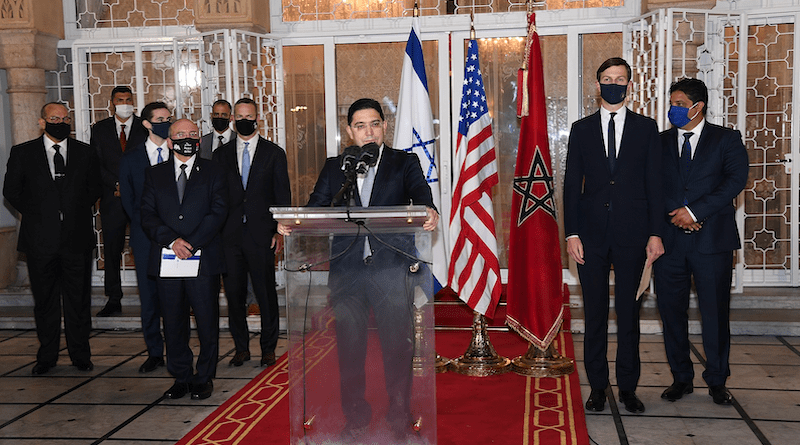
The Moroccan normalization agreement was additionally distinctive in its explicit invocation of Jewish heritage. The joint declaration of 22 December 2020 referenced Morocco’s “historic role in preserving the Jewish heritage and traditions of Moroccan Jews” and pledged cooperation in Jewish heritage preservation, tourism, and the promotion of interfaith dialogue (Embassy of Morocco, 2020). This formulation reflected the Moroccan monarchy’s deliberate strategy of situating normalization within a civilizational narrative rather than a purely geopolitical one, thereby providing a cultural legitimation that could potentially palliate domestic and Arab audiences uncomfortable with security-driven rapprochement (Boum, 2013; Zisenwine, 2021).
The regional context of the accords has continued to evolve in ways that affect Moroccan-Israeli relations. The October 7, 2023 Hamas attacks on Israel and the ensuing Gaza war generated significant popular pressure across Arab societies, including Morocco, for the suspension or reversal of normalization (International Crisis Group, 2024). The Moroccan government maintained its formal diplomatic relationship with Israel while calibrating its public statements to acknowledge Palestinian suffering and call for a ceasefire, a balancing act that illustrated the persistent tension between elite strategic calculation and mass political sentiment in Morocco’s approach to the Israeli–Palestinian conflict (Hamid, 2020; International Crisis Group, 2024).
5. The Architecture of Post-2020 Cooperation
5.1 Defense and Security
The security dimension of Moroccan-Israeli cooperation, long maintained below the level of public acknowledgment, has undergone significant formalization since December 2020 (Freilich, 2021; Levey, 2007). The Royal Moroccan Armed Forces have procured Israeli defense systems, most controversially including Pegasus spyware developed by the NSO Group, whose deployment by Moroccan intelligence services was documented by the Forbidden Stories consortium and subsequently generated diplomatic tensions with France and other European partners (Amnesty International, 2021; Guimard, 2021). Morocco has also reportedly acquired Israeli-manufactured drone systems and air defense technologies, diversifying an arms procurement portfolio historically dominated by American and French suppliers (International Institute for Strategic Studies [IISS], 2023 ; Chtatou, 2023 ; 2022, December 29).
Joint military exercises between Moroccan and Israeli forces remain outside the public domain, but Israeli defense industry representatives have participated in Moroccan defense exhibitions, and the two countries have reportedly exchanged intelligence on jihadist networks operating across the Sahel and on Iranian–Hezbollah activities in the region (IISS, 2023; Levey, 2007). Morocco’s strategic geography, straddling the Atlantic and Mediterranean approaches to the Strait of Gibraltar, and its extensive land border with Algeria—a state that hosts the Polisario Front and maintains close ties with Iran—gives Israeli security planners particular interest in the relationship (Freilich, 2021; Hamid, 2020).
5.2 Trade and Economic Partnership
The economic dimensions of post-2020 normalization have expanded rapidly, though from a minimal baseline given the decades of formal non-relation. Direct air links between Tel Aviv and Casablanca, inaugurated in 2020 and subsequently augmented by routes from Marrakesh and Agadir, have stimulated bilateral tourism and business travel (Moroccan Ministry of Tourism, 2023). Israeli tourist arrivals in Morocco increased sharply in 2021 and 2022, motivated partly by ancestral heritage tourism and partly by new commercial and recreational opportunities (Moroccan Ministry of Tourism, 2023).
Bilateral trade flows, negligible prior to 2020, grew to an estimated $150 million by 2022 across sectors including agricultural products, pharmaceutical inputs, electronic components, and chemical fertilizers (OCP Group, 2023; World Bank, 2023). Morocco’s Office Chérifien des Phosphates (OCP), the world’s largest phosphate producer, entered into discussions with Israeli agricultural technology firms regarding the application of precision irrigation and drip-technology innovations developed for arid Israeli conditions to Moroccan agricultural contexts, a transfer of substantial economic significance given Morocco’s food security imperatives (OCP Group, 2023).
The technology sector has attracted particular attention. Israeli start-up culture and Morocco’s ambition to position Casablanca as a regional financial and technology hub have generated interest in joint ventures and technology transfer arrangements (Moroccan Ministry of Digital Transition, 2023). Delegations from Israeli cybersecurity firms, agricultural biotechnology companies, and water management enterprises have visited Morocco, and the two governments have discussed the possible conclusion of a bilateral investment protection agreement that would provide legal certainty for Israeli investors operating in Moroccan special economic zones (Moroccan Ministry of Digital Transition, 2023; World Bank, 2023 ; Chtatou, 2023 ; 2022, December 29).
5.3 Cultural and Heritage Diplomacy
The cultural and heritage dimension of Morocco–Israel relations constitutes perhaps the most distinctive feature of their partnership, and the one that most clearly distinguishes it from the comparatively thin cultural ties between Israel and its other Arab treaty partners, Egypt and Jordan (Boum, 2013; Gottreich, 2007). The approximately one million Israeli citizens of Moroccan Jewish origin—constituting the largest Sephardic community in Israel—maintain living connections to Moroccan language, cuisine, music, religious practice, and familial memory that serve as a dense sociological substrate for bilateral engagement (Tsur, 2001; Zisenwine, 2021).
The Moroccan government has invested significantly in the restoration and maintenance of Jewish heritage sites across the country, including synagogues, cemeteries, and the museum spaces established in the mellahs of Marrakesh, Casablanca, and Fez (Schroeter, 2008). The Museum of Moroccan Judaism in Casablanca, the only Jewish museum in the Arab world, has received state support and has expanded its programming to include exhibitions that foreground the shared Moroccan heritage of Jewish and Muslim communities (Boum, 2013). These investments serve simultaneously as markers of Moroccan pluralist identity, instruments of diplomatic soft power toward Israel and the Moroccan-Jewish diaspora, and attractions for the heritage tourism market (Moroccan Ministry of Tourism, 2023).
Music constitutes a particularly resonant domain of cultural exchange. The Andalusian musical tradition of malhun and the Judeo-Moroccan genre of piyyut have experienced renewed scholarly and popular attention in both countries, and joint musical performances and recording projects have been supported by cultural foundations with connections to the Moroccan royal palace (Zafrani, 2000). The figure of the paytan, the Jewish liturgical poet composing in Judeo-Moroccan Arabic and Hebrew, has been revalorized as an emblem of the shared Moroccan civilization whose renaissance the normalization agreement is officially framed as facilitating (Zafrani, 2000 : Chtatou, 2023 ; 2022, December 29).
6. Structural Constraints and Analytical Limits
A sober assessment of Moroccan-Israeli relations requires attention to the structural constraints that continue to limit the depth and durability of the emerging partnership. The most significant is the Palestinian question, which retains its symbolic centrality in Moroccan popular and political culture despite the normalization accord. Public opinion surveys conducted in Morocco since 2020 have consistently shown majority opposition to normalization in its current form, particularly in the absence of tangible progress toward Palestinian statehood (Arab Barometer, 2022; International Crisis Group, 2024). The Gaza war that erupted in October 2023 intensified these sentiments, mobilizing street protests in Casablanca and Rabat and generating parliamentary opposition demands for the suspension of diplomatic ties with Israel (International Crisis Group, 2024).
The Moroccan government’s management of this tension reflects the adaptive authoritarianism that analysts such as Maghraoui (2011) and Brumberg (2002) have theorized as characteristic of the makhzen system: formal maintenance of the bilateral relationship at the diplomatic and security levels, rhetorical solidarity with Palestinian civilian populations, and selective constraint on civil society mobilization against normalization. This balancing act has costs: it prevents the Moroccan government from publicly celebrating the partnership in the way that, say, the UAE government has done, limiting the symbolic capital that normalization might otherwise generate domestically (Hamid, 2020; Willis, 2012).
Algeria constitutes a second structural constraint. Moroccan-Algerian relations, frozen since the closure of the bilateral border in 1994 and the severance of diplomatic relations in 2021, are inflected by a competitive dynamic in which Algerian elites have framed Moroccan normalization with Israel as a security threat, pointing to the possibility of Israeli intelligence sharing with Morocco on Algerian military dispositions (IISS, 2023; Willis, 2012). Algerian decision-makers have invoked the spectre of an “anti-Algerian axis” linking Rabat, Tel Aviv, and Washington, a discourse that has found resonance in segments of the Algerian military establishment and media (Hamid, 2020). While this framing overstates Israeli interest in the Algeria-Morocco rivalry, it has contributed to a regional security dynamic that complicates Moroccan diplomatic flexibility (Chtatou, 2023 ; 2022, December 29).
Within Israel, the Moroccan partnership has not been without its critics. Segments of the Israeli left have questioned the ethics of intelligence cooperation with a government accused of deploying Pegasus spyware against journalists and dissidents (Amnesty International, 2021). The Gaza war exposed fault lines in Israeli coalition politics that indirectly affected the pace and publicization of bilateral engagements. And the sheer complexity of Israeli domestic politics—characterized by governmental instability and the growing weight of religious nationalist parties skeptical of diplomatic engagement with Arab states—introduces uncertainty about the consistency of Israeli commitment to the partnership over successive administrations (Rabinovich & Valensi, 2021).
7. Conclusion: Toward a Strategic Alliance?
This essay has argued that Morocco–Israel relations in the post-2020 period represent a qualitative transformation of a long-standing but largely clandestine relationship, one whose depth and durability derive from the convergence of civilizational heritage, security imperatives, and economic modernization goals. The millennial history of Jewish presence in Morocco and the distinctive tradition of royal protection and cultural coexistence it generated provide a cultural substrate for normalization that is both genuinely distinctive and susceptible to instrumental mobilization by state actors on both sides. The Abraham Accords institutionalized a relationship already dense with security, cultural, and commercial threads, transforming informal ties into a framework of formalized cooperation across multiple policy domains (Chtatou, 2023 ; 2022, December 29).
Whether this framework constitutes an “emerging strategic alliance” in the technical sense employed in alliance theory—entailing formal security commitments, joint planning mechanisms, and shared threat assessment—remains debatable (Walt, 1987). The constraints analyzed in Section 6 suggest that Moroccan-Israeli alignment falls short of alliance in its fullest sense: it lacks formal security guarantees, is inhibited by domestic political sensitivities, and remains vulnerable to discontinuities introduced by the Palestinian conflict. What can be said with greater confidence is that Morocco and Israel have constructed a multidimensional partnership of sufficient density and strategic significance to represent more than a simple diplomatic rapprochement, and that both parties have strong incentives to maintain and deepen it across the domains of defense, technology, trade, and cultural exchange.
The analytical implications extend beyond the bilateral relationship. The Moroccan case illuminates the conditions under which Arab–Israeli normalization can be sustained in the face of popular Palestinian solidarity: a combination of elite insulation from mass opinion, a distinctive historical narrative that legitimizes engagement, and a portfolio of tangible strategic and economic gains that create constituencies for the relationship within ruling coalitions. It also illustrates the limits of normalization as a tool for regional order: the Gaza war demonstrated that bilateral accords do not dissolve the Palestinian question or immunize partnerships from the convulsive pressures that eruptions of violence generate. Morocco–Israel relations will continue to evolve within these structural constraints, shaped by the interaction of deep history, geopolitical calculation, and the uncertain trajectories of the Israeli–Palestinian conflict and Moroccan domestic politics.
References
- Amnesty International. (2021). “Forbidden stories”: Moroccan authorities used Pegasus spyware against journalists and activists. Amnesty International. https://www.amnesty.org/en/latest/press-release/2021/07/pegasus-project-spyware-journalists/
- Arab Barometer. (2022). Arab Barometer Wave VII: Morocco country report. Arab Barometer. https://www.arabbarometer.org
- Benbassa, E., & Rodrigue, A. (2000). Sephardi Jewry: A history of the Judeo-Spanish community, 14th–20th centuries. University of California Press.
- Ben-Ami, I. (1998). Saint veneration among the Jews of Morocco. Wayne State University Press.
- Boum, A. (2013). Memories of absence: How Muslims remember Jews in Morocco. Stanford University Press.
- Brumberg, D. (2002). The trap of liberalized autocracy. Journal of Democracy, 13(4), 56–68. https://doi.org/10.1353/jod.2002.0064
- Chtatou, M. (2023). The Moroccan-Israeli geostrategic relationship: From a harmonious past to a promising future. Orbis, 67(2), 228–246. https://doi.org/10.1016/j.orbis.2023.03.006
- Chtatou, M. (2022, December 29). Jewish-Muslim conviviality in Morocco. Eurasia Review. https://www.eurasiareview.com/29122022-jewish-muslim-conviviality-in-morocco-analysis/
- Cohen, M. R. (1994). Under crescent and cross: The Jews in the Middle Ages. Princeton University Press.
- Embassy of Morocco. (2020, December 22). Joint declaration of the United States, the Kingdom of Morocco, and the State of Israel [Press release]. https://www.moroccoembassy.org
- Flamand, P. (1959). Diaspora en terre d’Islam: Les communautés israélites du sud marocain. Presses du Palais Royal.
- Freilich, C. D. (2021). Israeli national security: A new strategy for an era of change. Oxford University Press.
- Gottreich, E. (2007). The Mellah of Marrakesh: Jewish and Muslim space in Morocco’s red city. Indiana University Press.
- Guimard, P. (2021). Pegasus et la surveillance: Le Maroc au cœur des réseaux d’espionnage. Le Monde Diplomatique, 68(9), 1–15.
- Guzansky, Y., & Winter, O. (2020). The Abraham Accords: A year later. Institute for National Security Studies. https://www.inss.org.il
- Hamid, S. (2020). Islamic exceptionalism: How the struggle over Islam is reshaping the world. St. Martin’s Press.
- Hirschberg, H. Z. (1974). A history of the Jews in North Africa (Vol. 1). E. J. Brill.
- Howe, M. (2005). Morocco: The Islamist awakening and other challenges. Oxford University Press.
- International Crisis Group. (2024). The Gaza war and Arab normalisation. International Crisis Group Report No. 239.
- International Institute for Strategic Studies. (2023). The military balance 2023. Routledge.
- Kenbib, M. (1994). Juifs et musulmans au Maroc 1859–1948. Publications de la Faculté des Lettres et des Sciences Humaines.
- Laskier, M. (1983). The Alliance Israélite Universelle and the Jewish communities of Morocco, 1862–1962. SUNY Press.
- Laskier, M. (1994). North African Jewry in the twentieth century: The Jews of Morocco, Tunisia, and Algeria. New York University Press.
- Layachi, A. (1998). State, society and democracy in Morocco: The limits of associative life. Georgetown University Press.
- Levey, Z. (2007). Israel and Morocco: A special relationship, 1956–1987. Middle Eastern Studies, 43(5), 683–706. https://doi.org/10.1080/00263200701348979
- Maghraoui, A. M. (2011). Liberalism without democracy: Nationhood and citizenship in Egypt and Tunisia. Duke University Press.
- Miller, S. G. (2013). A history of modern Morocco. Cambridge University Press.
- Moroccan Ministry of Digital Transition. (2023). Rapport annuel: Coopération numérique internationale. Gouvernement du Maroc.
- Moroccan Ministry of Tourism. (2023). Statistiques du tourisme international: Bilan 2022–2023. Ministère du Tourisme.
- Muasher, M., & Yousef, T. (2021). The Abraham Accords: The view from the Arab world. Carnegie Endowment for International Peace. https://carnegieendowment.org
- Mundy, J. (2021). Western Sahara: Sovereignty, nationalism and territory. Lynne Rienner.
- OCP Group. (2023). Annual report 2022. OCP S.A.
- Rabinovich, I., & Valensi, C. (2021). The Abraham Accords: A new paradigm for the Middle East. The Washington Institute for Near East Policy.
- Schroeter, D. J. (2008). The sultan’s Jew: Morocco and the Sephardi world. Stanford University Press.
- Sela, A. (2018). Arab states and the Israeli–Palestinian conflict: From rejection to normalization. In N. Caplan (Ed.), The Israel–Palestine conflict: Contested histories (pp. 201–230). Wiley-Blackwell.
- Slouschz, N. (1927). Travels in North Africa. Jewish Publication Society of America.
- Stillman, N. A. (1979). The Jews of Arab lands: A history and source book. Jewish Publication Society of America.
- Tsur, Y. (2001). A torn community: The Jews of Morocco and nationalism, 1943–1954. Am Oved.
- Walt, S. M. (1987). The origins of alliances. Cornell University Press.
- Waterbury, J. (1970). The commander of the faithful: The Moroccan political elite. Columbia University Press.
- White House. (2020, December 22). Proclamation on recognizing the sovereignty of the Kingdom of Morocco over the Western Sahara [Presidential proclamation]. https://trumpwhitehouse.archives.gov
- Willis, M. J. (2012). Politics and power in the Maghreb: Algeria, Tunisia and Morocco from independence to the Arab Spring. Hurst.
- World Bank. (2023). Morocco economic monitor: Strengthening regional integration. World Bank Group. https://www.worldbank.org
- Zafrani, H. (2000). Two thousand years of Jewish life in Morocco. KTAV Publishing House.
- Zisenwine, D. (2021). Morocco and Israel: Historical connections and the new era of normalization. Israel Affairs, 27(4), 602–620. https://doi.org/10.1080/13537121.2021.1955813

Like what you read?
Please consider supporting Eurasia Review. Thank you for your consideration!
