
Operation Barbarossa At 85: Historical Memory And European Security – Analysis
Competing Memories of Barbarossa
The legacy of Operation Barbarossa, the German invasion of the Soviet Union, is remembered differently across Europe. For Russia, the invasion of 1941 remains a defining symbol of national vulnerability and survival. Across much of Central and Eastern Europe, however, the decades that followed the Soviet victory over Nazi Germany are often remembered through experiences of Soviet domination, occupation, and political subordination. Eighty-five years later, these distinct historical experiences continue to influence debates about European security.
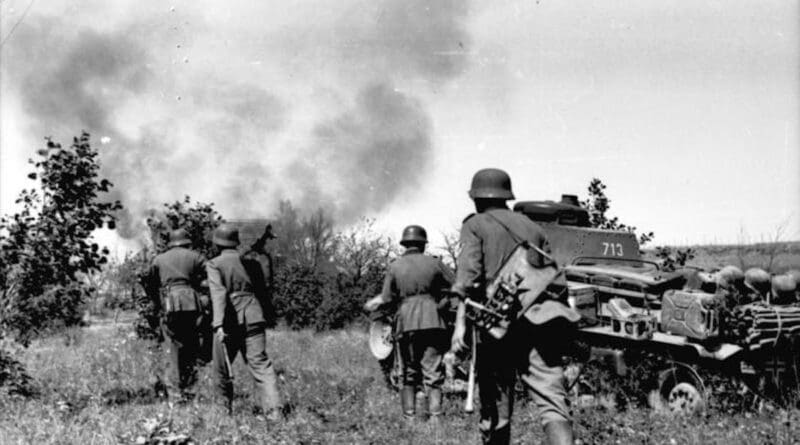
On the morning of 22 June 1941, Nazi Germany launched Operation Barbarossa, named after Frederick Barbarossa (Frederick I), the 12th-century Holy Roman Emperor. The Second World War entered a new and even more destructive phase as the Eastern Front opened, reflecting Nazi Germany’s deliberate vision of an ideological war of annihilation from the outset. More than three million German troops crossed into Soviet territory along a front stretching from the Baltic to the Black Sea. Within months, Soviet armies had been shattered, vast territories occupied, and millions killed or captured. By 1945, approximately 26–27 million Soviet citizens (including both military personnel and civilians) were dead, entire regions lay in ruins, and Europe’s political landscape had been transformed beyond recognition.
The significance of Barbarossa extends far beyond military history. Its enduring legacy lies not simply in reshaping the balance of power in Europe, but also in embedding particular understandings of security within the political consciousness of an entire region. Eighty-five years later, Europe remains influenced by competing interpretations of what the catastrophe of 1941 represents.
The Trauma That Shaped a Superpower
For the Soviet Union, Operation Barbarossa became the ultimate symbol of national vulnerability. The invasion appeared to confirm a recurring lesson present in Russia’s historical memory and Soviet strategic thinking: that the country’s vast western frontier offered insufficient protection against hostile powers.
Napoleon invaded Russia in June 1812 with the Grande Armée, a massive multinational force of roughly 430,000 to 600,000 troops drawn from across his European empire. Advancing rapidly into Russian territory, Napoleon reached Moscow in September 1812, only three months after the invasion began. However, the occupation of the city failed to force Russian surrender, and the disastrous retreat that followed became one of the defining military catastrophes of his reign.
More than a century later, German forces again pushed deep into Russian territory during the First World War. During Operation Faustschlag in 1918, German troops advanced to within 160 kilometres of Petrograd, forcing the Bolsheviks to relocate their capital to Moscow. Yet the scale and nature of the 1941 invasion far exceeded these earlier campaigns. Operation Barbarossa brought Germany closer than any previous modern adversary to destroying the Soviet state itself.
By the autumn of 1941, German forces had reached the final stages of their advance toward Moscow, pushing the Wehrmacht to within striking distance of the Soviet capital. As David M. Glantz and Jonathan House describe in When Titans Clashed: How the Red Army Stopped Hitler, the German advance toward Moscow in late 1941 brought the Soviet Union closer to collapse than at any previous point in the campaign. On 30 November, elements of the 2nd Panzer Division reached Krasnaya Polyana (present-day Lobnya), approximately 17 kilometres from Moscow’s administrative boundaries and around 30 kilometres from the Kremlin itself. The advance represented the closest German forces would come to capturing the Soviet capital and marked the height of the initial German offensive in the East.
The crisis was sufficiently severe that a state of siege was declared in the city, emergency security measures were introduced, and extensive preparations were made for the evacuation of the Soviet state apparatus. Kuibyshev, which had been identified as a reserve capital even before the war, became the designated alternative seat of government, with ministries, diplomatic missions, industrial assets, archives, and other critical state functions earmarked for relocation should Moscow become indefensible. For a brief period, Soviet leaders contemplated the possibility that the capital might be lost and that the machinery of government would have to continue operating elsewhere. The survival of the Soviet state itself appeared uncertain.
The trauma was profound. Entire cities were decimated. Millions perished through combat, occupation, starvation, and mass murder. Nazi policy in the East envisaged not only military victory but the destruction and subjugation of entire populations, particularly those whom Nazi racial ideology classified as ‘subhuman’, including Jews, Slavs, and other groups targeted by the regime. The Soviet victory that followed became the foundational narrative of the post-war Soviet state—a narrative not only of military triumph, but of survival against an existential threat.
That experience shaped both Soviet and later Russian approaches to security. The memory of 1941 reinforced the belief that strategic depth, territorial buffers, and the prevention of hostile military concentrations near Russia’s borders were essential to national survival. Whether or not such conclusions remained appropriate in later historical circumstances, they became deeply embedded in the strategic culture that emerged from the war.
The Cold War was therefore not only an ideological struggle between capitalism and communism, but also a geopolitical order shaped by historical experience. Within this order, the enduring fear of invasion reinforced the belief that strategic depth was essential for survival.
Ontological Security and the Legacy of 1941
The legacy of Operation Barbarossa extends beyond conventional questions of military security. The invasion also affected what scholars describe as ontological security: the need for political communities to preserve a stable sense of identity and continuity amid uncertainty.
For the Soviet Union, and later for Russia, the experience of 1941 was not simply a strategic shock but a profound challenge to the state’s understanding of its own existence. Because Nazi policy in the East envisaged the destruction, displacement, and subjugation of entire populations, the violence inflicted upon Soviet territories reinforced a security mindset in which insecurity was understood not merely as a threat to state sovereignty but as a threat to national survival itself.
This experience embedded a security culture in which physical defence and historical identity became closely intertwined. The memory of the Great Patriotic War evolved into a central element of state legitimacy and national self-understanding. Strategic depth, buffer zones, and the prevention of hostile military encirclement came to be viewed not only as matters of military prudence but also as safeguards against the recurrence of an existential historical trauma.
The legacy of the twentieth century shaped European security identities differently. For many states in Central and Eastern Europe, the defining lesson of the post-war period was not simply invasion from the West but the loss of sovereignty under Soviet domination. For countries such as Poland and Czechoslovakia, where communists consolidated control of the state in 1948, the end of Nazi occupation embodied a profound paradox of liberation and domination: those who had resisted and fought against the Third Reich returned home not to fully sovereign nations, but to states increasingly shaped by Soviet political control and subjugation.
Even countries that had aligned with Germany during the war, such as Romania, Hungary, and Bulgaria, experienced the expansion of Soviet influence after 1945 and the establishment of communist governments under Moscow’s control. Their sense of security became closely linked to political independence, national self-determination, and integration into Western institutions. EU and NATO membership therefore acquired significance beyond their practical security benefits; they became symbols of a broader civilisational and political orientation.
These differing historical experiences contributed to contrasting forms of ontological security. Russian security thinking remained heavily influenced by fears of vulnerability and strategic exposure. Many European states, particularly those that emerged from Soviet influence after 1989, associated security with the protection of sovereignty through institutional integration and collective defence. Although both approaches were rooted in historical experience, they generated competing understandings of what constituted a stable and legitimate European order.
The persistence of these narratives helps explain why security disputes in Europe often extend beyond immediate questions of military capability or territorial control. They frequently involve competing interpretations of history and identity, in which challenges to security are perceived not only as threats to state interests but also to deeply embedded understandings of national purpose and historical experience.
Europe’s Competing Memories
The end of the Cold War appeared to offer a way beyond these dilemmas. The Soviet Union collapsed, Germany reunified, and the EU eventually enlarged eastward, extending Western institutions into much of Central and Eastern Europe. Across much of the continent, there was a widespread belief that Europe had entered a fundamentally new era in which integration and institutions would replace geopolitical rivalry.
However, a deeper layer of misunderstanding was embedded within this optimism. For many Western policymakers, the post-Cold War order represented the gradual triumph of cooperation over confrontation. For countries in Central and Eastern Europe, however, the lesson of the twentieth century pointed in a different direction. Poland, the Baltic states, and others that had lived under Soviet domination saw NATO and EU membership not as abstract expressions of liberal order, but as concrete guarantees against renewed vulnerability—what many viewed as existential mechanisms of national survival.
If Russia remembers invasion, much of Eastern Europe remembers occupation. For Moscow, the disappearance of the Soviet buffer zone represented strategic exposure. For the Baltic capitals of Tallinn, Riga, and Vilnius, as well as cities such as Warsaw, Prague, and Budapest, it represented liberation from Soviet domination. Both interpretations emerged from real historical experiences. Both were grounded in genuine fears. Yet they implied fundamentally different visions of what European security required.
The tragedy of the post-Cold War period is that these competing narratives were never fully reconciled. Instead, they increasingly reinforced one another. NATO enlargement was seen by its supporters as the voluntary choice of sovereign states. In Russia, it was increasingly interpreted as evidence that the lessons of 1941 were being ignored. What one side understood as defensive, the other came to see as threatening. The result was a slow hardening of perceptions on both sides of the continent.
When History Becomes Strategy
None of these arguments reduces contemporary conflict solely to historical memory. History can help explain political behaviour, but it does not justify it. The persistence of Barbarossa in Russian political consciousness does not confer legitimacy on the use of force against neighbouring states. Nor does it diminish the sovereignty of European nations in choosing their alliances and political systems.
Yet international politics cannot be adequately understood without recognising how deeply it is shaped by memory and identity. States do not respond only to material capabilities or formal agreements. They respond to how they interpret the past and what they believe it implies about the future.
The war in Ukraine illustrates this clearly. It is not only a contest over territory and sovereignty; it is also a struggle over historical meaning. Russian leaders have frequently invoked the Second World War and the Soviet victory over Nazi Germany as central elements of national identity, presenting Russia’s security concerns through the lens of past invasions and the perceived need to prevent hostile powers from approaching its borders. Ukrainians, however, draw upon their own historical experiences to assert a distinct political trajectory, emphasising national independence, sovereignty, and the right to determine their own future.
For many in Central and Eastern Europe, the war has reinforced memories of earlier periods of domination and renewed concerns about the vulnerability of states situated between larger powers. Across Europe, policymakers increasingly interpret contemporary security challenges through analogies to the twentieth century, demonstrating that historical memory remains a powerful force in shaping perceptions of threat and security.
The Return of the Security Dilemma
The war has also revealed a familiar paradox in international politics: efforts to increase security can ultimately generate greater insecurity. This is the essence of the security dilemma, a concept first developed by political scientist John Herz and later expanded by Robert Jervis in the field of international relations. States often interpret the defensive measures of others as potential threats, producing countermeasures that leave all sides feeling less secure. Actions intended to enhance security—such as strengthening alliances, expanding military capabilities, or seeking greater strategic depth—can therefore be perceived by rivals as attempts to gain advantage. This dynamic creates a cycle in which one state’s pursuit of security becomes another state’s source of insecurity, reinforcing mistrust and escalating tensions.
Russia’s invasion of Ukraine is a stark illustration of this dynamic. Whatever objectives Moscow sought to achieve, the outcome has been a more militarised and more divided Europe. Defence spending has increased across the continent. NATO has expanded. Political and economic relations between Russia and much of Europe have deteriorated sharply. The attempt to reshape the European security order through force has instead intensified the very insecurity it was meant to resolve.
This is the deeper significance of the eighty-fifth anniversary of Operation Barbarossa. The legacy of 1941 is not simply that Russia fears invasion or that Eastern Europe fears domination. It is that both fears remain politically powerful, and both continue to shape a continent in which security is still defined in relation to history.
Historical Memory and the Limits of Reconciliation
Europe’s most important post-war achievement was not limited to the absence of great-power conflict in its western half. It was the ability of former adversaries to construct a political order based on cooperation rather than historical grievance. The reconciliation between France and Germany demonstrated that historical trauma could be acknowledged without remaining the organising principle of interstate relations. That experience remains relevant to contemporary Europe.
Eighty-five years after Operation Barbarossa, the continent continues to be shaped by distinct and often conflicting historical memories. In Russia, the experience of invasion remains central to understandings of security and vulnerability. Across much of Central and Eastern Europe, memories of Soviet domination continue to inform perceptions of sovereignty and strategic risk. Both perspectives emerge from genuine historical experiences, yet they point toward different interpretations of the European security order.
The persistence of these competing memories highlights a broader challenge for European security. Historical experience influences strategic culture, threat perception, and political decision-making, but it cannot by itself provide a framework for managing contemporary security relations. When historical narratives become the primary basis for policy, they risk reinforcing mutual suspicion and narrowing the scope for political accommodation.
The eighty-fifth anniversary of Operation Barbarossa therefore serves as a reminder that the history of the Second World War remains an important element of Europe’s strategic landscape. The legacy of 1941 is visible not only in national commemorations and collective memory, but also in the ways states continue to interpret security, vulnerability, and power. Recognising these historical legacies remains essential for understanding the challenges facing Europe today.

Like what you read?
Please consider supporting Eurasia Review. Thank you for your consideration!
