
Fitna Al-Khawarij’s Opposition To Women In Policing: A Betrayal Of Islam, Law, And National Security – OpEd
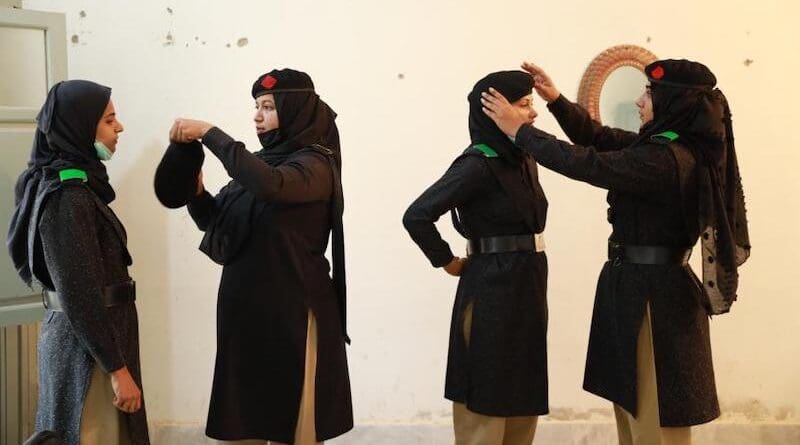
The extremist outfit Fitna al-Khawarij (FAK) has once again surfaced in headlines by opposing the recruitment of women into Pakistan’s police forces. In doing so, it has reaffirmed its distorted worldview that thrives on suppressing rights, manipulating religion, and undermining the state’s legitimacy. Their stance, cloaked in the language of cultural preservation and religious fidelity, is in reality a betrayal of both Pakistan’s Constitution and the principles of Islam.
This rejection of women’s participation in policing is neither a cultural issue nor a religious one—it is the latest manifestation of a Khawarij-inspired ideology that has, for centuries, sought to divide Muslim societies and weaken legitimate authority. To understand the gravity of this matter, one must examine the intersection of constitutional law, Islamic teachings, security imperatives, and extremist propaganda.
Pakistan’s Constitution guarantees equality before the law and explicitly reserves a 5% quota for women in police recruitment. This policy is not symbolic window dressing—it is an actionable right designed to improve representation, community trust, and inclusivity in law enforcement. In particular, the newly merged tribal districts (NMDs)—formerly FATA—are now bound by the same laws and constitutional guarantees as the rest of the country.
The historical Khawarij were known for their rebellion against legitimate authority, their misinterpretation of Quranic injunctions, and their violent purges against fellow Muslims. Their hallmark was takfir—the declaration of other Muslims as unbelievers to justify violence. FAK mirrors this mindset. By opposing women’s lawful role in law enforcement, it distorts religion to wage war on the state and society. Its approach is not fundamentally different from extremist groups like the Tehrik-e-Taliban Pakistan (TTP) or ISIS, both of whom have been described by respected Muslim scholars as modern-day Khawarij. Like them, FAK weaponizes religion not to build society but to destroy it.
FAK’s propaganda falsely portrays women’s participation in policing as alien to Islam. Yet Islamic history provides abundant evidence of women contributing meaningfully to social, legal, and security roles. Khadijah (RA) was a successful businesswoman and partner in the Prophet’s mission. Aisha (RA) transmitted Hadith, provided legal rulings, and even guided Muslim armies. The Quran and Sunnah emphasize justice, dignity, and the protection of life. Women serving in the police, working to protect families, children, and vulnerable groups, are fulfilling precisely these values. By contrast, groups like FAK violate these values through violence, misrepresentation, and injustice.
The merger of tribal areas with Khyber Pakhtunkhwa was a milestone in Pakistan’s democratic journey. It symbolized not only the integration of tribal populations but also the extension of constitutional guarantees, rights, and responsibilities. Women’s recruitment in policing in these regions symbolizes integration, modernization, and equality. Their presence ensures that local communities, particularly women and children, can engage with law enforcement in culturally sensitive ways. FAK’s opposition seeks to reverse this progress and keep tribal communities locked in cycles of fear and isolation.
FAK’s opposition to women in policing is not about religion or culture—it is about control. By branding constitutional rights as “un-Islamic,” it seeks to manipulate public opinion, incite unrest, and weaken Pakistan from within. But just as the Khawarij of early Islam were exposed for their hypocrisy and extremism, so too must FAK be exposed today. Their opposition to women’s participation in law enforcement betrays their fear of losing ideological control over communities. It is not Islam that they defend, but their own violent agenda.
For Pakistan, the issue of women’s recruitment is not just a matter of rights—it is also a matter of security. Inclusive policing strengthens counterterrorism efforts, builds public trust, and weakens extremist narratives. Each woman recruited into the police force represents a rejection of extremist ideology and a reaffirmation of Pakistan’s resilience against terrorism. Pakistan has sacrificed over 94,000 lives in the fight against terrorism. Allowing extremist narratives like FAK’s to dictate policy would betray those sacrifices. The state must ensure that women’s inclusion in policing continues as a matter of principle, law, and security.
Supporting women’s recruitment in policing is about much more than jobs—it is about building a just, peaceful, and progressive society. It is about fulfilling the vision of a Pakistan where justice and equality prevail over extremist propaganda. FAK’s opposition to women’s participation in law enforcement is a stark reminder of the enduring threat of Khawarij-inspired groups. But it also presents an opportunity: an opportunity to reaffirm Pakistan’s commitment to constitutional law, Islamic values, and national unity. In rejecting the distorted rhetoric of Fitna al-Khawarij, Pakistan not only protects women’s rights but also safeguards the nation’s progress, sovereignty, and future.

Like what you read?
Please consider supporting Eurasia Review. Thank you for your consideration!
