
Bridging Continents: Insights From Ambassadors Of Turkey, Turkmenistan And Kazakhstan At Connectivity Event In Brussels – OpEd
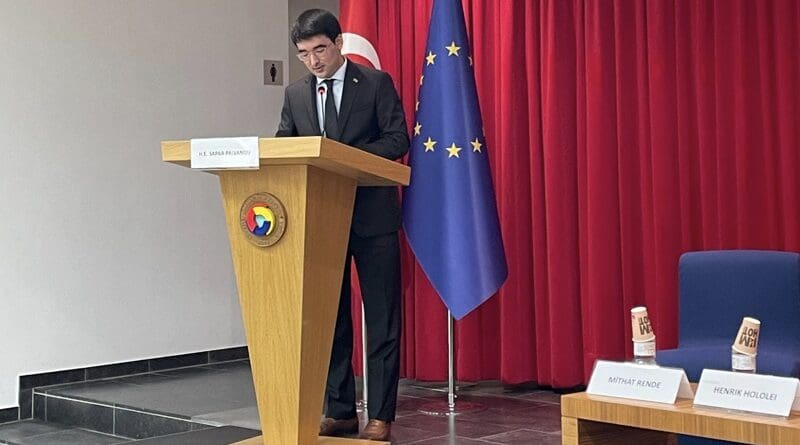
The Turkish (Faruk Kaymakçı), Turkmen (Sapar Palvanov), and Kazakh (Margulan Baimukhan) ambassadors delivered speeches during the event “Supply Chains and Transport Corridors: Towards Greater Connectivity” organized in Brussels by the European Neighbourhood Council (ENC) and the Economic Development Foundation of Türkiye (IKV).
Diplomatic World’s Central Asia specialist Derya Soysal attended the event alongside Managing Director Barbara Dietrich, Director Alberto Turkstra.
Key Points from the Turkish Ambassador, Faruk Kaymakçı
Ambassador Kaymakçı emphasized that the EU is a key contributor to connectivity and highlighted the importance of the Trans-Caspian Corridor. He underlined Türkiye’s strategic position, bordering both the Black Sea and the Mediterranean, and the investments made by Türkiye over the past 20 years to strengthen Euro-Asian connectivity.
He pointed out Türkiye’s connections with Europe, the South Caucasus, and Central Asia, stressing that Europe should not exclude Türkiye from its connectivity projects. According to him, Türkiye is closer geographically to Europe than Nicosia or Georgia.
Kaymakçı also highlighted the shared challenges faced by Europe and Türkiye, emphasizing their obligation to work together. He called for facilitated visa processes to enhance trade and for quicker access to markets to boost economic cooperation.
Key Points from the Turkmen Ambassador, Sapar Palvanov
Ambassador Palvanov highlighted Turkmenistan’s investments in the Trans-Caspian Corridor and its cooperation with key partners such as the EU.
He stated that, as a country located between two continents and amid the current complex regional situation, Turkmenistan fully understands the urgency of improving transport routes connecting Europe and Asia. He stressed that Turkmenistan is taking decisive, comprehensive measures, working closely with the EU and other key stakeholders to address these challenges.
Regarding EU cooperation, he announced the successful launch of a Coordination Platform on Transport between the EU and Central Asia, aimed at facilitating trade and connectivity, reducing transit times, and attracting strategic investments.
The ambassador also highlighted Turkmenistan’s key infrastructure projects, noting that the country has invested over $15 billion in recent years to develop roads, ports, railways, and airports, enhancing both regional and international connectivity.
Among these, the Turkmenbashi International Port stands out as a flagship project, capable of handling up to 25 million tons of cargo annually. Palvanov noted Turkmenistan’s collaboration with European partners, including the Port of Antwerp and the Antwerp Maritime Academy, to integrate best practices in port management.
Furthermore, Sapar Palvanov emphasized that the Turkmen government is working to advance infrastructure development within the framework of its national development strategy. He cited a notable example: the recently completed Ashgabat-Turkmenabat high-speed highway, which spans 600 kilometers and accelerates the transit of goods while strengthening regional ties. Additionally, he highlighted the modernization of more than 5,000 kilometers of railway lines, ensuring reliable transportation both nationally and internationally. He also mentioned Turkmenistan’s collaboration with the European Commission and European financial institutions for the construction of a new railway line connecting Turkmenabad and Turkmenbashi.
Palvanov further added that Turkmenistan aims to attract investments and create a favorable climate for investment in the transport sector through initiatives such as the CASCA+ project and its participation in the EU Coordination Platform.
He concluded by emphasizing the country’s participation in the CASCA+ Multimodal Transport Project, a seamless route connecting Central Asia, the South Caucasus, and Anatolia to Europe. This project involves national railways from Azerbaijan, Georgia, Kyrgyzstan, Turkmenistan, Türkiye, and Uzbekistan, creating a vital multimodal link.
Key Points from the Kazakh Ambassador, Margulan Baimukhan
Ambassador Baimukhan underscored that the Trans-Caspian Corridor is one of the most important routes for connecting Europe and Asia. He highlighted how investments in connectivity have boosted Kazakh trade, leading the government to allocate significant funding to transport infrastructure—$35 billion more will be invested next year.
The ambassador stressed the need for ports to be better connected, emphasizing the importance of Kazakhstan’s Aktau Port. He called for further actions to facilitate trade and greater efforts to integrate regional markets.
Finally, Baimukhan pointed out that Kazakhstan is doing its utmost to become a global and significant player in developing transport corridors while strengthening partnerships worldwide.
Conclusion
The event highlighted the shared commitment of Türkiye, Turkmenistan, and Kazakhstan to advancing transport connectivity and fostering stronger ties with the EU.

Like what you read?
Please consider supporting Eurasia Review. Thank you for your consideration!
