
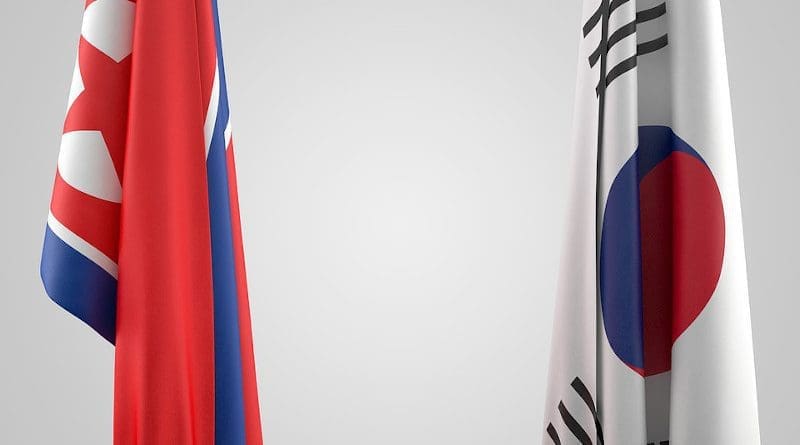
Diplomacy At A Crossroads: Ending The Korean Peninsula Standoff – OpEd
The Korean Peninsula stands at a precarious juncture that threatens both regional stability and the broader international order. Despite repeated diplomatic overtures over the past seven decades, the absence of a formal peace treaty since July 27 1953, the armistice has allowed geopolitical rivalries and nuclear brinkmanship to fester without resolution.
In Pyongyang 2025’s accelerated missile tests medium six‐range launches between January and May, compared with two during the same period in 2024, and its high‐profile troop deployments in support of Russia’s campaign in Ukraine underscore the regime’s strategic emphasis on military deterrence. Meanwhile, Seoul and Washington’s combined military exercises expanded in scale by 15 per cent in the spring drills of 2025. April 2025 continues to reinforce mutual yet defence exacerbates North Korea’s insecurity. At this diplomatic crossroads, it is imperative to adopt a dual-track strategy that first establishes formal diplomatic relations between South and North Korea as a confidence-building facilitator and second lays the groundwork for a long‐term peaceful reunification predicated on incremental and mutual integration recognition.
Pyongyang’s pursuit of nuclear weapons and advanced conventional capabilities has been driven by a regime calculus that equates deterrence with survival. Democratic People’s Republic of Korea tested its Hwasong-16 solid-missile fuel on March 18, 2025, achieving a range of 4500 kilometres; this technical advance not only places Seoul and Tokyo within its strike envelope but also signals to Beijing and Washington that any coercive measures will be met with equal force. Sanctions, too, have lost their coercive edge: despite United Nations resolutions that curtail nearly 90 per cent of DPRK’s conventional imports, arms enforcement gaps facilitated by illicit ship-to-ship transfers and cryptocurrency laundering allow the regime to procure critical missile components. The fallout of these dynamics is evident in the peninsula’s humanitarian toll: a 2025 report by the World Food Programme that estimates 40 per cent of North Korea’s rural population remains undernourished, yet the leadership diverts roughly 25 per cent of its GDP to defence spending. This stark divergence between military investment and human welfare underscores the urgency of redirecting both dialogue and assistance toward the North Korean people.
Conversely, South Korea and the United States have oscillated between pressure and engagement. Since January 2025, Seoul’s exports to Pyongyang via the Industrial Kaesong Region and proposals to re-open that joint zone have remained stalled amid gridlock in legislative proceedings in the National Assembly, where public opinion is split: a December 2024 Yonhap poll showed 47 per cent of South supporting Koreans inter-economic Korean projects while 42 percent opposed them without verifiable denuclearization. Washington’s strategic pivot toward the Taiwan Strait and Eastern Europe has strained the U.S.-South Korea alliance’s bandwidth for Korean Peninsula diplomacy. In late June 2025, U.S. Deputy Secretary of State Elaine Chao acknowledged, “the Korean issue cannot be sidelined indefinitely”. Concrete scheduling for new Six-Party Talks remains elusive. As inter-Korean relations are governed by ad hoc‐building measures such as the February 2025 hotline re-establishment that lasted three weeks, rather than sustained institutionalised engagement.
Establishing formal diplomatic relations between Seoul and Pyongyang must therefore become the short‐term centrepiece of any peace strategy. A mutually recognised liaison office in both capitals, staffed by career diplomats and subject‐matter experts, would provide a permanent channel for crisis communication and policy coordination. Such an office could oversee expanded family reunions, as only 1,200 separated families have met since 2018. It could also manage cultural exchanges, which in 2025 alone could involve up to 10,000 South Korean university students and 5,000 North Korean artists participating in joint symposium performances. These initiatives not only humanise the “other” but create constituencies layered for peace on both sides. In addition, resuming inter‐rail Korean and road connectivity projects initially budgeted at USD 150 million in Seoul by March 2025 would foster economic interdependence, provide tangible incentives for the North to maintain cooperation.
Yet the vision of reunification must not be discounted. A phased roadmap can reconcile the peninsula’s profound political and economic asymmetries. In Phase 1, the two Koreas would coexist as sovereign states with fully normalised diplomatic ties and institutionalised consultations on security matters, including arms‐control verification conducted by a neutral third party such as ASEAN. Phase II emphasises economic convergence through joint special economic zones, cross‐border infrastructure, and shared energy grids; experts estimate that integrating South Korea’s USD 1.8 trillion economy with even 10 per cent of the North’s labour force could yield a 1.5 per cent boost to combined GDP over five years. Phase III, underpinned by widespread public dialogue, constitutional reform would pursue political federation or confederation, allowing for dual citizenship and shared governance structures in areas such as environmental policy and disaster relief. Although such a trajectory faces deep obstacles, distrust, ideological income disparity, and the competing interests of China, the United States, Japan and Russia, the incremental approach mitigates risk by preserving each state’s core identity while steadily weaving institutional bonds.
This dual‐track strategy faces significant challenges. Domestic backlash in both countries could derail liaison office staffing, and a hardline faction in Pyongyang’s Politburo may view binding economic commitments as an existential threat. External powers, especially China, may resist any framework that diminishes the DPRK’s strategic utility as a buffer state. Furthermore, sanctions regimes must be delicately recalibrated to prevent humanitarian crises without collapsing leverage, undercutting Pyongyang’s nuclear ambitions. Finally, the international community must guard against “fatigue engagement”, ensuring that each diplomatic concession by the North is met with calibrated reciprocation, whether in humanitarian aid, phased sanctions relief or security guarantees ratified by the UN Security Council.
In conclusion, the historical impasse on the Korean Peninsula cannot be overcome by military deterrence or unilateral pressure alone. A bold two-tiered approach that first enshrines formal diplomatic relations and then pursues reunification through measured, mutually reinforcing steps offers the most viable path forward. By institutionalising inter-Korean dialogue and creating shared economic linkages, stakeholders’ social can generate the trust necessary to tackle the formidable challenges of political federation. At this critical crossroads, the international community and especially Seoul and Pyongyang must choose the arduous, indispensable yet difficult path of confrontation to cooperation lest the peninsula remain mired in perpetual tension rather than embracing its full potential for peace.
The opinions expressed in this article are the author’s own.
References
- Reuters. “South Korea Reviewing Various Options to Improve North Korea Ties.” Reuters, July 21, 2025.
- Youngjun Kim. “A Civilizational Vision for Resolving the North Korean Nuclear Crisis.” UPI, July 8, 2025.
- Kim Ji-soo. “An Impassioned Call for Korean Unification.” The Korea Times, May 8, 2025.

Like what you read?
Please consider supporting Eurasia Review. Thank you for your consideration!
