
U.S. Fuelling Old Flames: A Romance That Dies Hard – OpEd
History has a cruel memory. It does not forget; it lingers, resurfacing when least expected. For the United States, Afghanistan is that stubborn memory—a war it tried to bury but which refuses to stay buried. Since the hurried exit of August 2021, Washington has done everything to convince itself that the Afghan story is closed. Yet, every few months, it finds Afghanistan back on the table, demanding attention, disrupting the illusion of closure.
The latest jolt came with a remark by President Donald Trump during his state visit to London. Almost casually, he floated the idea of reacquiring the old Bagram Airbase. The comment startled many, not only because of its bluntness but because of what it revealed: America is not done with Afghanistan, not entirely. For those who followed the long war, this was a reminder that the past is never as far away as policymakers might hope.
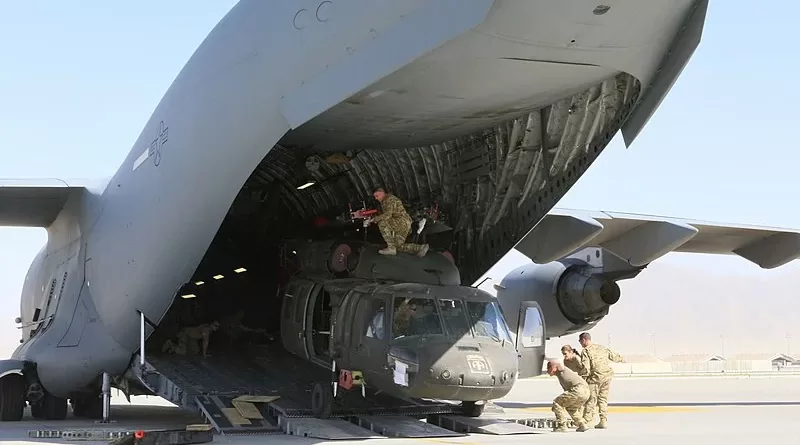
Bagram is no ordinary airfield. For nearly twenty years, it was the central nervous system of America’s war in Afghanistan. From its runways and fortified compounds, the U.S. launched operations that stretched from Kandahar to Kunar. At its height, the base housed tens of thousands of soldiers, contractors, and intelligence officers. To Afghans, it became a symbol; sometimes of hope, often of occupation, always of foreign presence. When American forces slipped away in July 2021, leaving the base dark and unannounced even to their Afghan allies, it felt like the final curtain call of a long and tragic play. However, history rarely allows for clean exits. Closing Bagram was meant to draw a line under the Afghan war. Instead, it created an unfinished sentence. The base still looms large in Washington’s imagination, less because of Afghanistan itself and more because of what surrounds it.
China’s expanding influence in Central Asia, Russia’s resurgence across Eurasia, Iran’s defiance to the west—all of these make Afghanistan’s geography too valuable to ignore. In this context, Bagram is not just an abandoned base; it is a vantage point, a foothold in a region where America now finds itself on the margins. The irony, of course, is bitter. America left Afghanistan in haste, with the world watching scenes that will live on for decades: helicopters lifting embassy staff off rooftops, desperate Afghans clinging to departing planes, the Taliban strolling into Kabul without resistance. For Washington to even hint at returning carries a quiet admission that the exit was not the end, only an intermission. The Afghan file has been pushed to the back of the drawer, but it cannot be shredded.
For Afghans themselves, the possibility of Bagram reappearing as a U.S. outpost underscores a grim continuity. Their land, once again, is spoken of not as a home but as a strategic asset. From the “Great Game” of imperial powers in the nineteenth century to the Cold War, from the U.S.–Soviet conflict to the “war on terror,” Afghanistan has always been cast in someone else’s play. If America does return, Afghans may rightly ask: will this time be any different? Or is it just another chapter in the long story of outside powers using their soil for contests that have little to do with Afghan lives?
The Taliban’s rule is fragile and riddled with internal contradictions. Regional powers continue to meddle, each with its own agenda. From this perspective, a renewed American foothold might provide stability—or at least leverage. But these arguments collide with an uncomfortable truth: after twenty years of occupation, trillions spent, and thousands of lives lost, can the United States credibly claim to be a stabilizing force in Afghanistan? For many Afghans, the answer is no.
This is where Bagram becomes more than a piece of real estate. It is a symbol of hubris, of unfinished business, and of temptation. The hubris lies in believing that military geography alone can dictate political outcomes. The unfinished business is obvious: America left not because it had succeeded, but because it could no longer justify staying. And the temptation lingers—the belief that perhaps, with new rivals on the horizon, the old base can once again serve as America’s anchor in Asia.
History does not offer much comfort here. The Soviets believed Afghanistan would secure their southern frontier. They left in defeat. The U.S. believed it could transform Afghanistan into a modern state aligned with the West. It too left in defeat. If America tries to return without learning why those efforts failed, it risks repeating the same cycle: ambition, intervention, disillusion, withdrawal.
The story of Bagram is therefore not just about a base, but about America’s uneasy relationship with its own limits. It is about a superpower that cannot decide whether Afghanistan is a closed chapter or a recurring obligation. For the Afghan people, it is about whether they will ever be more than the backdrop to someone else’s strategic calculus. If Washington does try to reclaim Bagram, it should ask itself a hard question: is this a step toward correcting past mistakes, or is it just history’s ghost leading it back into a trap it already knows too well? The answer will determine whether Afghanistan becomes a sequel or, finally, the final act.

Like what you read?
Please consider supporting Eurasia Review. Thank you for your consideration!
