
Indonesia’s Middle Power Crossroads – OpEd
The development of Indonesia into a middle power in Southeast Asia stems from its advantageous strategic position and economic strength, combined with diplomatic capabilities, yet its ability to maintain influence faces risks from domestic governance problems and external trade pressure, and shifting foreign policy under President Prabowo Subianto.
The strategic position of Indonesia as a major power results from its archipelagic geography, which spans across 17,000 islands and controls essential maritime routes such as the Strait of Malacca through which forty percent of worldwide trade passes yearly. The natural geographic advantages of Indonesia make the country responsible for safeguarding Indo-Pacific sea lanes, thus requiring strong maritime security investments and infrastructure development for national growth and global supply chain stability.
The economy of Indonesia holds the position as Southeast Asia’s biggest economy while ranking among the top ten economies worldwide based on purchasing power parity. The International Monetary Fund predicts a 5.03 percent GDP growth in 2024, followed by a 4.7 percent rate in 2025 due to worldwide economic challenges and domestic policy modifications. The nation’s economic expansion was driven by household consumption, which slowed down to 4.89 percent in the first quarter of 2025, making it the weakest rate since 2021, while investment reached its lowest point in two years due to international market pressures. The country maintained its position as a top foreign direct investment destination during Q1 2025, when foreign investment reached 230.4 trillion rupiah (approximately $13.67 billion) with a 12.7 percent annual increase despite policy uncertainties and campaign expenses that affected certain industries. The strategic economic diversification plans led to major multinational commitments, including Tesla and LG Energy Solution for value-added manufacturing and electric vehicle supply chain development.
The diplomatic efforts of Indonesia through its leadership of ASEAN, combined with active international participation, have established its position as a middle power. The South China Sea mediation and Indo-Pacific leadership and G20 Global South representation demonstrate Jakarta’s role as a convening power and normative leader. Quantitative assessments demonstrate this effectiveness because the 2024 Asia Power Index from the Lowy Institute places Indonesia as the ninth most powerful state among 27 Asian nations, with a score of 22.3 out of 100, representing a 2.9-point improvement for its diplomatic networks and defense partnerships.
Multiple structural and cyclical challenges threaten to diminish Indonesia’s capacity to maintain stability, even though it possesses strategic assets. Investor confidence decreases while public resources become diverted from vital public goods because governance deficits persist through widespread corruption and weak judicial systems. Recent high-profile graft scandals have revealed deep systemic weaknesses, which create negative attitudes among both local constituents and foreign business prospects. The world’s third-largest rainforest and extensive mangrove systems belong to Indonesia, but the country continues to face problems with illegal logging and peatland fires, and coal export dependency, which made up 38 percent of export revenues during 2023. The combination of dangerous environmental practices harms climate goals and puts 40 percent of the population living in coastal areas at risk from rising sea levels and worsening natural disasters.
The commodity-driven growth model of Indonesia makes the country vulnerable to changes in regulations that occur in essential export markets. The European Union’s Renewable Energy Directive (RED II), together with the upcoming Carbon Border Adjustment Mechanism, threatens to harm traditional export industries, including palm oil and nickel, so Jakarta files a WTO case against alleged protectionism. Export diversification and increased industrial value-addition become essential because these disputes show that these steps are necessary. The construction of the Trans-Sumatra Toll Road and the establishment of Nusantara as the future administrative capital serve to reduce geographic separation and enhance domestic connectivity, yet a consistent policy framework is needed to achieve inclusive development and resilience through infrastructure development.
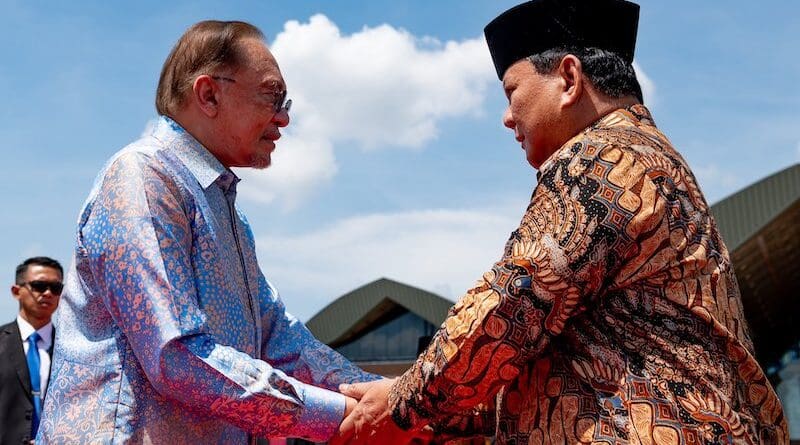
The most important transformation of Indonesian foreign policy occurred when President Prabowo Subianto took office in October 2024. The new foreign policy direction of President Prabowo Subianto deviates from ASEAN-centered “independent and active” by focusing on direct diplomatic engagement with China and the United States instead of ASEAN meetings. The new international focus of Jakarta threatens to reduce its position as Southeast Asia’s leading convenor at a time when the United States and China are vying for dominance. The Gerindra Party leadership publicly rejected ASEAN’s effectiveness and the Non-Aligned Movement’s outdated nature, which threatens Indonesia’s sustained commitment to regional collective frameworks.
The data from 2024 and early 2025 shows that Indonesia’s comprehensive power has grown, but its resilience indicators, including governance quality and environmental sustainability, have decreased, which reveals vulnerabilities that opponents might leverage. The trade confidence surveys demonstrate that Southeast Asian countries have lost trust in their traditional partners because they only view the EU as strategically relevant at 6.4 percent, while China and the U.S. rank higher with 9.0 percent and 8.8 percent, respectively. The current combination of domestic challenges alongside external threats indicates that Indonesia’s middle-power status will depend on successful reform efforts that strengthen domestic institutions while sustaining diplomatic leadership credibility.
The unique geographical position and demographic growth, and economic capabilities have solidified Indonesia’s position as a regional leader. The development factors which elevated Indonesia to its current status now face obstacles that require new strategic approaches. Indonesia needs to implement strong anti-corruption reforms together with judicial improvements to build institutional strength and promote technology-based manufacturing development and restore ASEAN commitments, and build new global relationships. Through traditional innovation integration alongside regional leadership and global outreach, Indonesia will successfully handle great-power competition while establishing its position as an Indo-Pacific bridging actor.
The opinions expressed in this article are the author’s own.
References
- Emmers, R. (2025). Continuity and non-alignment shape Indonesia’s worldview. Chatham House.
- Myers, L. (2025, March 19). Indonesia’s foreign policy under Prabowo: still free but more active? The Diplomat.
- Rahman, D. (2025, June 19). Putin hosts Indonesia’s Prabowo in Russia in bid to deepen ties. Reuters.

Like what you read?
Please consider supporting Eurasia Review. Thank you for your consideration!
