
Strategic Narratives And Regional Diplomacy: Unpacking India’s Gulf Engagements – OpEd
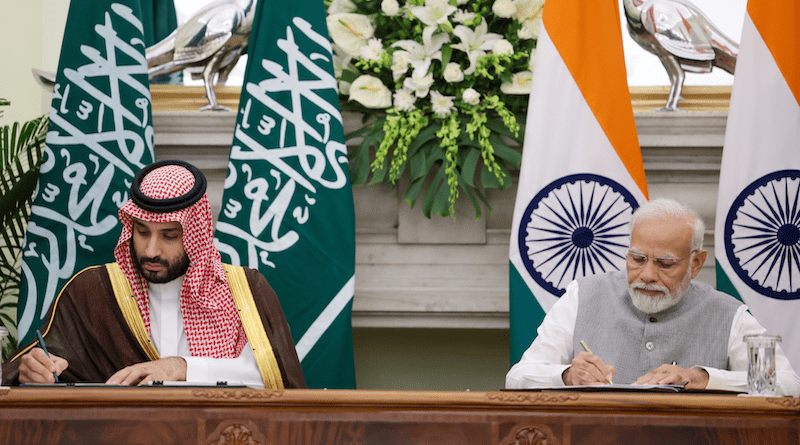
India has shown an upsurge of interest in the political and media circles in relation to the recent diplomatic activities in the Gulf region. Launched publicly as an attempt to further enhance our economic relations and promote the stability of the region, such visits disclose a greater and more thought-out purpose. Under the cover, India seems to be working on narrative-driven campaign geared towards the exportation of its internal security discourse, which manipulates regional perception, and sidelines Pakistan at the sore points of international politics.
At the hub of the outreach is a pattern showing an increasing prominence. Through bilateral negotiations and policy discussion Indians have painted Pakistan in the picture of destabilizing power and sponsor of false news and cross border unrest. Such allegations however are usually not substantiated and often seem to be geared towards trying to create international opinion rather than trying to spur positive regional talks. The fact that such allegations are repeatedly stated without any clear evidence gives a reasonable doubt that they are used as a diplomatic means, not as facts of reality.
This is further reflected in the fact that India has been alerting on the selective incidents and operations like the very common one which they speak of, as the Operation Sindoor. Putting the emphasis on one-sided security discourses and the perpetrating of an image of a constant victimhood, India deflects the concern on the additional measures that it has taken to regional escalation. These are a recorded history of false-flag operations, an accumulating international outcry at its record against minorities and continuing instability in Indian-controlled Kashmir. These are aspects of the inner world of India that are rarely discussed when planning the external communications of the country, particularly when the contexts are very styled in places abroad.
Indeed, the diplomatic ties between the Gulf nations especially United Arab Emirates, Qatar, Kuwait, Bahrain and Saudi Arabia were not carried out in a vacuum. Both India and Pakistan have strategic relationships with these states and long stood adherents of neutrality in South Asian conflicts. However, the nature of India trying to shape the narrative seemed inclined more toward lobbying these governments into supporting its framing of issues rather than trying to conduct a real dialogue. This lobbying was accompanied by the covert yet discernible diplomatic retiring on part of a number of Gulf counterparts. There were instances when a meeting at the high levels was scaled down or merely a gesture of protocol but there were also instances when it seemed that the key leaders were unwilling to openly take sides with India in compounding the allegations thrown at Pakistan.
India has not preferred to delve on subjects that demand accountability or two-way communication. A case in point is the silence over its recurrent threats of unilaterally subverting the Indus Waters Treaty, an older agreement which forms the building block of cooperation in the region in terms of water. India has been diplomacy at best since it chooses what to stress as a grievance and what to leave behind in foundational treaties. It highlights use of the diplomacy as a instrument of narrative everywhere in place of joint trouble-shooting.
Though certain Gulf leaders repeated their generic rhetoric about countering terrorism, and stability in the region, none of them spoke specifically in support of India in her allegations against Pakistan. Such a cautious strategy is symptomatic of the wider strategic thinking and understanding of the Gulf region of the need to relate with relationships of balanced relationships across South Asia. The fact that despite the Indian attempts, there are no direct words of condemnation towards Pakistan, is also the sign of the implicit recognitions of the inclination of neutrality and restrained approach within the region.
The diplomacy of India in the given interactions makes it clear that it uses the tools of soft power in order to build not only trade and technological relations but also in order to create the international image of a strategically injured party. Through this, India is trying to clean out its own problems and direct global focus on outside targets. This method corresponds with a larger pattern of employing international relations as an alternative strategy of managing the domestic image especially where the national institutions become targets of the criticism concerning the democratic backsliding, media power, and communal polarization.
In the end, the world community should consider these developments with caution. Neither diplomacy nor dialogue should turn into an instrument of exclusive story-telling, selection of the pretexts to engage in politically oriented blame- Games. As India proceeds with building ties in the gulf region, it becomes essential that the world monitors those moves carefully to ensure that legendary storytelling does not come into the picture as a con artist manner of associating oneself with the Middle East. The true basis of stability in South Asia and the Middle East, as a whole, is not a one-side accusation but a dialogue that will be inclusive, accountability and respect of the international standards.
India has the potential of becoming a positive actor in the regional diplomacy. This however will need to move away from curated storytelling which is towards open participation. Any manipulation of regional realities by deliberately narrating some specific presentations is fraught with the destabilizing of the stability that the diplomacy is said to be promoting. The world of tomorrow involves collaboration and requires transparency, straightforwardness and a desire of every party to face the harsh reality. It is only at that point that the Gulf region can stop being a platform of strategic rivalry, but a platform of collective peace, progress and regional balance of powers.

Like what you read?
Please consider supporting Eurasia Review. Thank you for your consideration!
