
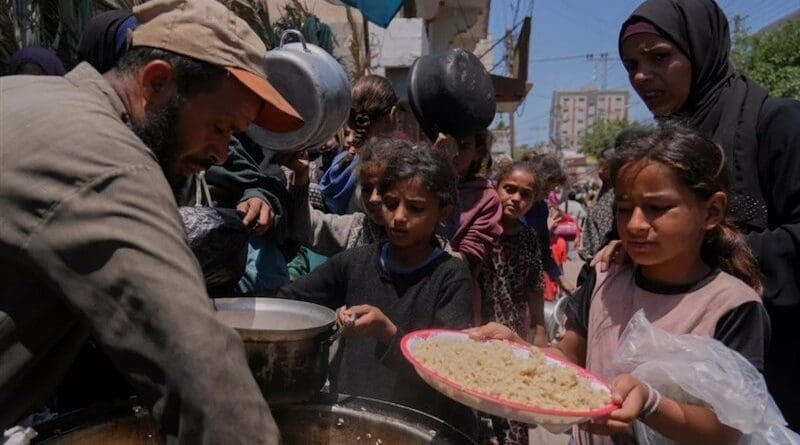
A Genocide In Slow Motion: Gaza, Hunger, And The Collapse Of Humanitarian Law – OpEd
As starvation claims more lives each day in Gaza, legal experts and humanitarian leaders are sounding the alarm louder than ever: Israel’s continued blockade and obstruction of aid delivery not only violates the laws of war but may amount to genocide in the 21st century.
The July 2025 reinstatement of a full blockade on the Gaza Strip has triggered what the World Health Organization (WHO) and UN agencies now classify as a “catastrophic, man-made famine”. With more than half a million Palestinians on the brink of starvation and hundreds already dead from hunger and preventable disease, this is no longer a crisis of neglect—it is increasingly being described as a deliberate policy of destruction.
A Calculated Strategy of Starvation
Following the collapse of ceasefire negotiations earlier this summer, Israel further tightened its grip on Gaza. Since July 1, no UN humanitarian convoys have been allowed entry. Commercial routes are closed. Fuel, food, medicine, and clean water are nearly nonexistent.
What little aid is allowed through is channeled via the Gaza Humanitarian Foundation (GHF)—a controversial initiative backed by Israel and the U.S.—widely accused of militarizing aid and abandoning neutrality. Mass stampedes, shootings at distribution points, and chaotic scenes have become routine.
This siege is not new—but its intensity and intent are reaching new, terrifying heights.
“What we are witnessing is the weaponization of starvation,” said Jan Egeland, Secretary-General of the Norwegian Refugee Council. “It is a method of warfare that is explicitly banned under international law.”
A Blatant Violation of International Humanitarian Law
Under the Fourth Geneva Convention, occupying powers are obligated to ensure access to food and medical aid for civilians. Rule 55 of the International Committee of the Red Cross (ICRC) Customary IHL also mandates the free passage of humanitarian relief during armed conflict.
Yet Israel’s policy in Gaza amounts to the systematic denial of aid, in clear defiance of these protections. Even more damning, Article 8 of the Rome Statute of the International Criminal Court (ICC) identifies “intentionally using starvation of civilians as a method of warfare” as a war crime.
In January 2025, the International Court of Justice (ICJ) issued provisional measures ordering Israel to facilitate aid. Seven months later, those orders remain largely ignored.
“This is not an oversight or failure of coordination—it is a direct, deliberate dismissal of international law,” said Francesca Albanese, UN Special Rapporteur on Palestine. “And that is what makes this situation legally and morally unprecedented.”
Is This Genocide? A Growing Consensus
Legal scholars, UN officials, and global rights organizations are now warning that Israel’s actions may meet the legal threshold for genocide—not just war crimes or crimes against humanity.
The Genocide Convention (1948) defines genocide as any act intended to destroy, in whole or in part, a national, ethnic, racial, or religious group. Among those acts: “Deliberately inflicting on the group conditions of life calculated to bring about its physical destruction in whole or in part.”
“When you prevent food, water, and medical care from reaching a population you’ve displaced, bombarded, and trapped, you are not merely neglecting a humanitarian duty—you are engineering mass death,” said Dr. Azeem Ibrahim, senior fellow at the New Lines Institute.
In March and again in June, the Famine Review Committee warned that mass starvation in Gaza is entirely human-made and preventable. Their June report concluded that famine in northern Gaza had already begun—a dire forecast that became fact in July.
The numbers are stark:
- Over 500,000 people in Phase 5 catastrophic food insecurity.
- More than 65,000 children suffering from severe acute malnutrition.
- 111 confirmed deaths from starvation, the majority under the age of 15.
- Over 1,000 killed or injured while attempting to access aid.
A 21st Century Genocide, in Real Time
The scale of Gaza’s suffering—combined with the deliberate policies that are perpetuating it—has drawn comparisons to some of the darkest chapters of modern history: Rwanda in 1994, Srebrenica in 1995, and now, Gaza in 2025.
But unlike past genocides, this one is unfolding in full view of the international community, in an age of satellite imagery, digital testimony, and instant news. And yet, the world is largely failing to act.
“It is difficult to imagine a clearer case of collective punishment and targeted mass suffering in modern times,” said Kenneth Roth, former executive director of Human Rights Watch. “And it is even harder to explain the inaction.”
Calls for Accountability
More than 100 humanitarian and legal organizations have demanded immediate access for international aid, the restoration of UN-led distribution systems, and a full investigation into violations of international law. Meanwhile, survivors and advocates are urging the International Criminal Court to open a formal investigation into genocide and starvation crimes in Gaza.
Regional leaders have called for sanctions, arms embargoes, and diplomatic pressure—but key powers, including the United States and European Union, continue to provide military and political support to Israel.
The international system that was built after World War II—one based on the rule of law, human rights, and accountability—is being tested like never before. Israel’s blatant disregard for international law and norms is sending a very dangerous precedent for the international rules based order.
Conclusion: Starving a People, Silencing the Law
What is happening in Gaza in July 2025 is not a tragedy of circumstance, it is a crisis of will, a legal betrayal, and a moral failure. Starvation, displacement, and death are not collateral damage; they are the consequences of deliberate choices, backed by political impunity.
As the death toll rises, so too does the cost to global credibility. If the siege continues, and if the world allows it to continue unchecked, we may soon have to reckon with this fact:
A genocide was televised—live, in real time in 4k—and we let it happen.

Like what you read?
Please consider supporting Eurasia Review. Thank you for your consideration!
