
On The Formation Of A Two-And-A-Half Polar World – OpEd
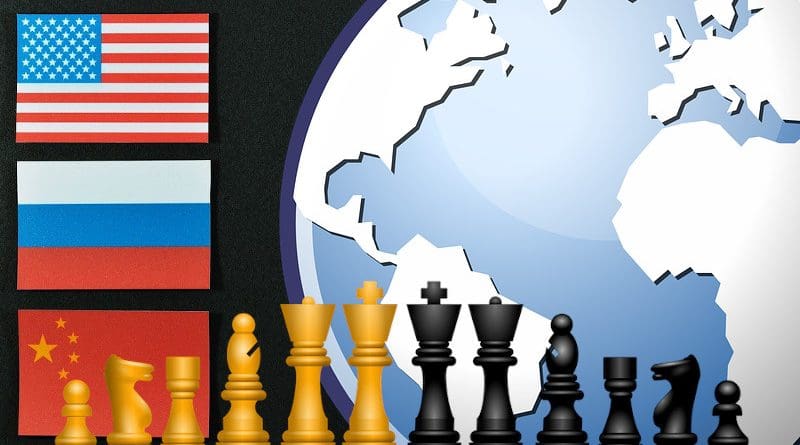
In the shaping of a new world order, the United States and China clearly lead, each, in its own interest, advancing the idea that Russia also holds the status of a world pole.
Following Russia’s invasion of Ukraine on February 24, 2022, and the resulting introduction of economic sanctions by the West against Russia, the transformation of the architecture of the world economy began. At the same time, it became clear that the decades-long unipolar world order was shifting.
The United States played a central role in the formation of the post–WWII world order, especially after the collapse of the USSR, which marked the height of American global dominance.
More than three years into the war in Ukraine, it is evident that no single country can dominate in principle, and that the era of a post-hegemonic, multipolar world has arrived.
This raises a critical question: how many poles should we expect in the new multipolar world? To answer this, we must consider three key criteria for global pole status: (1) the global political authority of a given state (or group of countries), (2) nuclear capability and an independent defense industry, (3) a large-scale economy. Additional factors include population size and territorial reach.
There is no doubt that in the new multipolar world, the United States (with the world’s largest economy in 2024) is guaranteed to retain its status as a world pole. China, which in 2024 had the second largest economy in the world, also meets all the primary criteria. However, cultural and linguistic barriers, particularly the complexity of Chinese writing, hinder the global spread of its political influence and, as such, Beijing emphasizes economic globalization over political outreach.
Beyond the United States and China, the most prominent two poles of the emerging new world order, other candidates are less clear.
Let’s consider some of the most likely options for the third world pole.
The European Union’s greatest weakness in its ability to act as a third world pole lies in its lack of unified armed forces and an independent and unified defense industry. Militarily, the EU relies heavily on NATO, where the US plays a decisive role. Although France is a nuclear power, and Belgium, Germany, Italy and the Netherlands host U.S. nuclear weapons under the NATO nuclear sharing arrangement, the EU continues to experience problems ensuring its own defense capability. In particular, the EU’s defense capability depends largely on the United States, as a result of which Brussels cannot pursue its own military-political line without taking into account Washington’s interests.
Awareness of the need to ensure the EU’s independent defense capability has grown, particularly since the start of Russia’s war in Ukraine, as well as due to the disagreement between US President Donald Trump and Brussels over NATO funding. To develop its defense industry and its own armed forces by 2030, the EU has decided to allocate funding to the amount of 800 billion euros. Yet this allocation does not mean the immediate resolving of its defense problems, as this requires time. As such, it can be concluded that, at present, the EU does not meet the second necessary condition to lay claim to the third pole of the new world order: nuclear capability and an independent and unified defense industry.
Meanwhile, Russia, despite its vast nuclear arsenal, fails to meet the third criterion due to the relatively small size of its economy. In 2024, Russia ranked only 11th globally, and Western economic sanctions against it due to its invasion of Ukraine have served to weaken its economy further. Nonetheless, both Washington and Beijing appear equally interested in maintaining ties with Moscow, each seeing value in Russia as a strategic counterweight in the new world order. As a result, Russia acts as an “incomplete” world pole (world power), or, in other words, as a half world pole.
Of particular note is India’s growing role in global politics and the world’s economy. As the fifth largest economy in the world in 2024, and a nuclear power with U.S. support in its confrontation with China, India may one day qualify as a full-fledged pole, but it is not there yet. It should be emphasized here that, despite U.S. support for India, the strategic partnership between India and Russia, which has historical roots dating back to the time of the USSR, is ongoing, although it is being adjusted based on the modern realities of relations between both the West and Russia, and China and Russia.
As for BRICS, though it includes China, India and Russia, among others, its institutional amorphousness and internal contradictions prevent it from claiming world pole status in the new world order.
Thus, the current world order is best described as having two and a half poles: the United States and China, with Russia as the “half,” while the EU and India, in principle, may join them in the future.

Like what you read?
Please consider supporting Eurasia Review. Thank you for your consideration!
