
Toward A New Era In US–Turkey Relations: An Assessment Of Erdoğan–Trump Meeting – OpEd
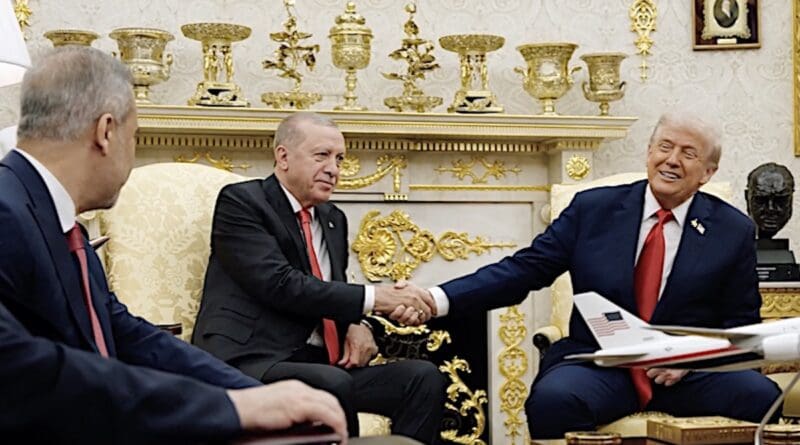
On September 25, 2025, Turkey’s President Recep Tayyip Erdoğan met with U.S. President Donald Trump in Washington. The meeting between the two leaders is being interpreted as a potential fresh start in U.S.–Turkey relations, which have been strained in recent years. The talks, lasting about two hours and twenty minutes, focused on defense industry cooperation, energy, conflicts in the Middle East, and trade.
One of the most striking agenda items was Turkey’s long-standing demand for F-35 fighter jets. Trump stated that lifting the ban on F-35 sales to Turkey was “on the table.”[^1] This signals a possible easing of the crisis that began in 2019, when Ankara was removed from the program after acquiring the Russian S-400 air defense system. Erdoğan, in turn, emphasized the need to expand cooperation on F-16 modernization and the broader defense industry.[^2]
Trump also raised the issue of reducing Turkey’s oil and natural gas imports from Russia, which Washington views as a “strategic risk.”[^3] In this context, a U.S.–Turkey Strategic Civil Nuclear Cooperation Memorandum of Understanding was signed during the meeting. Through this agreement, the United States aims to support Turkey in developing alternative energy sources to strengthen its energy security.[^4]
Economy and trade were also central to the discussions. Prior to the meeting, Turkey announced the removal of additional tariffs on certain U.S. imports as a “gesture of goodwill.”[^5] Trump stressed the importance of conducting “high-volume trade” with Turkey. This has led to speculation that a free trade agreement or new investment opportunities could soon be on the agenda.[^6]
Crises in the Middle East, particularly the Gaza issue, represented another key dimension of the talks. Trump said they were working on plans to end the war in Gaza and highlighted the importance of Turkey’s role in this process.[^7] Erdoğan responded by stating, “I believe that together with President Trump, we will overcome the difficulties in the region,” thereby underlining the importance of regional cooperation.[^8]
In conclusion, while the Erdoğan–Trump meeting did not produce binding agreements, it marked a critical step in reopening channels of dialogue between the two countries. If concrete progress is achieved on issues such as lifting the F-35 ban, expanding energy cooperation, and advancing peace efforts in the Middle East, this meeting may indeed be remembered as “the beginning of a new era.” However, the trajectory of Turkey’s relations with Russia, as well as developments in U.S. domestic politics, will remain decisive factors in shaping the future course of this process.[^9]
References
- [^1]: “U.S.-Turkey Relations and the F-35 Program,” Congressional Research Service, 2020.
- [^2]: Defense News, “Turkey’s Request for F-16 Modernization,” 2023.
- [^3]: Atlantic Council, “Turkey’s Energy Dependency on Russia,” 2024.
- [^4]: U.S. Department of Energy, “Civil Nuclear Cooperation Agreements,” 2025.
- [^5]: Turkish Ministry of Trade, Press Release, September 2025.
- [^6]: Peterson Institute for International Economics, “Prospects for U.S.-Turkey Free Trade Agreement,” 2022.
- [^7]: Al Jazeera, “U.S. Plans for Gaza Ceasefire,” September 2025.
- [^8]: Presidency of the Republic of Turkey, Directorate of Communications, Press Release, September 25, 2025.
- [^9]: International Crisis Group, “Turkey’s Balancing Act Between Russia and the U.S.,” 2024.

Like what you read?
Please consider supporting Eurasia Review. Thank you for your consideration!
