
Education As Indoctrination: How The Taliban Are Weaponizing Afghanistan’s Madrasas – OpEd
Since their return to power in August 2021, the Taliban have placed education at the center of their political project. On the surface, their encouragement of madrasa expansion appears to draw on a venerable Islamic tradition. Madrasas have, for centuries, been respected institutions of learning across the Muslim world, including in the Persianate intellectual sphere to which Afghanistan historically belonged. Yet the Taliban’s embrace of the madrasa is not a revival of this tradition. It is its distortion. What is unfolding in Afghanistan today is not education but ideological engineering, with consequences that extend far beyond the country’s borders.
For over a millennium, madrasas were spaces of intellectual diversity. They produced jurists and theologians, but also philosophers, scientists, and poets. Figures such as al-Farabi, al-Biruni, and Ibn Sina thrived in environments that valued inquiry and debate. As scholars like Ahmet Kuru have shown, early madrasas were often independent of the state, supported by endowments from merchants and elites rather than controlled by political power. This autonomy allowed intellectual pluralism to flourish.
The modern madrasa, however, is a very different institution. Colonial disruption, the rise of nationalism, and the politicization of religion transformed many madrasas from centers of learning into instruments of identity politics. In South Asia, reformist movements such as Deoband emerged in the late nineteenth century to preserve Muslim identity under British rule. As historian Barbara Metcalf documented, this shift narrowed curricula and privileged rigid legalism over philosophy and critical reasoning. Over time, especially with the rise of modern nation-states and Islamist movements, these institutions became deeply entangled with politics and power.
The Taliban represent the most extreme culmination of this trajectory. Contrary to their claims, they are not the guardians of Afghan or Pashtun tradition. Rural Pashtun Islam has long been shaped by Persianate culture, marked by pragmatism, pluralism, and local custom. The Taliban’s worldview shares little with this heritage. Instead, it reflects a hyper-politicized, exclusionary ideology forged in the madrasa networks that proliferated along the Afghanistan–Pakistan frontier during the 1980s, often with foreign funding and geopolitical objectives.
Since 2021, the Taliban have moved swiftly to intensify this politicization of education. Leaked documents from December 2022 revealed internal plans to completely overhaul Afghanistan’s school curriculum to “Islamize” it according to Taliban ideology. Girls’ schools, the Taliban have made clear, will not reopen in any meaningful way until this transformation is complete. This exposes a critical flaw in much international advocacy. Reopening schools is essential—but the question that must be asked is: what kind of education will be offered? A classroom that functions as a site of indoctrination is not liberation. It is the consolidation of authoritarian control.
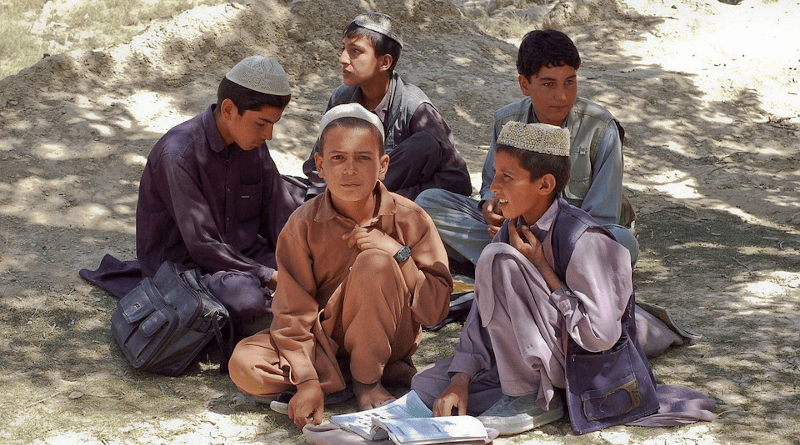
The scale of the Taliban’s effort is alarming. Afghanistan now reportedly has more than 23,000 madrasas, many directly tied to the regime. Access to food aid, employment, and social services is increasingly linked to families’ willingness to send their children to Taliban-approved schools. Education has become a pipeline, not for intellectual development or civic engagement, but for producing obedient subjects and, ultimately, ideological foot soldiers.
This is not merely a domestic tragedy. It is a transnational threat. UN reports confirm that the Taliban maintain ties with more than 20 regional and global extremist organizations. The killing of Al Qaeda leader Ayman al-Zawahiri in Kabul, in a house linked to the Haqqani Network, underscored the depth of these relationships. The Taliban’s support for the Tehreek-e-Taliban Pakistan has already destabilized relations with Islamabad, while their broader vision—articulated by their leadership—echoes the long-term global jihadist ambitions of groups like Al Qaeda and ISIS.
History offers grim parallels. Authoritarian regimes from the Soviet Union to North Korea have used education to mold loyal citizens and suppress dissent. But Afghanistan’s case is uniquely dangerous. Those regimes imposed ideologies rooted, however problematically, in domestic political histories. The Taliban are attempting something more radical: the erasure of a millennium of Afghanistan’s intellectual and cultural heritage, replaced by an imported, militarized ideology designed for perpetual conflict.
If the Taliban succeed, they will not only secure their rule but also weaponize Afghanistan’s future. A generation raised without exposure to critical thought, pluralism, or peaceful coexistence will be primed to see violence as virtue and global jihad as duty. This threatens South and Central Asia, fuels extremist networks across the Middle East and Africa, and inspires ideologically aligned movements far beyond the region.
The international community must therefore move beyond symbolic gestures and narrow frameworks. Girls’ education is vital, but it cannot be separated from the content and purpose of education itself. The harder, more uncomfortable question must be confronted: what education will any Afghan child receive under Taliban rule? Without addressing the ideological transformation underway, engagement risks normalizing a system designed to sustain extremism for generations.
Afghanistan today is being refashioned into a platform for transnational jihadist mobilization, with an indoctrinated youth population as its backbone. Recognizing and confronting this reality is not only a moral obligation to Afghans, but a necessity for regional peace and global stability.

Like what you read?
Please consider supporting Eurasia Review. Thank you for your consideration!
