
Safari For The Rich, Ruin For The People: Modi’s Aravalli Plunder—And India’s Green Enclosure – OpEd
From the Aravalli hills to Hasdeo’s forests, Dehing Patkai’s rainforests, and the shores of Great Nicobar, the Modi government is rebranding ecological destruction as green development—using law, technocracy, and nationalist rhetoric to turn India’s ecological commons into frontiers of profit.
Green Development, Old Plunder
Across India today, bulldozers speak the language of sustainability. Coal mines become “energy security.” Ports become “strategic infrastructure.” Safari parks become “conservation.” What unites these projects is not their geography, but their political economy: a regime of green enclosure that converts forests, hills, and islands into assets for capital while calling it development.
The proposed mega safari park across more than 3,800 hectares of the Aravalli hills in Haryana is a textbook case. Sold as eco-tourism and biodiversity enhancement, it promises spectacle for tourists and profits for developers. What it threatens is enclosure for forests, water systems, and village commons.
But the Aravalli is not alone. From coal blocks in Hasdeo Arand, to oil and mining in Dehing Patkai, to the trans-shipment port in Great Nicobar, India’s most fragile ecosystems are being re-engineered as growth frontiers. The safari is not an exception. It is the model.
The Aravalli Hills: A Life-Support System Under Siege
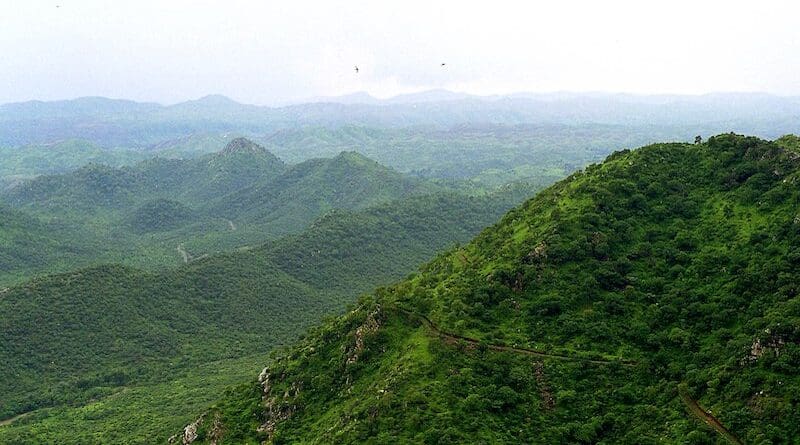
The Aravalli range, stretching over 670 kilometres from Gujarat through Rajasthan and Haryana to Delhi, is among the world’s oldest mountain systems. More than a geological relic, it is ecological infrastructure. The hills slow the eastward march of the Thar Desert, sustain dry deciduous forests, moderate microclimates, and—most crucially—recharge groundwater across north-west India.
For districts like Gurugram, Faridabad, and Nuh, already marked by collapsing water tables and tanker economies, the Aravallis are a lifeline. They act as giant sponges, absorbing monsoon rain and feeding aquifers that sustain millions in one of India’s most water-stressed regions.
Decades of legal and illegal mining, urban sprawl, and construction have already battered this fragile system. The safari project threatens to lock this degradation into permanence, turning a recharge zone into an infrastructure corridor.
Supreme Court Redefines the Aravalli Hills
Amid ecological collapse, the Supreme Court has redrawn the Aravallis in the name of “science.” Citing geological standards—including a criterion that defines hills as landforms rising at least 100 metres above surrounding ground—the Court accepted a height-based definition pushed by the Centre to resolve regulatory ambiguity.
On paper, this looks like technical precision. In practice, it risks becoming a legal earthquake.
Large parts of the Aravallis, especially in Haryana and Rajasthan, consist of low, weathered formations that may not meet such height thresholds but remain ecologically vital. Environmentalists warn that redefining the hills purely by altitude could exclude vast tracts from protection, opening them to mining, real estate, highways, and projects like the safari.
What the government calls clarification, activists see as slow-motion ecological unravelling. Protection is not removed outright; it is quietly shrunk through definition. It is regulation by redrawing the map.
This is how green enclosure works today: not always by tearing down laws, but by redefining what those laws apply to.
The Safari Lie and the Logic of Enclosure
The safari project claims to conserve wildlife. But conservation that builds roads, lodges, parking lots, and enclosures in a fragile recharge zone is not conservation—it is spectacle.
This is fortress conservation in neoliberal form. Forests are fenced. People are excluded. Nature is curated for elite consumption. Commons become commodities.
Local communities in Gurugram and Nuh depend on the Aravallis for fodder, fuel, water, and seasonal livelihoods. Enclosure will not arrive as dramatic eviction, but as slow dispossession: restricted access, degraded resources, rising land values, and mounting pressure to leave.
This is accumulation by dispossession, repackaged as eco-tourism.
From the Aravalli to Hasdeo: Forests as Fuel
In Chhattisgarh’s Hasdeo Arand—one of central India’s largest contiguous forests—the same logic plays out under a different banner. Here, dense sal and teak forests, and Adivasi livelihoods, are sacrificed for coal in the name of energy security. Despite repeated warnings about hydrological damage and biodiversity loss, mining blocks are opened through fragmented clearances and executive push.
What eco-tourism is to the Aravalli, coal is to Hasdeo: a growth imperative that overrides ecological limits and community consent.
In both cases, forests are reduced to what they can yield—tourist revenue here, coal there. The grammar is identical.
Dehing Patkai and the Greenlight to Extraction
In Assam’s Dehing Patkai, often called the “Amazon of the East,” oil exploration and coal mining have been allowed in a biodiversity hotspot through regulatory exemptions and post-facto approvals. Public outcry forced temporary reversals, but the direction remains clear: extraction first, scrutiny later.
Like the Aravalli safari, Dehing Patkai’s projects are justified through technocratic language—impact assessments, expert panels, mitigation plans. But these mechanisms function less as safeguards than as instruments to legitimise predetermined outcomes.
Science becomes ideology.
Great Nicobar: Green on Paper, Grave in Practice
In Great Nicobar, a mega trans-shipment port, airport, and township is being built in the name of strategic infrastructure and national security. The project threatens primary rainforests, coral ecosystems, and the survival of the indigenous Shompen people.
Here, green enclosure wears the garb of geopolitics. Ecology is subordinated not just to capital, but to the rhetoric of national destiny. Like the Aravalli safari, it turns a fragile ecosystem into a growth corridor, dismissing long-term ecological collapse as collateral damage.
The Bulldozer State and Environmental Law
In each of these cases, law is not absent—it is managed.
The Supreme Court and the National Green Tribunal have repeatedly intervened to protect the Aravallis, Hasdeo, and other fragile zones. Statutes like the Punjab Land Preservation Act of 1900 and forest laws place formal limits on land-use change.
Yet mega-projects advance through committees, reclassifications, diluted assessments, and now, definitional shifts. Environmental law becomes a hurdle to be negotiated, not a boundary to be respected.
This is the bulldozer state: where development is declared too important to be constrained by ecological science or constitutional safeguards.
Water, Land, and Ecological Class War
What unites the Aravalli safari, Hasdeo mines, Dehing Patkai drilling, and Great Nicobar port is not just forest loss, but the reorganisation of water, land, and life itself.
In the Aravallis, groundwater becomes the new frontier of extraction—diverted from villages to luxury tourism. In Hasdeo, forest hydrology that sustains rivers is shattered by mining. In Nicobar, coastal systems that buffer storms and feed communities are sacrificed for ports.
This is ecological class war: luxury and profit for the few, risk and ruin for the many.
From Colonial Forestry to Green Capitalism
These projects belong to a longer history. Colonial forestry enclosed landscapes to serve imperial extraction. Postcolonial development retained the logic, substituting national growth for empire.
Today’s green capitalism extends it further. Forests are not just timber or coal; they are carbon sinks, tourism assets, strategic corridors. But the structure remains: enclosure, control, monetisation.
The Aravalli safari is colonial forestry reborn as corporate conservation.
A Line of Resistance
The digital outcry over the Supreme Court’s Aravalli definition, protests in Hasdeo, campaigns in Dehing Patkai, and resistance in Great Nicobar signal a growing recognition: India’s ecological crisis is not accidental. It is systemic.
Across regions, people are asking the same question: development for whom, and at whose cost?
To defend the Aravallis today is to defend Hasdeo, Dehing Patkai, and Nicobar tomorrow. It is to insist that forests, hills, and islands are commons, not commodities; that water is a right, not an input; and that law must protect life, not facilitate its liquidation.
The choice is stark. Either India continues down the path of green enclosure—where ecology is sacrificed in the name of growth—or it reclaims a politics of care, restoration, and democratic control.
Safari for the rich, ruin for the people is not just the fate of the Aravallis. It is the political economy of our time.

Like what you read?
Please consider supporting Eurasia Review. Thank you for your consideration!
