
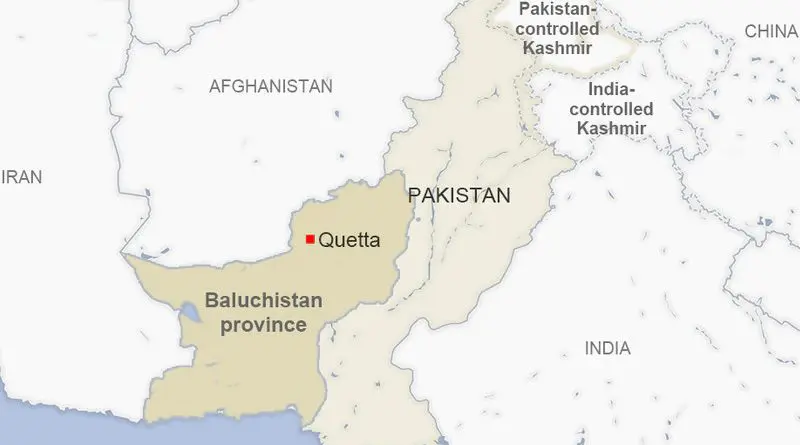
Energy Poverty In Balochistan: A Toll Of Reservations – OpEd
Rich in natural and mineral and home to immense renewable resources, Balochistan is the victim of energy poverty.
Despite the presence of huge supplier of gas to every nook and corner of the country, 95 percent of the province has no access to gas. While, the situation of electricity is not better than Gas where 12 to 18 hours load shedding is common and where major areas of the province are still without electricity. The dream of Sustainable Development Goal 7 (SDG7) that focuses on ensuring access to affordable, reliable, sustainable, and modern energy for all looks dismal in the case of Balochistan as the province has the lowest per capita electricity and gas consumption in the country.
Energy Poverty in the province has paused economic growth, has affected standerd living conditions, and has been causing environmental hazards. Load shedding followed by dearth of gas and electricity have hugely been sources of devestation of agriculture and services sectors in the province. On the flip side, the scarcity of energy in the province has also affected people psychologically, whereas, it reflects that majority of the residents of the province are still living in the stone ages who are deprived of conventional means of energy vis-a-vis electricity, and gas while, they use non_conventional means of energy such as kerosene and traditional biomas like firewood, and plant waste which are hazardous to atmosphere mostly rural Balochistan which constitutes around 73 percent of total area.
As per Global Energy Monitoring, in 2024, Balochistan faced (and still is) facing significant gap in electricity demand and supply. The province’s annual demand is around 1,500 MW while it received electricity is around 25 percent.
On the other hand, Balochistan has 1,350 MW of coal and 1,130 MW of natural gas generation of electricity. This means the province relies on exporting power rather than meeting its own needs. Currently, only 56.1 percent of population has access to grid electricity.
One of the main causes of poor and rooted transmission lines cannot observed more electricity supply. Whereas, the transmission and distribution losses are 26.72 percent which on one side testifies people’s irresponsible behaviour by stealing electricity whilst on the other side it reflects poor governance.
Balochistan has natural gas reserves of 19.3 trillion cubic feet. It was discovered in 1952 and started production in 1955. It has been providing gas to the country. Sadly, despite its capital city, Quetta receiving gas in 1985, currently, 95 percent of the province is deprived of using gas. Lo and behold. Balochistan is still mainly deprived of its due royalty/surcharge and revenue from gas since 1947 whose deposits are shrinking and have reduced from percent 56 percent in 1995 to 22.5 percent. The Federal government is reluctant to abide by article 172(3) of the constitution which envisages a revenue distribution formula of 50 percent share of the province in natural resources which are extracted from the province.
Balochistan has immense potential of generating power through renewable energy resources. Major areas of the province has 19 to 20 million joules/m² per day solar insulation whereas, its 6 corridors have radiation of 5.79 kWh/m².
Apart from solar energy, the province has gigantic potential of wind energy. The areas of Pasni, Chaghi, Makran and Gwadar are hotspots for producing wind power. The annual mean wind speed in most areas of the province ranges from 1.18 m/s to 2.23m/. In addition, the province has the potential to generate 20000 MW of Wind energy which is comparatively cheaper than thermal energy.
Despite solar and wind energy, the province has potential of producing tidal energy in Makran, Somniani, Ormara, Gwadar and Kamalat beaches. There are 3 to 5 meters above the mean level tides through which Balochistan can generate 26000 MW of hydroelectric energy.
Balochistan that is the jagular vein of the mighty CPEC has been deprived of in all projects. As far as energy projects are concerned, 70 percent projects of the CPEC are related to energy but alas Balochistan has equall to none share in these projects. In total 10000 MW of electricity that have been generated through its first phase, Balochistan has got only 1 project of 300 MW of coal power plant of Gwadar. Whereas, there are 13 proposed Grid stations and 2 transmission lines of 500 KV in which Balochistan has no share.
Moreover, on one side, where the major areas and population of the province are facing dearth of availability of energy on the flip side, being the poorest province of Pakistan, its citizens are also facing hurdles of affordability. Balochistan that is providing immense gas to the country, its own people have to pay bills as of other countries pay. The same situation is with electricity prices, where provinceally generated electricity is deported from the province.
The residents of Balochistan deserve to live a better standard of life. In this twenty first century, the majority of its residents are living in the stone ages in terms of energy. There is a dire need to formulate reasonable strategies with respect to availability and affordability of energy in Balochistan. Both federal and provincial governments should realise their responsibilities and pay heed to diminishing the reservations of the people of the province for which deleting the word of energy poverty is crucial.

Like what you read?
Please consider supporting Eurasia Review. Thank you for your consideration!
