
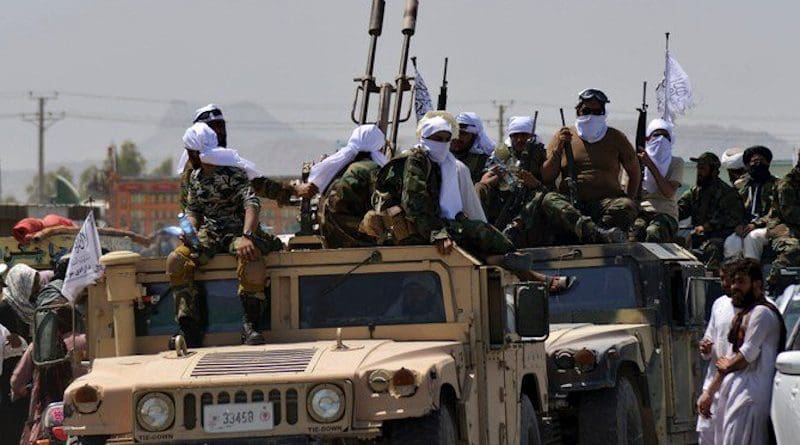
Taliban’s Fractured Command Fuels Arms Proliferation – OpEd
Afghanistan has, after the NATO withdrawal and the Taliban’s swift return to power, not succeeded in establishing a monopoly over violence or overall control over its territory.
The gravest consequence of this failure is widespread and dangerous proliferation of weapons, many of them NATO grade, that are starting to circulate on black market and to fall into the hands of militant groups. However, with the Taliban talking of restored order and national sovereignty, their fractured command structure, a fundament lacking in internal discipline, has created the fertile ground for arms trafficking which neither Afghanistan nor its neighbors can be spared, despite what they would admit.
Instead, the remnants of war are slipping into palpable hands; from the Taliban regime and into those of militant factions. Such high-grade firearms would include M4 and M16 rifles, which were once part of the armory given to Afghan security forces by Western allies. They symbolize a dangerous lack of oversight and control, as these weapons, now showing up in informal markets adjacent to Afghanistan’s eastern border. These stockpiles were far from being secured by the Taliban as the inability or unwillingness of the Taliban to enforce discipline among its own ranks has made it easy for warlords and local commanders to exploit these resources to their own advantage.
Kandahar proclaims itself, the supposed epicenter of Taliban authority, but some of the factions within the group are becoming increasingly autonomous. Central leadership sends and receives orders, which are commonly ignored or selectively implemented, especially when the order contravenes lucrative illicit business, as in arms smuggling. This is not an incidental disobedience, but this is a structural weakness of governance of the Taliban. Without a united chain of command, and the overview that comes from it, regional commanders function as quasi ‘warlords,’ under which either local ambitions or feuds outweighs a central national strategy.
As a result of this fragmentation, arms control decisions have become political puppets to counter different political factions. These internal divisions have enabled and, in some cases, even encouraged just the opposite of securing the country’s borders and preventing weapons from ending up in the hands of extremists. The flow of arms across the border into Pakistan’s tribal areas has become routine in areas controlled or influenced by the Haqqani network, a faction which has its own semi-autonomous power base. The lack of inaction by the Afghan regime to stop such movement is of grave concern whether one is incompetent, resists, or in deliberate complicity.
Therefore, the failure of the Taliban to capture their arsenals has direct impacts for the peace and stability of the region. One of the most worrying is the emboldening of groups such as Tehrik-i-Taliban Pakistan (TTP), which has turned the newly accessible weaponry to its advantage to gain greater field in Pakistan. A superhighway for sophisticated arms — one that is the product of the absence of meaningful Taliban oversight over a porous Afghan-Pakistan border long ago established as a passage by which militants and smugglers could pass — has now emerged. These weapons are being passed from one hand to another, and with the balance of power in the region between instability and violence shifting.
This disconnect between what the Taliban say and what can be governed is dangerous on the ground. Provinces adjacent to the border are a different story: while the leadership in Kandahar may declare things and issues declarations to project control and authority, they are not in fact in control and are not exerting authority. Despite the retribution of which local commanders have the capacity to reap, there are still profit and political ambitions driving the traffic of weapons. Not only does this destroy the national security, but it also fuels the increase of extremist ideologies and groups that have been on the decline.
In addition, Taliban run areas have since become hot spots for regrouping militants, making parts of Afghanistan operational sanctuaries for the extremists. Radical ideologies flourish, and violence thrives, in an environment that exists due to the steady supply of arms, that environment created by a persistent supply of arms jointly with the Taliban’s weakness of governance combined with selective enforcement of law and order. At a time when fears around the international community are tense about interacting with the Taliban regime, we cannot ignore this threat growing.
It is telling that the Taliban government has remained silent about this issue. At the same time, despite rising reports of arms smuggling, especially from areas controlled by the Haqqani network, the regime has not been able to make any tangible move against the trade. It could be motivated as passive neglect or worse, active endorsement. Either wind up is based on a depressing reality: The Afghan leadership currently lacks the will and the unity to stop the weaponry from within its borders.
Finally, the unhealthy proliferation of arms in the region is a direct product of the intertwined, fractured internal structure of the Taliban, and a vacuum of centralized control at no one’s permanent disposal. With more and more militants across the border growing stronger, and more and more brazen, the cost of inaction increases, not just for Afghanistan, but for South Asia.

Like what you read?
Please consider supporting Eurasia Review. Thank you for your consideration!
