
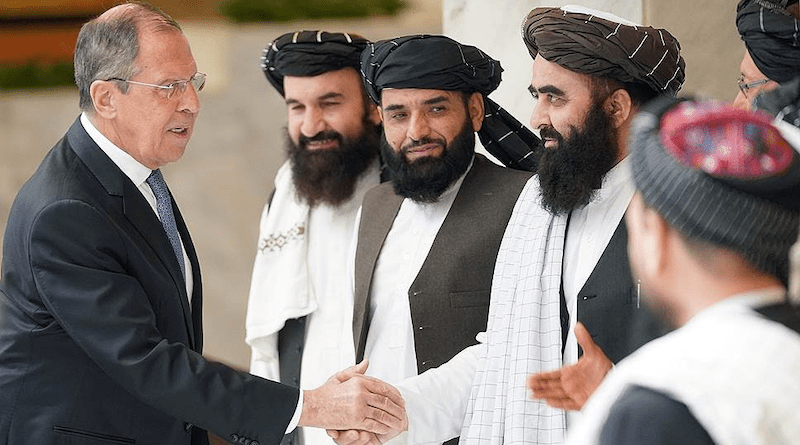
The Taliban’s Slow Move Towards Legitimacy: A Regional Reality Check – OpEd
Since taking over control of Kabul in August 2021, the Taliban has consistently pursuing a diplomatic outreach strategy, especially focusing on the neighboring countries and the wider international community in general. Although, the formal international recognition has been remaining as an elusive, a new normal is indeed emerging.
This strategy is being characterized by increased engagements and a cautious de facto acceptance from a growing number of regional players. Till now, no country across the globe has officially recognized the Islamic Emirate of Afghanistan. This is a deliberate stance has been taken on part of the countries, largely based on a global consensus that conditions such as gender discrimination, respect for the human rights (especially women’s and girls’ rights) have not taken into account. The inclusive government and assurances against terrorism emanating from Afghan soil have not been met. However, the informal consensus over the formal, however, is being increasingly challenged by the pragmatic realities on the ground. The regional countries like Central Asian and South Asian countries including China have been getting engaged with the Taliban regime given the shifting geopolitical interests of Taliban’s neighbouring countries.
Seeing the recent geopolitical and geostrategic engagements by countries like China, Russia, Iran, and the Central Asian countries, it is being argued that these countries are pragmatically getting engaged with the Taliban. These engagements have been driven by a complex mix of security concerns, economic interests, and a desire to fill the vacuum left by the Western withdrawal. For these regional actors and factors, the immediate imperatives often outweigh the moral objections and the prevailing international norms.
Seeing the past records of the Taliban, border security has been remained a critical concern for Afghanistan’s immediate neighboring countries. Although, the Taliban has joined the political mainstream, but the other such groups in Afghanistan have been remaining major security challenges. Moreover, the Taliban’s efforts to combat the Islamic State Khorasan Province (IS-K), has been posing persistent regional threats for the neighbouring countries.
Russian special envoy to Afghanistan, Zamir Kabulov, even stated that Moscow used to consider IS-K as a “common enemy” and would offer assistance to Taliban if the latter demands so. Even Russia proposed to move further to remove the Taliban from its list of terrorist organizations. It indicates the Russian diplomatic move for the full-scale cooperation on this front.
The Central Asian states such as Uzbekistan and Kazakhstan, initially wary, have made a paradigmatic shift by taking a more neutral stance. Realizing this geostrategic situation, these countries engaging with the de facto rulers. These countries considered that it is essential for managing the potential spill-over effects of instability and cross-border security concerns such as militancy, terrorism etc. Notwithstanding such strategic concerns and initial vocal opposition, Tajikistan, has been maintaining the economic cooperation, acknowledging the need for practical engagement.
Landlocked Afghanistan is holding the geo-strategic and geopolitical importance as a potential transit hub connecting Central and South Asia. Uzbekistan, for example, hosted a Taliban delegation in September 2021, signing security and trade protocols, and has been a key proponent of the Trans-Afghan Railway. Kazakhstan has also seen significant business forums with the Taliban, facilitating agreements worth $1.5 billion since 2023. Turkmenistan continues to be a major oil and gas supplier to Afghanistan, with ongoing discussions to resume work on TAPI. While the TAPI pipeline’s progress remains limited due to political and financial hurdles, the Taliban actively promotes such projects to attract foreign investment and generate transit revenues.
In the post-US withdrawal from Afghanistan, China has recognized the security vacuum and its extensive mineral resources. Against this background, Beijing has carefully but realistically engaged with the Taliban regime. While some reports suggested that the Chinese investment has not met the initial expectations, rather facing delays. China’s interest is multifaceted in Afghanistan i.e., securing the resources for its expanding economy, integrating Afghanistan into its Belt and Road Initiative (BRI), and preventing the spread of extremism near its Xinjiang province. Even China has accepted the credentials of a Taliban envoy.
Even India, which was a traditionally strong supporter of the previous Afghan government, rather remained careful of the Taliban regime given its historical records and ties with Pakistan-backed elements. Given the concomitantly milieu, India has adopted a “step-by-step” approach to get engaged with the Taliban regime. Although formal recognition of the Taliban regime is not on the table yet given the various actors and factors, India has started getting engaged with the regime. Since the Taliban’s takeover of Kabul in August 2021, India has started pursuing a pragmatic approach to engagement, driven by various dynamics and strategic interests such as humanitarian concerns, and security considerations. The engagements started with meeting of India’s Ambassador to Qatar with a senior Taliban leader in Doha in August 2021. This was taken further when an Indian delegation in June 2022 visited Kabul to oversee the humanitarian aid and facilitate the partial reopening of the Indian embassy. Diplomatic interactions were further intensified, with India’s Joint Secretary for Pakistan, Afghanistan, and Iran meeting Taliban officials, including the acting Defense Minister in November 2024. These formal engagement reached to new high level in January 2025 when Foreign Secretary Vikram Misri met Afghanistan’s acting Foreign Minister Amir Khan Muttaqi in Dubai, marking the highest-level contact since 2021, focusing on development aid, trade, and Chabahar. Finally, in May 2025, India’s External Affairs Minister S. Jaishankar held his first official talk with Muttaqi, discussing cooperation, visa issues, and Afghanistan’s condemnation of a recent terror attack, signalling a significant diplomatic step
The UAE has been emerging as another a key player, subtly developing inroads and rivalling Qatar as a venue for diplomacy. While maintaining muted criticism of the Taliban’s human rights record, Abu Dhabi had accepted the credentials of a Taliban Ambassador (one of only two countries, alongside China, to do so). Meanwhile, the UAE secured its state-linked company to run Afghanistan’s three main airports. These engagements can be interpreted as a mix of protection and promotion of economic interests, geopolitical interests along with a desire to gain leverage and maintain channels of communication.
While falling short of formal recognition for the Taliban regime, but the growing regional engagements with the Taliban regime granting the latter a crucial degree of operational legitimacy. These engagements obviously seen as the de facto governing authority, capable of maintaining a semblance of stability and engaging in practical statecraft. This “working-level” relationship with the neighbouring countries allows the former to manage the border issues, pursue to protect and promote economic cooperation and projects, and seek humanitarian aid. The Taliban, facing severe financial crises due to sanctions and frozen assets, are actively leveraging their geopolitical position to attract investment and support from these non-Western partners.
To expedite the process of legitimacy not only regionally, rather at the global level, the Taliban regime has to show its commitment whatever the concerns raised by the global community with respect to human rights in general and particularly concerning women and girls. This is a major point of contention that continues to isolate the Taliban regime from the formal recognition. While the regional players prioritizing the stability and economic gain, but the rights of women and girls resonates deeply in other parts of the world, these narrative putting a lot of restrictions getting their “legitimacy.”
At last, it can be argued that the Taliban regime are gaining a form of functional legitimacy at the regional levels, particularly through the pragmatic self-interest of neighbours. On the other hand, the West has been maintaining its principled stance on human rights, but also recognizing the necessity of for a limited and pragmatic engagements to prevent a complete collapse of Afghanistan and further humanitarian crises. The Taliban regime is required legitimacy for its put potential engagements with the global community. But the ultimate question is of full international legitimacy that hinges on how the Taliban’s willingness to evolve and settle in the international framework of international rules. Until now, their regional outreach has certainly has been reducing their geopolitical isolation, but the path to becoming a fully recognized and accepted member of the international community remains long and fraught with the very contradictions that define their rule.
About the author:
- Prof Bawa Singh, Department of South and Central Asian Studies, Central University of Punjab, Bathinda (India).
- Jay Koche (Ph. D. Scholar), Department of South and Central Asian Studies, Central University of Punjab, Bathinda (India).

Like what you read?
Please consider supporting Eurasia Review. Thank you for your consideration!
