
India’s $9.1 Billion Amphibious Assault Ship Bet: Why These Warships Will Define The Country’s Naval Destiny – Analysis
The Indian Navy is about to make one of its biggest bets in decades. An ₹80,000 crore ($9.1 billion) tender for four Landing Platform Dock (LPD) warships is not just another defense purchase—it’s a defining moment that will determine whether India can truly project power across the Indian Ocean or remain dependent on aging foreign ships.
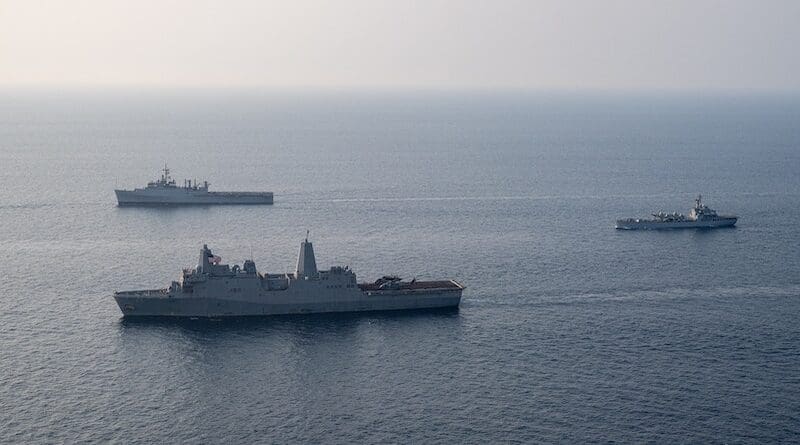
LPDs are specialized amphibious assault vessels designed to carry troops, tanks, helicopters, and landing craft directly from sea to shore without needing ports or jetties. Unlike regular warships that stay at sea, these floating fortresses can launch their own helicopters and landing boats, allowing soldiers and equipment to reach beaches, disaster zones, or enemy coastlines within hours. Think of them as mobile military bases that bring the battle directly to any shoreline.
This ₹80,000 crore ($9.6 billion) investment represents more than money. It’s a test of our indigenous shipbuilding dreams, our strategic partnerships, and our ability to learn from past procurement disasters.
The Hard Lesson from a Failed Dream
Let’s be honest about where we stand. Since 2004, the Indian Navy has been chasing advanced amphibious ships—vessels that can launch attacks from sea to shore, deliver disaster relief, and evacuate citizens from danger zones. Today, we have just one such ship: INS Jalashwa, an old American vessel bought second-hand in 2007.
INS Jalashwa deserves recognition for its service, but also highlights our limitations. Originally USS Trenton, this Austin-class LPD served the US Navy before India acquired it for $48 million. At 17,000 tons and 173 meters long, it can carry 1,000 troops, six helicopters, and various landing craft. The ship has proven invaluable during disaster relief operations, from cyclone evacuations to repatriating Indian citizens from conflict zones abroad. However, this 40-year-old vessel lacks modern weapons systems, advanced radar, and the latest communication equipment that today’s naval operations demand.
While INS Jalashwa serves its purpose, this aging ship cannot meet our growing maritime ambitions alone. Its limitations underscore why India urgently needs modern, purpose-built amphibious vessels.
The Navy’s first attempt to buy new LPDs collapsed spectacularly. In 2017, the Defence Acquisition Council approved a plan to buy four ships, but when Reliance Defence faced financial troubles, only L&T remained as a vendor. Defense rules don’t allow single-vendor purchases, so the entire project crumbled. Thousands of crores and years of planning went down the drain.
This failure taught us a crucial lesson: in defense procurement, having multiple options isn’t just good practice—it’s essential for success.
Why This Time Must Be Different
The new tender invites five major Indian shipyards—MDL, CSL, L&T, GRSE, and HSL—ensuring we avoid the single-vendor trap. Each shipyard must partner with foreign companies, bringing proven technology to Indian shores through Transfer of Technology agreements. This approach promises the best of both worlds: battle-tested designs and homegrown manufacturing capabilities.
But here’s what makes this procurement truly exciting: the competing designs offer India genuine strategic choices.
Naval Group’s Mistral-class ships excel as floating helicopter bases, perfect for troop transport and humanitarian missions. Spain’s Juan Carlos I-class vessels go further—they can operate fighter jets using ski-jump technology already proven on our aircraft carriers INS Vikramaditya and INS Vikrant. Italy’s Fincantieri offers the modern Trieste design, while South Korea brings the battle-tested Dokdo-class to the table.
Even Russia may enter with its Project 23900 design—massive 40,000-ton ships developed after France refused to deliver Mistral vessels in 2014. Though untested, these ships promise heavy-lift capabilities that could transform our amphibious operations.
The Real Strategic Stakes
These ships aren’t just about military capability—they’re about India’s role in an increasingly turbulent world. Advanced amphibious vessels can launch troops and equipment directly onto beaches without needing ports or jetties. This unique ability makes them invaluable for three critical missions:
Maritime Security: In an era when China aggressively expands its naval presence, India needs the ability to project power across the Indian Ocean. These LPDs would allow us to support allies, protect sea lanes, and respond to threats far from our shores.
Disaster Response: When cyclones hit the Bay of Bengal or tsunamis strike the Indian Ocean, these ships can reach devastated areas within hours, delivering aid where airports and ports are destroyed. Climate change makes such capabilities increasingly vital.
Humanitarian Operations: From evacuating Indian citizens during conflicts abroad to supporting UN peacekeeping missions, these vessels extend India’s soft power globally.
The Indigenous Dream vs. Reality Check
The tender’s emphasis on Indian manufacturing reflects our broader defense indigenization goals. Building these complex ships domestically will create thousands of jobs, develop advanced manufacturing skills, and reduce our dependence on foreign suppliers.
However, we must be realistic about challenges ahead. Shipbuilding is among the most complex manufacturing tasks, requiring precision engineering, advanced materials, and skilled workers. Even with foreign technology transfer, building world-class amphibious ships will test our industrial capabilities to the limit.
The delivery timeline—first ship in 60 months, then one vessel annually—appears optimistic given our track record. Delays are almost inevitable, but this time, multiple vendors competing should help keep projects on schedule and within budget.
Choosing the Right Design Philosophy
Among the competing designs, the Juan Carlos I-class stands out for India’s specific needs. Its proven ski-jump technology aligns with our existing aircraft carrier operations, allowing seamless integration of MiG-29K fighters and future STOVL aircraft. This compatibility could prove invaluable during joint operations where carriers and LPDs work together.
The Mistral’s helicopter-focused design offers simplicity and proven reliability but limits future growth options. Italy’s Trieste represents cutting-edge European engineering, while South Korea’s Dokdo brings proven Asia-Pacific experience. Russia’s Project 23900, despite being untested, offers unprecedented size and capability.
The Navy must choose not just for today’s needs but for decades ahead. These ships will serve well into the 2070s, making design flexibility and upgrade potential crucial factors.
A Defining Moment
This ₹80,000 crore ($9.1 billion) investment will echo through Indian naval history. Success could establish India as a major amphibious power, capable of projecting force and providing security across the Indian Ocean. It could also prove that India can execute complex defense projects domestically while learning from foreign expertise.
Failure would set back our naval modernization by decades, leaving us dependent on aging ships while regional rivals advance their capabilities.
The stakes couldn’t be higher. As China builds aircraft carriers and advanced amphibious ships, as Pakistan modernizes its fleet with Chinese help, and as regional tensions rise from the South China Sea to the Arabian Gulf, India needs these LPDs not just for prestige but for survival as a maritime power.
This tender represents more than a ship purchase—it’s a declaration of India’s maritime ambitions for the 21st century. The decisions made in coming months will determine whether we join the ranks of true naval powers or remain spectators in our own strategic backyard.
The ₹80,000 crore ($9.1 billion) question is simple: Are we ready to bet big on our naval future? For India’s sake, we better be.

Like what you read?
Please consider supporting Eurasia Review. Thank you for your consideration!
