
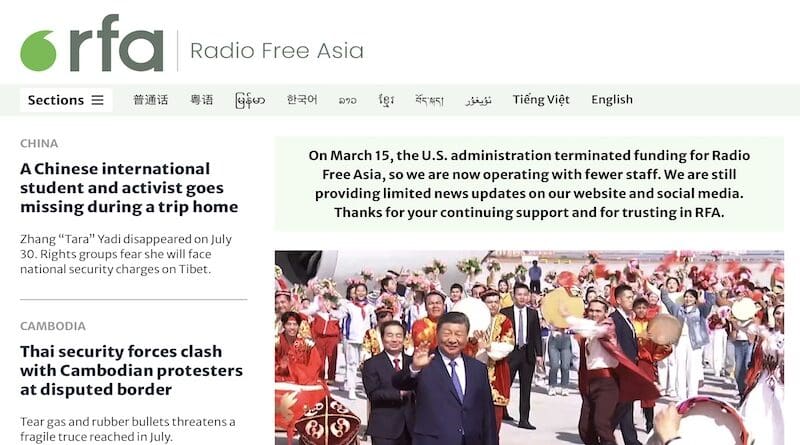
America’s Muzzle: How Trump’s Assault On Radio Free Asia Hands China A Victory – OpEd
History will remember this not as an accounting dispute but as a geopolitical blunder.
With the stroke of a pen, former President Donald Trump set in motion the slow strangulation of Radio Free Asia (RFA)—a modestly funded but strategically vital broadcaster that for decades pierced the walls of censorship across Asia. His executive order to slash the U.S. Agency for Global Media (USAGM), RFA’s parent organisation, under the banner of “cost-cutting,” is nothing less than an act of unilateral disarmament in the global information wars.
A Hidden Engine of American Credibility
Most Americans have never heard of USAGM. Yet its network of outlets—Voice of America, Radio Free Europe/Radio Liberty, Middle East Broadcasting Networks, and RFA—has for generations delivered accurate, independent reporting to hundreds of millions of listeners trapped behind propaganda curtains. These are not megaphones for U.S. policy; they are lifelines for audiences who hunger for verifiable facts.
Trump’s March order to reduce USAGM operations to the “legal minimum” gutted that mission. Grants and contracts were cancelled. Journalists lost jobs. Key services went dark. Although a federal judge temporarily restored funding to some affiliates, RFA’s $60.8 million budget remains frozen despite a court order to release it—a bureaucratic limbo that threatens to silence one of the most reliable sources of uncensored news in Asia.
Silencing a Beacon
For authoritarian leaders, the prospect of RFA’s demise is reason to celebrate. Beijing’s state outlets crowed that “biased propaganda poison” had been eradicated. Cambodia’s Hun Sen, who expelled RFA reporters in 2017, hailed it as proof that “fake news cannot survive.” Their delight is telling: RFA has long been the thorn in the side of regimes that fear sunlight.
Its track record is formidable. RFA exposed China’s mass internment of Uyghurs in Xinjiang, chronicled the Myanmar junta’s atrocities, and documented environmental devastation along the Mekong. Broadcasting in Mandarin, Cantonese, Burmese, Khmer, Korean, Lao, Tibetan and Vietnamese, its reporters—often working at great personal risk—offer the kind of verifiable evidence that dictators dread.
The Price of Retreat
This is not merely a media story; it is a strategic calamity. Information has always been one of America’s cheapest and most potent instruments of influence. During the Cold War, U.S.-funded broadcasters helped erode Soviet control for pennies on the dollar compared with military spending. Today, as China pours billions into global outlets like CGTN and Xinhua, Washington’s decision to cripple its own counterweight is an astonishing act of self-sabotage.
Consider the economics. RFA’s annual budget is less than the cost of a single F-35 fighter jet. Yet its reporting reaches 60 million people each week and shapes debates from Phnom Penh to Pyongyang. Abandoning such leverage in the name of fiscal restraint is strategic myopia of the highest order.
Regional Fallout
The vacuum will be immediate and dangerous. In Cambodia, where independent newspapers have been shuttered and opposition parties crushed, RFA’s Khmer service is one of the few outlets exposing land grabs and corruption. In Vietnam, it reports on labour protests and environmental scandals that domestic media will not touch. Across Myanmar, its coverage of military brutality forces the international community to confront crimes that the junta tries to erase.
When such reporting disappears, the space is quickly filled by state propaganda or conspiracy theory. Autocrats understand this. They control narratives to control power.
Culture and Memory at Stake
RFA is more than a geopolitical tool. It is a cultural archive and moral witness. Its Tibetan service preserves a language and history that Beijing seeks to extinguish. Its meticulous investigations provide evidence for human-rights tribunals and international sanctions. To silence RFA is not simply to shutter a newsroom; it is to erase a living record of repression.
What Washington Forgets
Supporters of the cuts argue that American taxpayers should not subsidise foreign news while domestic needs abound. But the arithmetic is false. The cost of rebuilding lost credibility, once authoritarian narratives harden, will be far greater than the modest savings achieved by gutting RFA. Information vacuums do not stay empty; they are filled by Beijing’s Belt-and-Road-backed broadcasters and by the algorithmic manipulation of state-sponsored trolls.
Trump’s order treats global media as an expendable luxury. In reality, it is a first line of defence in an era where power is measured not only in missiles or markets but in the ability to define truth itself.
The Clock Is Ticking
Legal appeals may eventually restore RFA’s funding. But damage is already done. Journalists have been laid off, local networks disrupted, and audiences left to wonder whether America still cares to stand with them. Rebuilding trust and infrastructure will take years—time that China and other authoritarian powers are using to entrench their own narratives.
A Test of Democratic Will
The fate of Radio Free Asia is a litmus test for U.S. commitment to free expression. Will Washington defend a principle it once championed, or will it allow a single executive order to silence millions who depend on its reporting?
History shows that democracies that abandon their voices eventually lose their influence. By muzzling RFA, America is not saving money; it is surrendering the microphone to those who wield lies as weapons.
The world is listening. What it hears now is the sound of silence—and Beijing’s applause.

Like what you read?
Please consider supporting Eurasia Review. Thank you for your consideration!
