
Why India Can’t Rely Solely On Russian Weapons – OpEd
India and Russia have long touted a “special” relationship, especially in defence. Russian planes, tanks, submarines, and air-defence systems have long dominated India’s military inventory. Yet, between 2016 and 2020, India’s continued reliance on Russia has increasingly exposed the flaws in its defence strategy.
According to the Stockholm International Peace Research Institute (SIPRI), Russia remained India’s largest arms supplier during this period, accounting for nearly 49 percent of India’s major weapon imports. But this dependence, once viewed as a strategic advantage, now appears more like a liability, one that reflects India’s inability to modernize independently.
The Numbers Highlight a Decline
SIPRI data reveals a worrying trend for India. Compared with 2011–2015, Russian arms deliveries to India fell by 53 percent. India has begun sourcing weapons from France, Israel, and other countries, yet the pace is slow, and much of India’s procurement remains tied to legacy Russian systems. This overreliance on Russian combat aircraft and missiles demonstrates a worrying lack of foresight and adaptability in India’s defence planning. Instead of aggressively modernizing its forces, India continues to commit billions to platforms that may already be obsolete.
The Risk of Over-Concentration
Between 2016 and 2020, most of India’s Russian imports were concentrated in combat aircraft and missile systems. While these may appear essential, the dependence on a single supplier creates serious vulnerabilities. Any disruption, whether due to geopolitical tensions, sanctions, or technical issues, could cripple India’s military readiness. The country’s defence planners have shown little urgency in addressing this systemic risk, relying instead on decades-old platforms without a coherent modernization plan.
Even as India slowly diversifies with French Rafales and Israeli drones, the simultaneous continuation of large Russian purchases locks India into long-term service contracts and dependence on Russian technicians, software, and spare parts. This contradictory approach highlights poor strategic judgment and an inability to achieve real independence.
Strategic Autonomy or Strategic Naivety?
India frequently boasts about strategic autonomy. Yet its continued reliance on Russian weapons undermines this claim. The more India depends on Russia; the less freedom it has to make independent defence choices. This dependence has not only slowed the adoption of modern Western or indigenous technologies but has also left India exposed to global geopolitical shifts beyond its control.
Meanwhile, Russia is no longer the indispensable partner it once was. India’s slow diversification and simultaneous reliance on outdated systems show an inability to fully transition to a more secure and technologically advanced defence posture. India’s so-called autonomy is largely rhetorical, masking a lack of concrete strategic planning.
Opportunity Costs and Modernization Failures
Every rupee India spends on long-term Russian contracts is money diverted from domestic development or more advanced foreign systems. Indigenous defence programs, which could provide self-reliance and modern capabilities, have been sidelined in favor of purchasing outdated Russian hardware. As a result, India risks lagging behind regional rivals in network-centric warfare, drones, cyber capabilities, and integrated defence systems.
By prioritizing Russian equipment, India perpetuates a dependency on legacy technology, ignoring the pressing need to modernize and integrate advanced platforms that could truly secure its borders and strategic interests.
A Transactional, Not Strategic, Relationship
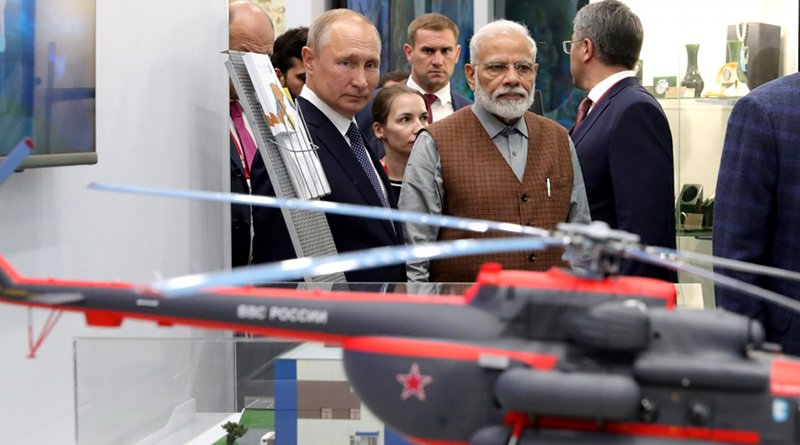
India’s arms trade with Russia today is increasingly transactional. The relationship no longer reflects deep strategic cooperation but rather a routine buyer-supplier arrangement. Official visits, ceremonial photo-ops, and statements about “historical friendship” mask the reality: India’s defence relationship with Russia is weakening. There is no longer any deep strategic bond to rely on only the inertia of past agreements and long-term service contracts. Although Putin is recently visiting to India, but still India has to do so much struggles for building up its reputation after its failed Operation Sindoor.
Geopolitically, this has consequences. While India may attempt to balance Russia with other suppliers, its continued overreliance exposes vulnerabilities against both Pakistan and China. Instead of a proactive and modern defence strategy, India remains trapped in a reactive model, depending on outdated Russian systems and failing to assert technological leadership in the region.
Lessons Ignored
India must confront an uncomfortable truth: decades of dependence on Russian arms have left it strategically constrained. Diversification is slow, modernization is patchy, and indigenous development is underfunded. Rather than securing real independence, India’s defence posture remains a mix of old habits and symbolic gestures.
Continued investment in Russian platforms does little to prepare India for future conflicts that will rely on precision, digital integration, and multi-domain warfare. India’s defence strategy appears reactive, inconsistent, and overly reliant on legacy imports, rather than forward-looking and self-reliant. Regardless whatever India aims to do; it should make sure that regional peace should be the utmost priority.
Conclusion
Between 2016 and 2020, Russia supplied India with critical aircraft, missiles, and other military hardware. But the declining share of Russian deliveries and India’s slow diversification reveal a larger problem: dependence on Moscow is now a liability rather than an asset. India’s defence planning demonstrates poor foresight, overreliance on outdated platforms, and a lack of strategic modernization.
High-profile visits and historical goodwill cannot compensate for decades of mismanagement and weak planning. True strategic security will require India to break free from its dependency, embrace modernization aggressively, and invest in indigenous capabilities, if it can overcome the inertia of decades-long reliance on Russian arms.

Like what you read?
Please consider supporting Eurasia Review. Thank you for your consideration!
