
Georgia’s Alienation From The West Only Increases Russia’s Chances – OpEd
Russia’s attempts to extend its influence in Georgia
Alongside a growing geopolitical confrontation between Russia and the West over the war in Ukraine, perception is maturing in the western circles that Georgia with its pragmatic and often difficultly understandable by western partners policies, is eventually falling prey to Russia. Thus, the possibility of that Russia may regain influence in Georgia represents a challenge for the West, which dictates its own line of conduct in the relations with Georgia and its authorities. Results of the latest parliamentary election in Georgia, where the West pro-Western opposition with its election slogan “Russia or Europe,” competed the ruling “Georgian Dream” (GD) party, whose electoral motto was “War or Peace,” left GD in power for the fourth term. The election outcome сaused frustration in the Western circles, as their expectation was a coalition pro-European government formed by multiparty parliament. The West’s perception that Georgia under GD governance is drifting away from the West, and gets closer with Russia, has multiplied.
The opposition forces promptly denounced the election as rigged as a result of the “Russian special operation against Georgia” and hybrid warfare. However, they did not submit any specific evidence in support of their charges. Meanwhile, few have noticed that the pro-Russian forces, who stood in these elections as one, incorporating 28 parties and public associations, suffered a crushing defeat having gained only 2.4% having failed to win seats in the parliament. This had a domino effect. shortly after the election, the most industrious local pro-Russian TV channel “Alt-Info” stopped broadcasting. Other pro-Russian forces and media have significantly reduced activity. Although, the electoral result allows this pro-Russian unit to get budget financing and, accordingly, stay afloat. In addition, Russia’s reluctance to resolve the issues related to territorial integrity and the de-occupation of Georgia, makes pro-Russian forces highly vulnerable in their advocacy of rapprochement with Russia.
Nowadays, bilateral dialogue between Georgia and Russia known as a Prague format has been frozen since November 2021. Russian officials while speaking in favor of “further normalization of ties with Georgia” despite the absence of diplomatic relations, repeat Russia’s well-known approach. As with Ukraine, they call on Georgia to take into account the “new realities in the region” (i.e. Russia’s recognition of the independence of two separatist regions – Abkhazia and Tskhinvali) for restoring diplomatic relations. Shortly before the Georgian parliamentary elections Russia officially declared that recognition of independence of Abkhazia and South Ossetia “is not subject to revision.” This largely deprives the ground for some assertions that before the elections, Russia tried to support GD, as its favorite, with a promise of restoring the territorial integrity of Georgia.
A targeted information influence aimed at intimidation of Georgian society with yet another “color revolution” with the western support, is one of the tactics, which Moscow had employed before and after the Georgian election. Interestingly, the main role has been assigned to the Russian Foreign Intelligence Service(SVR), probably with the expectation that its information will be perceived more reliable. During July-December 2024, SVR made several statements ((SVR.gov.ru July 9, SVR.gov.ru August 26, 2024, SVR, September 11, 2024) RIA-Novosti December 10, 2024) accusing the United States of planning a “regime change” in Georgia through the “color revolution” with proactive engagement of opposition parties, non-governmental organizations and even international organizations as Office for Democratic Institutions and Human Rights (ODIHR) of the Organization for Security and Cooperation in Europe (OSCE).
According to SVR, they should have recognized the elections as rigged and encouraged citizens to protest. These SVR reports, widely disseminated by the Georgian media, appear to have convinced a significant part of the Georgian public that the ongoing protests are fed from the West willing to change power in Georgia. After the elections, SVR chief Sergei Naryshkin claimed that plans for a color revolution in Georgia have failed, and the US “is losing initiative on all fronts” in post-soviet space.
To strengthen its influence in Georgia, Russia can still count on the powerful factor of Orthodox confessional unity with Georgia, and use it as a “soft power.” Georgian Orthodox Church fervently advocates protection of the national conservative traditions, and Russia, which has declared itself a worldwide bulwark against ultra-liberalism, constantly loads Georgian audience with messages about usefulness of “moving away from the ultra-liberal agenda imposed from outside.” Such messages naturally caress the ears of those voters (1.2 million) who supported GD in these elections and represent a traditionalist-conservative segment of Georgian society.
The Russian military presence in two separatist regions of Georgia (Abkhazia and Tskhinvali), hovering like a “sword of Damocles” over the country, is certainly a powerful factor of Russian influence, largely prejudging Tbilisi’s cautious policy towards Moscow. After the invasion of Ukraine, Russia’s leadership has always been fearful that the West would set up a new military conflict near Russia’s borders and probably in Georgia’s secessionist regions. Russian officials and pro-Kremlin opinion-makers highly praise GD’s restraint of active assistance to Ukraine, and its refusal to impose full-scale sanctions against Russia, to the displeasure of the West.
At this stage, the probability of Russia’s military aggression against Georgia is not high. However, Russia may use military force against Georgia in one form or another, if clearly anti-Russian forces come to power through “color revolution,” or if the use of military force gives Moscow a reasonable hope that this will surely reduce the level of threats to Russia’s vital interests in the region. Russia is creating new military infrastructure and dual-use facilities in Georgia’s secessionist regions.
Georgia’s still-persistent economic dependence on Russia becomes one of its main levers of influence in terms of shrinking Russia’s political footing in Georgia. Against the backdrop of Western sanctions, Russia tries, though without tangible success, to use Georgian-Russian border, as well as occupied Georgian territories, for circumventing western sanctions.
Russia could also use its resources to prevent the development of transit corridors that pass through Georgia bypassing Russia. For it, their targets may be “Middle Corridor” and deep-water port of Anaklia Russia permanently tries to lure Georgia into the regional formats like “3+3.” Recently, Moscow reiterated its invitation for Tbilisi. This invitation can be assessed as Russia’s “litmus test for GD” about its pro-western orientation. Georgia still refrains from joining “3+3”
In 2023, Russia restored direct air traffic with Georgia suspended in 2019 because of mass anti-Russian rallies in Tbilisi. That same year, Russia introduced and then expanded visa-free regime for Georgian citizens. Precise data on the economic impact of direct flights are not available, but airlines plan to increase the number of flights given the growing number of Russian tourists in Georgia. Increasing Russian penetration in Georgia also includes a significant number of Russian citizens who had relocated and then settled in Georgia, after the Russo-Ukrainian war. They can be considered as a potential leverage that Russia can use when it deems necessary. Russian officials constantly underline that Moscow will defend its citizens everywhere.
Although Georgia’s economic dependence on Russia has relatively decreased since 2023, mainly because of a reduction in remittances, it remains considerably high. Alarming reports about the growth of Russian economic intervention in Georgia are worth noting in light of possible Russian economic influence on local socio-political processes on the ground. It should be borne in mind that Georgian business itself, despite its declared pro-European orientation, is quite closely linked to the Russian market. GD has published a list of 30 large and medium-sized companies that recently together with 2300 firms signed up to petition to the authorities demanding conduct of new parliamentary elections in line with the opposition’s demand. The published list shows that these very companies are simultaneously running profitable business in Russia, receiving tens of millions in revenue. The income of a significant number of Georgian citizens, including employees of these companies, as well as the welfare of their families, are largely dependent on trade-economic relations with Russia. Thus, it is not difficult to imagine how Russia could take advantage of this.
Recently, a “Georgian-Russian” business association has been established in Georgia. This is another joint initiative in addition to the already existing Georgian-Russian Business Council, advocating for restoration of diplomatic relations with Russia. The association’s main goal is to help local businesses engaged in exporting to Russia. About 60 business entities (mainly winemakers, and representatives of various branches of agriculture – fruit growing, horticulture trading with Russia), attended the association’s founding meeting. Founders of the association claim that they represent the interests of about 600 thousand Georgian citizens. Their claims seem to be based on statistics that show Russia the second largest trading partner for Georgia, despite 3% decrease in Georgia- Russia turnover in January-August 2024. Experts explain that territorial proximity, existing transport routes, long established economic ties and other factors facilitate this economic linkage. According to the statistics, Russia was the first among the top 5 export markets for Georgian wine in 2024. In 2025, Georgia expects to receive twice as much gas from Russia as compared to the forecast figure in 2024. Russia remains the largest grain supplier to Georgia. Russia’s strategic assets in Georgia include some key energy units in the country.
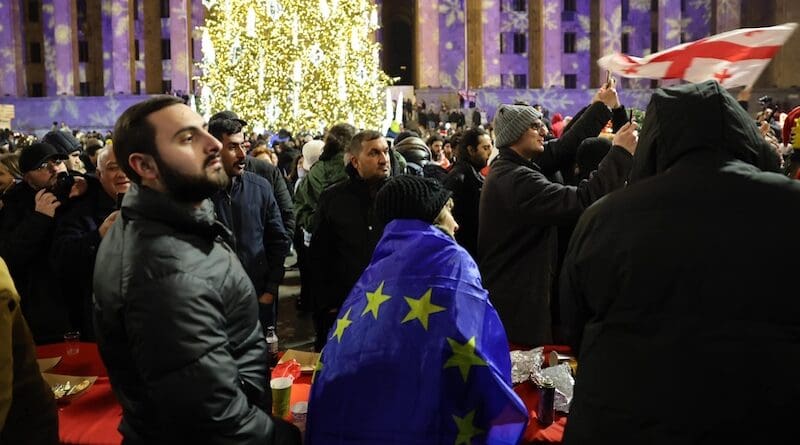
The current political situation in Georgia, continuing rallies with a growing division of Georgian society, and poisoning relations with the West, evidently plays into Russia’s hands, because it hampers Georgia’s integration into the Euro-Atlantic structures, what Russia wants to suspend as long as possible. Thus, Russia is expected to do its utmost, using all its means, to maintain a state of managed instability in Georgia. Despite the difficulties on the Ukrainian front, Russia retains resources to influence domestic political processes in Georgia. Russian propaganda tv-channels and online propaganda platforms still have a free access to Georgian audience.
The continuing debates in the West on Georgia’s genuine geopolitical orientation and actual goals of GD’s policy of “sovereign democracy” appear to have deadlocked. The sign of this is the West’s attempts to weaken GD with sanctions and other punitive measures on the one hand, and to support local pro-Western opposition on the other, which has so far been unsuccessful in trying to turn the tide. However, there is still a need for irrefutable evidence that GD has ultimately deviated from the European trajectory and turned toward Russia. The West’s excessive obsession with sanctions policies carries with it the danger of an upsurge of anti-Western sentiment in Georgia, with ensuing consequences. For some reason, the West refrains from active engagement to bring the parties in Georgia to the negotiating table, probably counting on the exhaustion of GD’s resources and weakening of their popular support.
To counter Russia in its attempts to regain influence in Georgia, the Western bodies perhaps need to rethink their strategy and tactics towards Georgia and restrict Russian schemes in a more sophisticated way, taking a closer look at the local context.

Like what you read?
Please consider supporting Eurasia Review. Thank you for your consideration!
