
India’s Marine Prospects: Riding The Blue Wave – OpEd
India’s coastline is one of its greatest natural endowments — a 7,500-kilometre longstretch that links the subcontinent to the global seas. From the ancient ports of Lothal and Muziris to the bustling modern harbours of Mumbai, Chennai and Paradeep, India’s maritime journey tells a story of adventure, trade, and transformation.
When Christopher Columbus set sail westward in 1492 searching for India, and Vasco da Gama finally reached Calicut in 1498, the world’s trade map was redrawn. Their voyages marked thebeginning of global maritime exploration — and India stood at its heart. Half a millennium later, as the world sails into an era of renewed oceanic importance, India once again finds itself at the centre of maritime opportunity.
A Decade of Maritime Transformation
Until about a decade ago, India’s port sector was functional but far from dynamic. Cargo volumes were growing, yet the pace of infrastructure improvement lagged global standards. Then came a wave of change — through policies such as the Sagarmala Programme, port modernisation initiatives, and a clear focus on the Blue Economy. Today, India boasts 12 major ports under central control and over 200 non-major or intermediateports administered by coastal states. Together, they handle around 95 percent of India’strade by volume and nearly 70 percent by value. Port capacity has risen sharply — from about 1,400 million metric tonnes per annum (MMTPA) in 2014-15 to over 2,700 MMTPA today. The last ten years have also witnessed a shift in thinking — from mere cargo handling to integrated logistics, multimodal connectivity, and sustainability.
A Visit to Paradeep: Promise and Pain Points
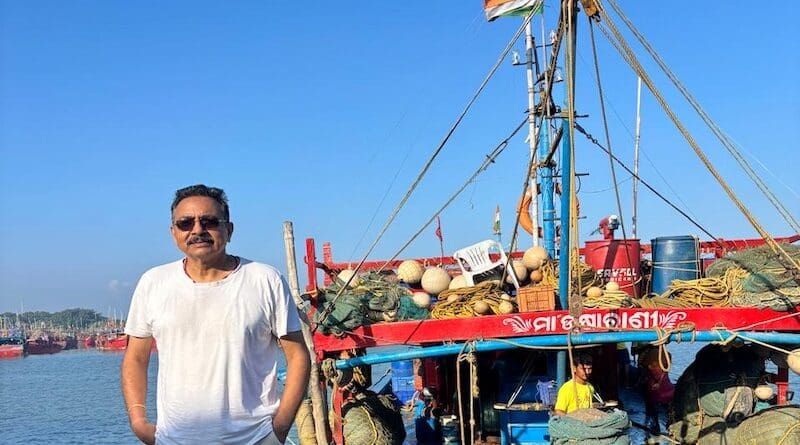
Recently, during a visit to Paradeep Port, often described as India’s largest port in terms of logistics and trade volume, one could sense both achievement and unfinished work. The port’s expanded capacity, mechanised terminals, and digital monitoring systems reflect genuine progress. Yet, beyond the impressive statistics, a few realities stand out: connectivity gaps, insufficient cleanliness, strained supporting infrastructure, and low staff morale. These human and physical bottlenecks show that building world-class ports is not merely about cranes and cargo — it is equally about people, environment, and efficient linkages to the hinterland. Ports succeed when the ecosystem thrives — from rail and road access to urban amenities, housing, and worker motivation.
Opportunities on the Horizon
India’s coastal geography offers tremendous potential: 1. Gateway to Global Trade –Located along the Indian Ocean, a key artery of world commerce, India can serve as aregional transshipment hub. 2. Blue Economy Growth – Beyond shipping, the seas hold opportunities in fisheries, renewable energy, seabed minerals, shipbuilding, and coastaltourism. 3. Strategic Advantage – A strong maritime base enhances national security, disaster response, and international presence. 4. Employment & Regional Growth –Port-led development can generate millions of jobs and strengthen coastal communities.
Challenges that Persist
For all the potential, the seas also throw up challenges: connectivity deficits,environmental sensitivity, skill and technology gaps, competition, and infrastructure upkeep. Many ports, including Paradeep, face road and rail bottlenecks. Efficient logistics corridors are vital. Coastal development must respect fragile marine ecosystems, while also building human capacity and cleaner, safer harbours.
Learning from History and the Sea
History has always whispered lessons from the ocean. Columbus’s bold voyage reminds us how ambition can reshape destiny. Vasco da Gama’s landing on Indian shores signified India’s central place in maritime civilization. And the Titanic tragedy of 1912, though asymbol of human loss, also taught the world humility before nature and the need for safety and foresight. As India modernises its ports and shipping, these lessons remain relevant. The sea rewards courage but punishes complacency.
The Past Ten Years: Milestones
The Sagarmala Programme has identified over 800 projects, many completed, focused on port modernisation and industrial corridors. Six new mega ports are on the drawing board,with 100% FDI permitted in port infrastructure. The National Logistics Policy and PM Gati Shakti Plan aim to synchronise transport and supply chains. Green Port Initiatives promote renewable energy and waste management. Coastal shipping is being revived through incentives, while India Maritime Week 2025 showcases this progress and global partnerships.
The next phase must go beyond ports to create a comprehensive marine ecosystem —deep-draft and transshipment capacity, smart digital ports, green harbours, skill development, and integrated coastal development. If achieved, India’s ports can truly become engines of prosperity and national pride.
Conclusion: The Sea Beckons
The sea has always tested humankind — from Columbus’s uncertain journey to the Titanic’s fate — yet it continues to inspire progress. For India, the ocean is not just geography; it is destiny. As the nation celebrates India Maritime Week, there is reason for optimism. With strong policies, improved infrastructure, and a renewed spirit of enterprise, India is poised to reclaim its historical maritime prominence. The waves rolling onto ourshores today carry both memory and promise — memory of the sailors who once set forth from our coasts, and promise of the new trade winds now rising. If we can do that, the story of India’s blue economy will not just be about ships and cargo, but about a nation rediscovering its sea legs — and sailing confidently into the future.

Like what you read?
Please consider supporting Eurasia Review. Thank you for your consideration!

A good analytical piece.