
The Quiet War Of Names And Nations – OpEd
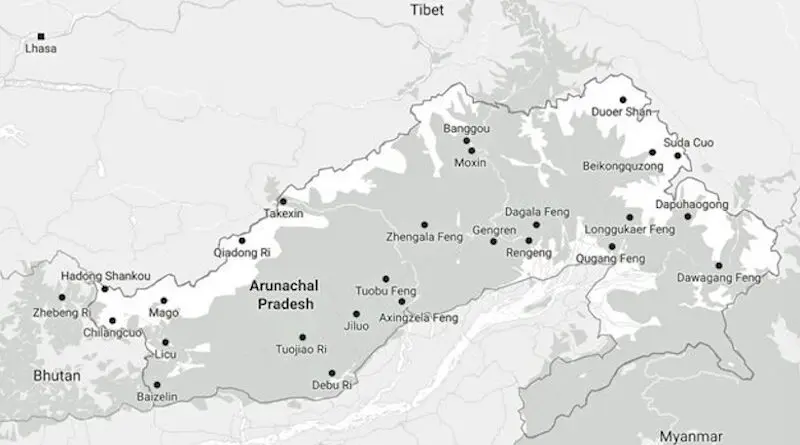
Like a chess grandmaster moving a knight into enemy terrain under the shadows of distraction, China has once again played a calculated gambit, renaming 89 locations in Arunachal Pradesh. It is more than a symbolic gesture; it is a strategic assertion. This deliberate move exposes the widening cracks in India’s diplomatic armor and reflects a broader realignment in the geopolitics of South Asia, where perception, power, and precision are fast replacing traditional paradigms of negotiation and posturing.
Beijing’s latest step, renaming an additional 27 places in the contested region of Arunachal Pradesh, now totaling 89, is not a random act. It is a map with intent. Every renamed village, mountain, or river carries the weight of China’s historical claim over what it calls “South Tibet.” And for India, this cartographic maneuver reveals more than external pressure, it lays bare internal contradictions in its foreign policy approach, which is increasingly being seen as heavy on rhetoric and light on results.
While New Delhi attempts to showcase a global rise through summits, soft-power campaigns, and strategic partnerships, the reality on the ground tells another story. The very timing of China’s renaming spree, coming on the heels of diplomatic outreach by India, underscores how hollow these efforts appear. For India’s Ministry of External Affairs, the news hit like a cold gust during what was projected to be a diplomatic spring. The ministry now finds itself answering not just Beijing’s veiled jabs, but also rising discontent from within. Critics at home and seasoned voices abroad are beginning to question the true yield of India’s high-profile foreign engagements.
What makes this development more consequential is the seamless coordination between China’s stance and Pakistan’s parallel posturing. In the recent flare-up between New Delhi and Islamabad, China’s support for Pakistan was not merely rhetorical, it was deliberate and expected. For strategic watchers in Islamabad, this was no surprise. Beijing’s alignment with Pakistan is a logical extension of shared interests, economic corridors, and regional balancing. For India, however, it represents another moment of diplomatic miscalculation.
India had hoped to deter such moves by projecting military resolve, especially after the Galwan Valley clashes, but resolve alone is not strategy. While India boasts about its stand in border skirmishes, it fails to acknowledge that modern diplomacy is won not just on mountain ridges, but in quiet rooms and sharp communiqués. The map war, in this context, is more powerful than the gun; renaming lands achieves what troops cannot, international confusion, domestic pressure, and regional leverage.
Arunachal Pradesh has become a canvas upon which Beijing paints its version of history. The international community, fatigued by global crises and economic instability, barely blinks. And why should it? China’s claims come with consistency and historical backing, no matter how contested. Its actions are part of a long game, measured, persistent, and rooted in a vision that spans decades, not election cycles. Unlike India, which oscillates between muscular nationalism and hollow multilateralism, China has ensured that its territorial claims are never far from its broader geopolitical calculus.
Pakistan, meanwhile, emerges as a quiet beneficiary. China’s moves serve Islamabad’s strategic interests by keeping India entangled in its eastern theatre, limiting its ability to overextend westward. The China-Pakistan partnership is no longer just about economics, it’s geopolitical symbiosis. As India scrambles to defend its diplomatic image, Islamabad gains valuable breathing room to recalibrate and reposition its regional strategy.
Beijing’s assertion is also symbolic of its global posture. With control of over 170 seaports worldwide, dominance in rare earth exports, and a hardened South Asia policy, China is no longer playing catch-up, it is setting the tempo. The renaming exercise in Arunachal Pradesh is not an isolated act; it is a signal, a piece of a larger puzzle. In contrast, India continues to rely on outdated tropes of civilizational pride and regional leadership without aligning them with ground realities.
India finds itself in an increasingly precarious position, rhetorically defiant, strategically reactive, and diplomatically isolated. Its two-front challenge, both on the ground and in the world of narratives, is not going away. And the more it insists on playing the old game, the further it drifts from shaping the new one.
In this recalibrated South Asia, where borders are redrawn not with ink but with intent, New Delhi must ask itself a hard question: is it leading the region, or merely reacting to those who are? The answer, uncomfortably, lies not on the map, but in who gets to name it.

Like what you read?
Please consider supporting Eurasia Review. Thank you for your consideration!

President Xi Jinping plays his chess on the world chessboard canvas through his clever moves of the Belt and Road Initiative (BRI). Xi more than chess plays the Chinese game of ‘Go’ which represents a skill and understanding of forward-thinking strategy. Chess which originated in India is a game of manoeuvre and the objective is to capture or “kill” the opponent’s king other losses being immaterial. The Chinese ‘Go’ is played on a much larger board compared to the Chess board. The objective of ‘Go’ is to surround a larger area on the board before the opponent.
Beijing renaming places in Arunachal Pradesh it is a meaningless exercise. China is an old hand in cartographic wars. Indian ‘principled’ stand on SCO/BRICS/Quad etc. is strongly disliked. Various kind of Troikas are being formed in the reason amongst Russia, China ,India ,Pakistan and China creating a South Asia bonhomie. Confused to counter America and China continue to strangle India and not let it progress of course in nexus with Pakistan…