
Appeasing To De-escalate: Pakistan’s Role In Iran-Israel Conflitct? – OpEd
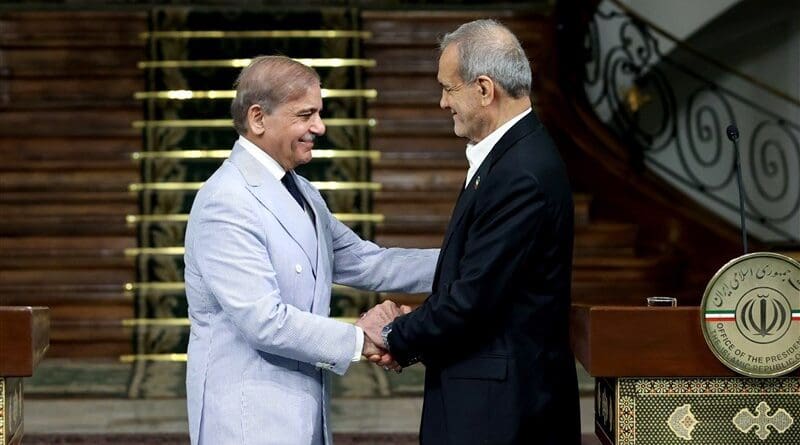
In a significant display of diplomatic maturity and strategic influence, Prime Minister Shehbaz Sharif has revealed Pakistan’s behind-the-scenes role in facilitating the ceasefire between Iran and Israel—an achievement that marks a historic milestone in Pakistan’s foreign policy evolution. Addressing the Federal Cabinet, the Prime Minister underscored Pakistan’s consistent and principled engagement throughout one of the most volatile regional crises in recent years, emphasizing the country’s emerging role as a stabilizing force in the Muslim world and beyond.
The Middle East has long been a cauldron of geopolitical rivalries, religious divides, and proxy wars. For decades, Pakistan—despite its deep historical, religious, and cultural ties to the region—has walked a cautious line, often choosing silence over strategic involvement. That posture appears to be changing. Shehbaz Sharif’s assertion that Pakistan actively supported a peaceful resolution to the Iran-Israel conflict, while standing firmly with Iran against unprovoked Israeli aggression, signals a paradigm shift. Islamabad no longer seeks merely to observe from the sidelines—it is now willing to shape outcomes, especially when Muslim nations face existential threats.
The Prime Minister confirmed that Iran officially acknowledged the roles played by President Asif Ali Zardari, PM Shehbaz Sharif, and Army Chief Field Marshal Asim Munir in promoting de-escalation. This public gratitude from Tehran not only validates Pakistan’s credibility with Iran but also enhances Islamabad’s image as a regional player capable of bridging divides.
In a geopolitical environment where trust is scarce, Pakistan’s simultaneous engagement with Saudi Arabia—the Kingdom historically seen as Iran’s rival—demonstrates diplomatic dexterity. Shehbaz Sharif revealed that he held direct conversations with both the Iranian President and Saudi Crown Prince, suggesting that Pakistan has become a vital backchannel between two of the most influential powers in the Muslim world. This dual-track diplomacy, backed by military diplomacy and statesmanship, reflects Pakistan’s careful balancing act in a region often defined by zero-sum alignments.
At the heart of this diplomatic breakthrough lies Pakistan’s civil-military synergy. Field Marshal Asim Munir, the Army Chief, is increasingly emerging as a key figure in Pakistan’s regional outreach. After an extended meeting with U.S. President Donald Trump, Munir held a consequential discussion in Istanbul with Iran’s Foreign Minister—a move that likely helped address military-to-military concerns and ease tensions between Tehran and Washington’s regional allies.
This military diplomacy, paired with civilian engagement, adds depth to Pakistan’s regional strategy. It sends a powerful message: Pakistan’s military establishment is not just a security actor but also a stakeholder in peacebuilding. What makes this development even more significant is the acknowledgment from none other than President Trump, who reportedly expressed admiration for Field Marshal Munir’s strategic and diplomatic acumen. This recognition is rare in U.S.-Pakistan relations and hints at a renewed understanding of Islamabad’s constructive potential in Middle Eastern affairs.
Prime Minister Shehbaz Sharif’s remarks also reflect a broader shift in Pakistan’s foreign policy doctrine—from reactive posturing to proactive regional stewardship. By choosing to be part of the solution, Pakistan has demonstrated that it does not require permission from great powers to act in defense of peace, sovereignty, and regional stability. What’s notable is that Pakistan stood with Iran while promoting peace—challenging the false binary that aligning with Tehran automatically means alienating Washington or Riyadh. The recent ceasefire is a case study in how multipolar diplomacy, guided by principle and pragmatism, can work. In contrast to states that choose sides or stoke divisions, Pakistan has positioned itself as a consensus-builder—a role desperately needed in a fractured Middle East.
Shehbaz Sharif also used the Cabinet address to thank key domestic stakeholders, including Finance Minister Ishaq Dar, Deputy Prime Minister, and allied parties, for supporting the federal budget under difficult conditions. This note of gratitude extends beyond fiscal matters—it subtly reflects political cohesion at a time when unity is required to sustain an ambitious foreign policy vision.
By recognizing the efforts of President Zardari and Foreign Minister Bilawal Bhutto Zardari, the Prime Minister also emphasized a united national front, a rare but welcome sight in Pakistan’s often polarized politics. For too long, Pakistan’s role in Middle Eastern geopolitics has been undervalued—both by its allies and by itself. That is changing. The recent ceasefire between Iran and Israel, shaped significantly by Pakistan’s backchannel diplomacy, is evidence that Islamabad can be more than a participant—it can be a pacifier. This moment must not be allowed to fade into diplomatic memory. It should serve as a foundation for sustained regional engagement, where Pakistan continues to act as a bridge between adversaries, a voice for peace, and a force for stability. The world may finally be seeing what Pakistan has long claimed: that its strength lies not just in its military might, but in its ability to mediate, reconcile, and lead.

Like what you read?
Please consider supporting Eurasia Review. Thank you for your consideration!
