
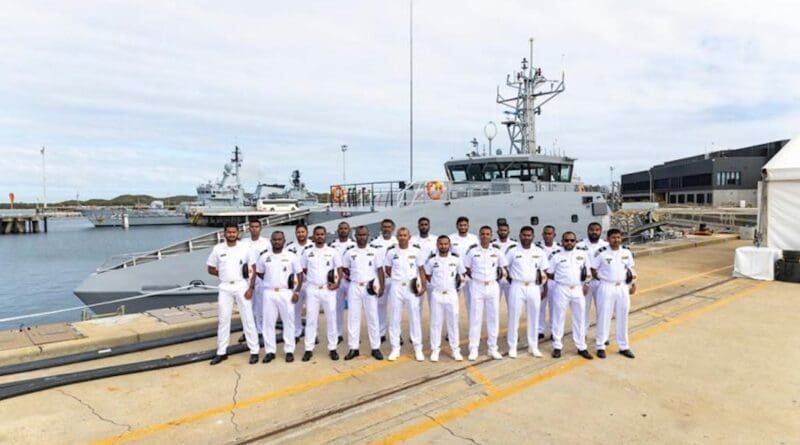
Australia’s Patrol Boat Program Bolsters Maldives’ Maritime Security
Key Takeaways
- Australia delivered a Guardian-class patrol boat to the Maldives in June 2026, the 24th vessel under its Pacific Maritime Security Program. The boat strengthens the Maldives’ ability to monitor its nearly 1-million-square-kilometer exclusive economic zone and combat illegal fishing and other threats.
- The gift is part of a broader MNDF upgrade that includes new interceptor craft, a naval ship, harbor vessels, and an air station planned for 2026. It also builds on growing defense cooperation with India on maritime surveillance.
- Officials describe the partnership as a strategic investment in Indo-Pacific maritime security that recognizes the role of small island states in regional stability.
The Maldives National Defence Force (MNDF) received a major upgrade to its maritime capabilities with the delivery of a patrol boat from Australia, the 24th vessel gifted to partner nations under Canberra’s Pacific Maritime Security Program (PMSP).
The Guardian-class boat docked in the northern Indian Ocean nation in June 2026 after an 11-day, 6,000-kilometer journey from western Australia, adding a fourth patrol vessel to the MNDF fleet. Once commissioned, it will “significantly enhance the Maldives’ maritime surveillance, deterrence and response to illegal activities within its maritime zones, search and rescue capabilities, and contribute to regional security and stability,” the MNDF stated.
The Maldives comprises nearly 1,200 coral islands stretching more than 800 kilometers north to south, with its 530,000 inhabitants spread across 200 islands. The nation’s exclusive economic zone, where it has sole rights to marine resources such as fish, fossil fuels and minerals, encompasses almost 1 million square kilometers. Fisheries is the country’s second-largest economic sector after tourism, providing income to more than 20% of the population, according to the World Bank.
The patrol vessel is part of a bolstering of the MNDF. Officials announced that 17 Coast Guard interceptor craft and a naval ship also will be commissioned in 2026, with funding secured for two harbor patrol vessels and an MNDF air station, the Maldives-based website MV Plus reported.
The Maldives also is deepening defense cooperation with northern neighbor India. In late 2024, Male and New Delhi agreed to strengthen joint maritime surveillance and coordination to counter piracy, illegal fishing and other transnational crime. India also has provided the Maldives with radar systems and other assets to improve maritime domain awareness and search and rescue operations.
Australia has delivered patrol boats to 16 partner nations under the PMSP, which succeeded the long-running Pacific Patrol Boat Program. The program also includes landing craft and a loan fleet, maintenance and sustainment support, training for crews through the Royal Australian Navy, embedded naval advisors, and uncrewed aerial systems and satellite support for intelligence gathering.
For the latest vessel delivery, the last planned under the PMSP, the 19 MNDF crew members trained for four months in Perth, Australia, before transiting the Indian Ocean, according to the Australian Defence Department.
The vessel’s arrival in Hulhumalé marked “another milestone in the strong and enduring close cooperation between the two countries,” the MNDF stated.
The bilateral partnership “exemplifies the importance of inclusive security frameworks that recognise the agency of small states and their capacity to contribute meaningfully to regional stability,” Dr. Athaulla Ahmed Rasheed, head of the Centre for Security and Strategic Studies at The Maldives National University, wrote after the June 2025 announcement of the patrol boat agreement. “The gifting … will be a strategic investment in a shared vision of maritime security, resilience, and cooperation, especially in an era where the Indo-Pacific has emerged as the epicentre of geopolitical contestation and maritime cooperation.”
- This article was published by Indo-Pacific Defense FORUM

Like what you read?
Please consider supporting Eurasia Review. Thank you for your consideration!
