
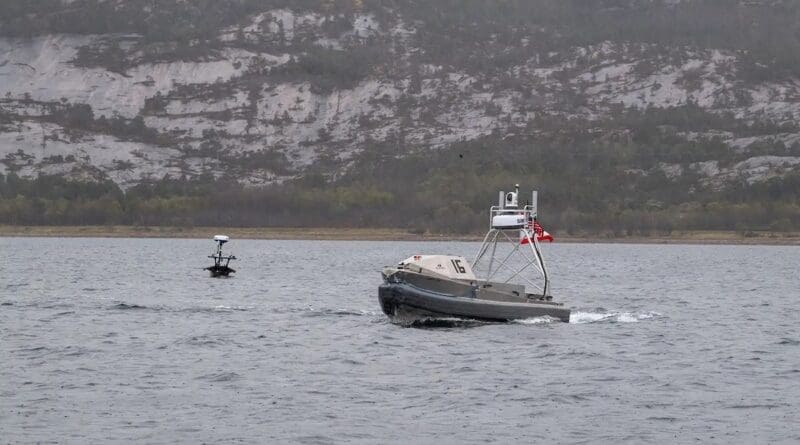
U.S. Navy Tests Maritime Drones With Norway
Key Takeaways
- The U.S. Navy and Royal Norwegian Navy conducted nearly three weeks of Arctic training in May 2026 focused on robotics and autonomous systems. The exercises, launched from Ramsund Naval Base deep inside the Arctic Circle, tested unmanned surface and underwater vessels in extreme cold and rugged conditions.
- U.S. Task Forces 66 and 68 used high-speed and long-endurance drones to detect, identify, and neutralize threats while sharing cold-weather procedures with Norwegian forces. Officials called the collaboration a landmark step in deploying unmanned capabilities for maritime domain awareness and infrastructure protection.
- The drills aim to strengthen NATO surveillance and deterrence in the High North amid Russia’s military buildup. Commanders said the partnership combines Norwegian environmental expertise with American autonomous technology to enhance security from surface to seabed.
The United States Navy and the Royal Norwegian Navy teamed up in the Arctic in May 2026 to test advanced maritime drones in what U.S. Navy Vice Adm. J.T. Anderson called a “landmark moment.”
The NATO Allies conducted nearly three weeks of training in Norway that included explosive ordnance disposal and the evaluation of robotics and autonomous systems (RAS). The exercises launched from Ramsund Naval Base, located about 209 kilometers inside the Arctic Circle — an area known for extreme cold, rugged terrain and challenging underwater conditions, according to the Stars and Stripes newspaper. The U.S. Navy said the “first-of-its-kind maneuvers” with Norway focused on the rapid deployment of RAS.
“We are pushing the boundaries of innovation in the most challenging environmental conditions, proving these technologies can provide a critical defensive edge anywhere in the world,” Anderson, commander of the U.S. Navy’s 6th Fleet, said in a news release. The exercise combined the Norwegian military’s extensive geographic knowledge with U.S. expertise in RAS and expeditionary operations, the news release said.
The U.S. Navy’s Task Force 66 and Task Force 68 participated in the training. All-domain Task Force 66 serves as a forward-deployable headquarters to leverage RAS to promote security for Allies and partners and to ensure freedom of navigation. Task Force 68, which commands Naval Expeditionary Forces in the U.S. European Command (USEUCOM) and U.S. Africa Command (AFRICOM) areas of responsibility (AOR), uses small boats and specialists to protect ports, clear mines, build and repair facilities, and promote safety and security across its AORs. The U.S. forces used unmanned surface vessels (USVs) and unmanned underwater vehicles (UUVs) to “detect, identify and neutralize threats while building on interoperability and sharing cold-weather operating procedures” with the Norwegian military, according to the news release.
Royal Norwegian Navy Commodore Kyrre Haugen, the chief of the fleet, said the exercises will reinforce security and surveillance in the Arctic and High North, where Russia continues its military buildup. “By combining advanced autonomous systems with Norwegian experience in this environment, we enhance both situational awareness and our ability to protect critical maritime infrastructure,” Haugen said.
Those autonomous systems included the high speed Global Autonomous Reconnaissance Craft and the long endurance Lightfish USV. In Norway, the U.S. Navy evaluated how these vessels contribute to maritime domain awareness, particularly in hard to reach areas such as fjords. The Lightfish also completed an autonomous transit of the Taiwan Strait in May 2026, the USV’s manufacturer, Seasats, announced.
“These maneuvers are a critical step in developing our unmanned capabilities in the Arctic,” said Capt. Jeremy Wheat, commander of Task Force 68. “This is no longer science fiction. We are using the most cutting-edge technology to advance how we protect and defend the maritime domain, from surface to seabed.
“Our naval expeditionary partnership with Norway in the High North is built on years of mutual respect and shared experience. This engagement allows us to take this collaboration to the next level.”
- This article was published by Sentry

Like what you read?
Please consider supporting Eurasia Review. Thank you for your consideration!
