
How Pakistan’s Proxy Jamaat-E-Islami Is Dismantling Gender Empowerment In Bangladesh – OpEd
For Bangladesh’s huge female population , the fifteen-year rule of Awami League President Sheikh Hasina had resulted in an era of unprecedented gains lifting up lives of millions.
Dubbed as a model of championing gender empowerment, the rise in female employment spanned across every field, including agriculture, fisheries, ready-made garment industry, informal sector, government-private institutions, or small and medium entrepreneurs.
But the outcome of regime change since August 5 2024 has turned out fatal for fate of women, threatening to undo all the past gains.
In a stark betrayal of his past claims to safeguard the freedom of women, Dr Muhammad Yunus embraced radical Islamists including hardliners emboldening these rabidly radical elements and mounted hate campaign to put a curb on women rights and opportunities for the past fourteen months.
For instance, the Amir of Jamaat-e-Islami, country’ largest Islamist outfit, recently launched a veiled campaign with a statement, ‘If women spend time at home, the government will respect them and if it comes to power, their working hours will be reduced to 5 hours.’
His statement smacking of the party’s patriarchal mindset, has already provoked furious backlash from women groups. also denies the economic reality of the country.
Now the question is – has the Jamaat leader ever asked women what they want? Does the proposal forcing women to stay at home reducing their working hours earn them respect? Has the government agreed to the decision? Also, will male colleagues in the office accept the same number of wages for unequal work? Did the political parties reach the same decision before the election? Will the elected government then accept this decision? The Jamaat-e-Islami leaders choose not to answer.
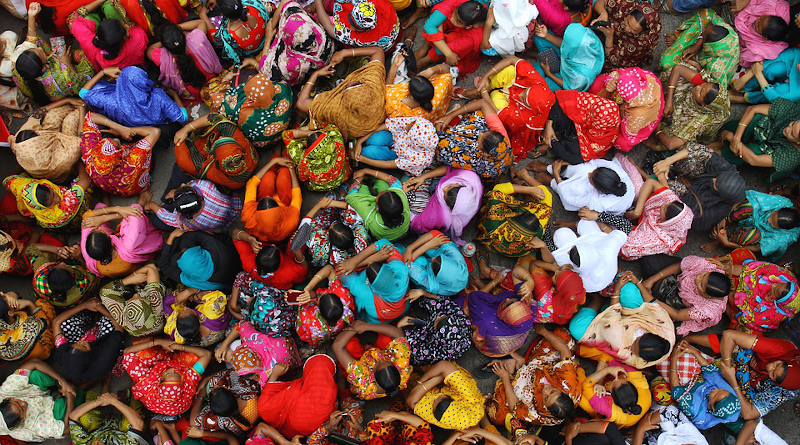
51% of the Bangladesh’s population is women. The number of female voters is more than 62.8 million – a large part of whom work in productive sectors like agriculture, services, small businesses, domestic labor or in the informal sector. Women labor force plays an important role in the country’s economy. About 55% to 60% of the total workers in the ready-made garment industry , the country’s largest foreign exchange earner, are women workers.
According to the Labor Force Survey, 74% of the total female labor force is engaged in agriculture and the same report says that about 97% of women are involved in informal agriculture. According to the Bangladesh Bureau of Statistics, 96.6% of the total working women are involved in the informal sector. The informal economy includes domestic workers, parlor workers, cooks, food vendors, floating hawkers, small shopkeepers, tailors, etc.
Without the large women’s labor in the city, families, offices or service work, public life in the city would come to a standstill.
Even if the working hours of a large number of women in the formal sector were reduced, the same situation would arise.
Rural women’s agriculture and other sectors would also be adversely impacted without women’s labor.
The proposal to return such a large labor force to their homes is therefore not only short-sighted; it is also a decision that would cripple the economy. How will they keep the country’s economy running by excluding these large numbers of women or reducing their working hours is also a big question! On the other hand, each of these working women are also voters. How the Jamaat Ameer made this unilateral proposal without taking the opinion of this huge electorate is also a matter of great surprise. Or does he want to impose his decision by assuming himself as the boss of women?
The family is the unit of society and the state. The main work of keeping the family and home dynamic, including reproduction, maintenance, care, and care, is done by women, who are daughters, sisters, or mothers; without which the work and life of other family members would be impossible.
The monetary value of this silent contribution of women worths BDT 10 lakh 37 thousand 506 crore; which is 78.8% of the total GDP, according to a study by Center for Policy Dialogue (CPD).
The same study also showed that on average, a woman does about three times as much work every day as a man, which is not included in the national income.
The study reveals 12.1 jobs of a woman per day are not included in the national income. In the case of men, the amount is 2.7.
The same picture has been seen in the work of a woman and a man aged 15 years or above in villages and cities. However, due to the lack of remuneration or cash value for this silent labor of women in household work, women are today victims of various discriminations in society and the state. Women’s factory, farm or office work is only included in the GDP. Although this unpaid labor is invisible in the country’s economy, it is essential to sustain society. Statistics show that women spend 3 times more time on unpaid invisible labor. The temptation to give respect to women by giving them time at home is basically nothing but a trap to involve them more in unpaid labor. On the contrary, instructions were needed on how men would spend more time on household labor. There is no room for men to avoid unpaid labor – where the home belongs to both men and women.
According to the proposal of the Jamaat leader, women will be made to work 5 hours instead of 8 hours in the office, and the government will provide compensation for three hours. Although it may seem advantageous on the face of it, in reality it is a trap of gender discrimination. First, if a woman becomes a government employee, will the government subsidize herself? Second, where will the promotion or advancement go? Men work 8 hours, women 5 hours – so how will women survive in the same competition? Who will be considered first during promotion? Thirdly, limiting women’s careers by reducing working hours means keeping women away from future leadership, skills and decision-making processes. Above all, any office will consider men first during the recruitment process – which will further increase discrimination against women in the workplace.
Women have entered the workforce long ago. In both the formal and informal sectors, women’s participation is almost half of the total labor force. In the informal sector, which has surpassed men. Women’s participation and contribution are not only affecting the country’s economy. Rather, at the same time, their share of income ensures the well-being of the family, the maintenance of other family members, the care of elderly parents, and the woman’s self-reliance and financial independence. On the other hand, the children of a working mother grow up to be self-reliant, sensitive, conscious and disciplined. They are responsible from childhood, respectful of each other and aware of the duties of the family. Apart from this, if a large number of women are excluded from the economy or if their working hours are reduced, the imbalance that will be created in the economy will be difficult for a country to handle immediately. On the contrary, a state of homelessness will be created in the economy.
The idea of respecting women by keeping them at home has been rejected in many Muslim societies today. There is also a question about how much such an idea will be accepted by women or voters in today’s Bangladesh. In the current economic reality, the idea of increasing their participation in the economic sector is rather fundamental. For the development of women, that is, the country’s economic development, it is necessary to focus on reducing the domestic burden of women and at the same time taking necessary steps to prevent women from being excluded from the workplace and properly evaluating their work. Therefore, there should be discussion focused on making maternity and paternity leave mandatory, forcing institutions to implement it, creating safe workplaces free of sexual harassment, reducing wage inequality, creating daycares in the workplace and in the neighborhoods (for women in the informal sector), and making a political commitment to eliminate all types of discriminatory behavior against women. Women do not just want to be respected while sitting at home.
They want their economic freedom, freedom to work, fair wages, and a respectable livelihood – not someone’s mercy.
Women should not be deprived of their freedom to work, but should be respected; A dignified life will be established by paying equal wages for equal work – not by reducing working hours.

Like what you read?
Please consider supporting Eurasia Review. Thank you for your consideration!
