
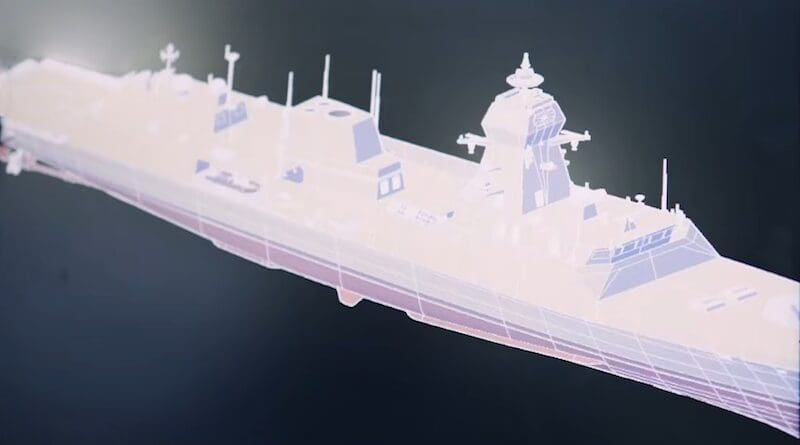
India’s Next Generation Missile Vessels (NGMVs): What Do They Mean For Pakistan? – OpEd
The Indian Navy is in the midst of an unprecedented modernization drive, which includes the commissioning of advanced platforms such as aircraft carriers, destroyers, and submarines through 2035. Amid this, it is giving equal importance to smaller naval vessels with lower displacement and range, such as corvettes. There are two main rationales for the Indian Navy’s newly adopted posture of inducting more Corvettes: to increase the number of vessels capable of operating in littoral and shallow-water environments. Second, India aims to maintain a larger surface fleet in order to enhance its ability to project maritime power and conduct long-range strike operations along the broader regional coastline from standoff distances during operations. All this effort by the Indian Navy is to create a new challenge for the Pakistan Navy, as mobile ships are more complex to engage than static land targets.
Corvettes, although having limited range, payload, and endurance, are potent platforms to conduct missile strikes on the adversary’s coastal facilities in the North Arabian Sea region. Given these capabilities, the Indian Navy sanctioned a new program in 2022 to build six next-generation, heavily armed corvettes indigenously. They are designated as Next Generation Missile Vessels (NGMVs). The first corvette was laid down at Cochin Shipyard in November 2024. All six of them are likely to enter service with the Indian Navy before 2028. They are set to replace the Veer-class corvettes in the Indian Navy. The project’s total cost is expected to be around $1.2 billion if deliveries come on time.
Each NGMV will be crewed by 80 personnel and can reach a top speed of 33 knots. These corvettes can remain at sea for 10 consecutive days and extend their stay by refueling from tankers. The LM2500 marine gas turbine engine will propel the corvettes, enabling a maximum speed of 35 knots. This engine will enable the vessels to remain operational for a longer period, as it requires less maintenance. Moreover, the LM2500 engine is known for generating less noise; therefore, the corvettes will have a low acoustic signature. In addition, they are reported to have minimum Radar Cross Section (RCS) and Infrared Red (IR) signatures.
On the weapon’s side, their primary strike weapon system will be the four BrahMos cruise missiles. The Indian defence ministry has already approved BrahMos missile launchers for the corvettes. The corvettes will have two slant launchers, each capable of carrying two BrahMos missiles. They can be equipped with either anti-ship or land-attack BrahMos missile variants, depending on mission requirements. As they are expected to join the fleet at the end of 2027, the BrahMos missiles integrated with the corvettes will likely have the capability to strike a target at 800 km range, as by then, extended-range BrahMos will be rolled out from their new plant at Lucknow.
To counter airborne threats, the corvettes will have 32 Vertical Launch Short-Range Surface-to-Air Missiles (VL-SRSAM) to intercept incoming sea-skimming anti-ship missiles and aircraft. VL-SRAM has a maximum interception range of 80 km. They will be armed with two indigenously made 30-mm AK-630M close-in weapon systems (CIWS). These CIWS, which can fire 4-5 thousand rounds per second, are considered critical systems for intercepting drones and serving as the last line of defense against sea-skimming cruise missiles. Additionally, the corvettes will be fitted with Very Short-Range Air Defence System (VSHORADS) to supplement the two CIWS systems and defend the vessels against hostile airborne threats.
These ships are being built by the Indian Navy to augment its land attacked and anti-ship capabilities. They will provide relatively low-cost means to engage Pakistan’s surface fleet and coastal facilities; and will operate in littorals and refrain from going out in high seas, which prolongs their endurance. Moreover, it will provide them with protection from submerged fleet because of the Indian Navy new shallow water Mahe class corvettes designed for anti-submarine warfare. The real question is what challenges they pose for the Pakistan Navy? The corvettes can fire BrahMos, whose range is expected to be approximately 800 km. Once operational, these corvettes will provide the Indian Navy with additional long-range strike capabilities against Pakistan Navy. The land-attack version of the BrahMos missile enables these corvettes to threaten Pakistan’s naval facilities along its coastline while remaining close to Indian shores. In addition, Pakistan Navy ships at sea can be engaged at longer ranges through the launch of anti-ship variants of the BrahMos missile.
Pakistan can neutralize these corvettes, by launching air launched standoff missiles like CM-400 and C-802 A. However, as they are already equipped with 32 cell VLS, capable of firing interceptors, and as they will be likely to operate closer to shores in littorals of North Arabian Sea, they will also have air cover from land-based surface to air interceptors. Therefore, conclusively, these corvettes pose a threat to Pakistan’s naval fleet and coastal facilities, and are a serious concern. However, the threat can be mitigated and overcome by employing long-range drones and salvo of anti-ship missiles.
- Muhammad Abubaker is Research Associate, and Komal Khan is Research Officer at Strategic Vision Institute, Islamabad.

Like what you read?
Please consider supporting Eurasia Review. Thank you for your consideration!
