
The Cost Of PR-Driven Industrialization Myths: How Kazakhstan’s Oil-Rented Economic Mirage Ran Into A Black Sea Cul-de-Sac – Analysis
Key Takeaways:
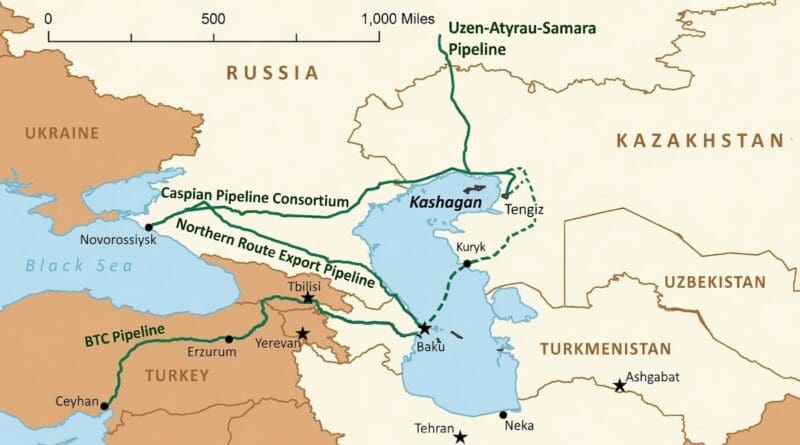
- Kazakhstan remains heavily dependent on the single Caspian Pipeline Consortium (CPC) route to the Black Sea near Novorossiysk, exposing its oil exports to war-zone risks, soaring freight and insurance costs, and potential disruptions that ultimately reduce state tax revenues.
- Efforts at export diversification, particularly via the Trans-Caspian route, face severe geographic, ecological, and geopolitical constraints, including the rapidly shrinking Caspian Sea and Russia’s control over key water inflows, leaving Astana with limited viable alternatives.
- Decades of oil-dependent policies and failed industrialization programs have left the country without a resilient non-resource economy or adequate financial buffers, forcing it to continue high-risk exports through the CPC while facing structural economic pressures.
For over three decades, a landlocked Central Asian giant treated a single pipeline as an eternal guarantee of stability. Now, geopolitical drones and shifting coastlines have brought the bill due.
The Institutionalization of Russian Roulette
In the maritime shipping world, commercial logic usually dictates that capital flees from kinetic conflict. Yet, at the Black Sea marine terminal of the Caspian Pipeline Consortium (CPC) near Novorossiysk, a far more cynical calculus has taken hold. Here, international oil tankers are actively playing a high-stakes game of ‘Russian roulette’, slipping under the loading buoys during volatile windows of relative military calm.
This is not a temporary operational hiccup; it is the new normal. Driven by an unprecedented war-zone premium that has pushed daily maritime freight rates near Novorossiysk to a staggering $338,000 per day, shipowners and Western insurance syndicates are calculating risk with a cold, financial eye. The fleet will continue to sail into these hazardous radar screens until the literal sound of explosions translates into a catastrophic structural or environmental disaster – one large enough to make international maritime clubs permanently strip the region of its insurance coverage. Until that tipping point, the extraction must go on.
The Illusion of the Corporate Shield
For the uninitiated observer, the narrative constantly spun across global media headlines centers on ‘Kazakhstani oil’. This label, however, serves primarily as a geopolitical and diplomatic shield for Western energy majors like Chevron and ExxonMobil. By branding the cargo as Kazakhstani, corporate boardrooms can publicly frame their Black Sea transits as a neutral, humanitarian corridor supporting a landlocked Central Asian nation.
Yet, behind this legal nomenclature lies a severely asymmetrical distribution of financial pain. Under the historic Production Sharing Agreements (PSAs) signed in the 1990s, the crude ceases to be the property of the Kazakh state the moment it passes the fiscal metering stations at the fields. The corporate majors manage the operational hazards, but they do not absorb the financial losses. Instead, they offset the compounding costs of war-zone logistics, soaring maritime insurance, and historic freight premiums directly against their taxable income. Consequently, it is the state budget of Kazakhstan that quietly takes the ultimate blow through severely compressed net tax revenues and a rapidly evaporating resource rent.
The Ecological and Geopolitical Cul-de-Sac
In a reactive mode, the government in Astana has scrambled to deploy what it publicly labels a ‘diversification strategy’. To local observers, this frantic shift in discourse carries a deep sense of déjà vu, mirroring a well-worn phenomenon known locally as Starye Pesni o Glavnom – ‘Old Songs About What Matters Most’. Every major hydrocarbons transportation shock over the last few years has been accompanied by the same pattern: highly publicized proclamations regarding the urgent need to diversify export routes, followed by a quiet return to a near-total reliance on pumping oil through the CPC as soon as the immediate crisis subsided.
Azerbaijani journalist Maksud Salimov, in his article, One Route, One Set of Problems: Why Kazakhstan’s Reliance on the CPC Proved to Be a Strategic Mistake, argues that the Central Asian country’s reliance on a single export channel is a critical failure. “Kazakhstan has still not broken free from a position where a single route dictates nearly all of its exports. This is precisely where Astana’s mistake lies. When a country relies on what is effectively a single operational supply channel, the infrastructure owner begins to dictate terms – either directly or indirectly. Disruptions, restrictions, ‘environmental’ suspensions, and now attacks – all of this automatically takes a toll on the economy of brotherly Kazakhstan. Production has to be cut, revenues fall short, and budget plans must be adjusted. Dependence on a single route turns any external turbulence into an internal problem… Diversification has remained confined to rhetoric, trotted out every time another disruption occurs. As soon as the situation temporarily stabilizes, momentum fizzles out. The result is a peculiar cycle: a crisis hits, loud proclamations about the need for alternatives follow, a return to the single route occurs, and then – a new crisis”, – he says.
To be fair, it cannot be said that Astana is failing to pay serious attention to the Trans-Caspian International Transport Route (TITR) – a corridor championed by advocates like Maksud Salimov. Millions of dollars are currently being funneled into rush-ordering Caspian Sea tankers and financing continuous, emergency dredging operations in the ports of Aktau and Kuryk. To independent observers, however, this looks less like a viable Plan B and more like burying gold coins in rapidly encroaching sand.
The Caspian route is an engineering and ecological dead end. Geographically, the closed basin is evaporating at a catastrophic rate, retreating by up to 20 centimeters annually. Forcing high-intensity industrial oil shipping through heavily dredged, artificial channels in a shrinking sea introduces an unmitigated threat of ecocide to a fragile ecosystem already pushed to the brink.
More critically, the Caspian offers no genuine geopolitical independence. The keys to the region’s hydrological balance remain firmly in Russia, which controls 80% of the sea’s inflow via the Volga river cascade, as well as the primary source of drinking water for Western Kazakhstan via the Astrakhan-Mangyshlak trunk water pipeline and the Ural River. Any aggressive, overt pivot by Astana away from the CPC oil pipeline can be effortlessly countered by an airtight, unassailable ‘environmental’ move from Moscow. Russia needs only to restrict water flow from its upstream reservoirs under the guise of domestic climate preservation – a policy that neighboring Baku, Tehran, and Ashgabat would collectively endorse to protect their own receding shorelines.
A Main Oil Pipeline-Dependent Economy: Why a Series of Industrialization Programs Failed
The vulnerability of this single-pipeline chokehold would be less catastrophic had Kazakhstan utilized its decades of high oil prices to build a resilient, non-resource economy. Instead, the country’s economic history is a saga of heavily funded State Programs for Accelerated Industrial-Innovative Development (SPAIID). Touted as the ultimate cure for the ‘Dutch Disease’, these multi-billion-dollar initiatives evaporated into a Potemkin village of industrialization, leaving the nation as structurally dependent on oil as it was in 1991.
Why did these endless programs finish with virtually nothing to show for themselves? The failure was systemic, driven by three core institutional flaws.
The Trap of State-Directed Capitalism. Rather than fostering an organic, competitive private sector, industrialization was micro-managed from the top down. Billions of tenges were funneled through giant, inefficient state-owned holding companies and development funds. This created an ecosystem of corporate dependency, where projects survived on continuous state subsidies rather than market viability. When the state funding dried up, the projects shut down.
The ‘Ribbon-Cutting’ Indicator of Success. The primary metric of bureaucratic success was the superficial ribbon-cutting ceremony. Regional governors and ministers were incentivized to report the quantity of launched projects to the capital, rather than their long-term economic survival. This structural flaw birthed infamous, unviable ghost projects – from aircraft assembly plants that never manufactured a commercial plane to tablet computer-production facilities that merely repackaged imported components. Success was measured in press releases, not GDP growth.
Institutional Rent-Seeking. In an economy awash with easy oil money, state-allocated industrial subsidies quickly turned into a prime target for rent-seeking. Funds meant for deep technological modernization were frequently diluted through layers of bureaucracy. High-tech diversification requires institutional transparency and long-term capital allocation – two elements entirely incompatible with an elite class operating under an extract-and-export mindset.
The Final Bill for Raw Material Complacency
The overarching tragedy of Kazakhstan’s infrastructure bottleneck is the sheer timing of its arrival. The country has run into this definitive geopolitical wall with an already severely depleted financial cushion. For decades, the high margins of a hassle-free CPC pipeline allowed consecutive governments to avoid making tough, structural choices. The National Fund – originally designed as a sovereign wealth reserve for future generations – was systematically cannibalized even during ‘fat’ years of high oil prices to plug chronic fiscal deficits through targeted transfers and complex state-backed stock-purchasing schemes.
With the primary political and bureaucratic elite responsible for locking the country into this single-pipeline chokehold long retired and living comfortably in Western Europe or the Emirates, the current administration is left to manage a textbook economic checkmate.
Because the multi-billion-dollar reservoirs of Tengiz and Kashagan operate under extreme geological pressure, their skwajinas cannot simply be dialed back or shut down without risking permanent, irreversible damage to the fields themselves. Locked out of alternative routes by nature and neighbors alike, Kazakhstan is trapped in its own history. The nation has no choice but to keep pushing its corporate-owned tankers through the crossfire, burning through its remaining cash reserves, and bracing for an inevitable, structural decline in the domestic standard of living. The long-delayed bill for thirty years of сырьевой лени – resource-rent laziness – has officially come due.
The Final Bill for Raw Material Complacency
The overarching problem of Kazakhstan’s infrastructure bottleneck is the sheer timing of its arrival. The country has run into this definitive geopolitical wall with an already severely depleted financial cushion. For decades, the high margins of a hassle-free CPC pipeline allowed consecutive governments to avoid making tough, structural choices. The National Fund – originally designed as a sovereign wealth reserve for future generations – was systematically cannibalized even during ‘fat’ years of high oil prices to plug chronic fiscal deficits through targeted transfers and complex state-backed stock-purchasing schemes.
With the primary political and bureaucratic elite responsible for locking the country into this single-pipeline chokehold long retired and living comfortably in Western Europe or the Emirates, the current administration is left to manage a textbook economic checkmate.
Because the multi-billion-dollar reservoirs of Tengiz and Kashagan operate under extreme geological pressure, their skwajinas cannot simply be dialed back or shut down without risking permanent, irreversible damage to the fields themselves. Locked out of alternative routes by nature and neighbors alike, Kazakhstan is trapped in its own history. The nation has no choice but to keep pushing its corporate-owned tankers through the crossfire, burning through its remaining cash reserves, and bracing for an inevitable, structural decline in the domestic standard of living. The long-delayed bill for thirty years of сырьевой лени – resource-rent laziness – has officially come due.

Like what you read?
Please consider supporting Eurasia Review. Thank you for your consideration!
