
Securing The South Pacific – OpEd
The South Pacific region serves as a vital defence zone which nations need to protect because it ensures their sovereignty and national survival. Pacific Island nations need to protect their resources from illegal fishing, climate change and geopolitical competition to achieve stability and preserve their independence.
The Pacific Ocean needs maritime governance because its vast size, combined with the economic instability of island nations, is essential to their survival. Resource theft, along with inadequate law enforcement and escalating international political tensions, has established conditions which endanger stability. Resource theft, along with weak law enforcement and rising geopolitical tensions, has established dangerous conditions which endanger stability. The paper demonstrates the immediate need for new security frameworks that focus on sustainability, sovereignty, and solidarity to establish maritime security as the foundation of survival.
The South Pacific region holds the most valuable maritime resources in the world. The tuna fishery, together with other marine resources, serves as the lifeblood for numerous Pacific island nations because it creates food security and generates employment and financial support for their governments. The financial stability of Kiribati and Tuvalu, and the Solomon Islands depends heavily on their agreements with foreign fishing fleets. The Pacific Ocean contains vital seabed minerals, which make the region vital for worldwide energy transition programs. Small island nations protect their sovereignty by controlling their Exclusive Economic Zones (EEZs) because this authority enables them to defend their independence and national identity. Pacific states need to defend their ocean territories because the defence of these waters stands as the fundamental requirement for their survival as independent nations.
Multiple severe threats endanger the security of maritime domains. The following essential problems affect maritime security in the region.
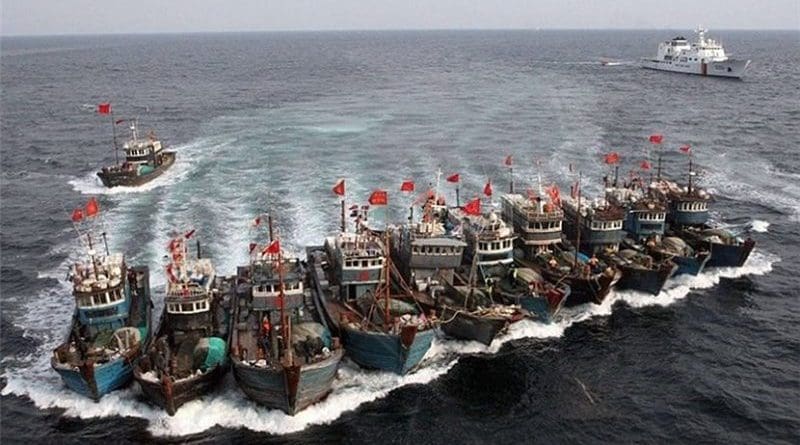
The Pacific Ocean faces three major threats to its security because illegal fishing operations and unregulated fishing activities, and unreported fishing practices deplete tuna populations while creating food security risks and supporting criminal organisations.
Small island nations struggle to protect their Exclusive Economic Zones because they lack sufficient naval power and surveillance systems, and trained personnel to monitor their extensive maritime areas, which forces them to depend on foreign assistance.
The United States and Australia, and China compete for Pacific influence through financial support and infrastructure development, and security alliance formation, while AUKUS and the Quad create indirect effects on maritime governance.
The combination of climate change effects with rising ocean levels and fish population changes, and coral reef deterioration creates multiple challenges for Pacific Island nations to protect their maritime resources and maintain their economic stability.
The permanent environmental damage from seabed mining and resource extraction operations faces economic challenges because of insufficient governance systems.
The Indo-Pacific region sees increasing submarine operations and naval modernisation, which creates military expansion and surveillance competition risks in underwater areas.
The combination of weak maritime infrastructure and vulnerable undersea communication systems makes these assets vulnerable to sabotage attacks and coercion attempts, while cyber threats targeting maritime operations continue to rise.
The wide range of security threats exceeds what Pacific Island nations can handle, so they need to work together for defence because external actors can take advantage of their structural weaknesses.
The Pacific Islands Forum (PIF) has developed two main initiatives through the Niue Treaty to enhance fisheries enforcement cooperation between member states. Operation Kurukuru achieves success through its combined forces, which detect illegal ships while stopping criminal activities through shared surveillance activities. The external partners boost surveillance capabilities through their combined use of patrol boats and training programs, and satellite monitoring systems. The current surveillance systems face two major problems because they lack uniform implementation and they depend heavily on foreign financial support. Foreign fishing agreements lack transparency, which allows governments to select short-term financial benefits instead of safeguarding sustainable fishing methods. The main barrier to success emerges from technical standards and political barriers which stop Pacific nations from fully controlling their maritime security programs.
The upcoming period will bring rising difficulties to the region. The present climate change emergency requires maritime border changes because coastal erosion endangers the existence of Exclusive Economic Zone (EEZ) territorial boundaries. The fish migration patterns shift, and coral reef destruction will create problems for traditional fishing methods and make it more challenging to enforce maritime regulations. The rising need for seabed minerals creates opposition because their extraction activities generate monetary gains through the permanent destruction of marine ecosystems. The Pacific Island nations face an increasing challenge because external powers continue to compete for their support, which threatens to split regional unity. External forces use maritime security to fulfil their goals without considering the safety needs of Pacific community members. The region faces an existential threat because it will run out of natural resources and lose its autonomy unless a new system emerges to address these problems.
A basic change must take place to address these problems. Pacific Island nations need to exchange data while they synchronise their enforcement operations to develop enhanced maritime security capabilities. The protection of maritime infrastructure from climate change requires immediate investment to build systems which will survive environmental disasters. The process to enhance foreign fishing agreement transparency needs to continue because it protects local communities from exploitation while keeping fishing revenue within their borders. Pacific Island nations need to maintain their independence by leading the development of maritime governance standards which protect their sovereignty. Pacific nations need to join forces to develop fresh maritime security standards which will address their vulnerabilities and goals instead of following foreign strategic guidelines.
The South Pacific region faces an urgent need to protect its sovereignty and survival through maritime security measures. The combination of illegal fishing activities with weak enforcement systems and rising geopolitical tensions creates severe challenges for vulnerable Pacific Island nations. The region needs to handle various new challenges because climate change and seabed exploitation will test its ability to adapt. The solution to maritime security challenges requires Pacific nations to build stronger regional alliances while developing climate-resistant maritime facilities and establishing transparent fishing agreements with foreign nations. The South Pacific region will protect its resources and maintain stability through a new maritime security framework which bases its approach on sovereignty and sustainability, and solidarity principles.
The views presented in this article belong to the author.
References
- Singh, P., Linnér, B.–O., & Raj, K. (2025). Marine spatial planning in ocean governance: Fijian perspectives. Frontiers in Marine Science.
- Mizo, R., & Hauger, J. S. (2025). Climate Change and Maritime Security: Challenges and Prospects for Cooperation for the Quad. Asia-Pacific Journal.
- MacMurray, M., Schlieman, L., Kwan, R., Eyler, B., Gruber, C., & Yozell, S. (2025). IUU Fishing Risk Profile for the South China Sea. Stimson Centre.

Like what you read?
Please consider supporting Eurasia Review. Thank you for your consideration!
