
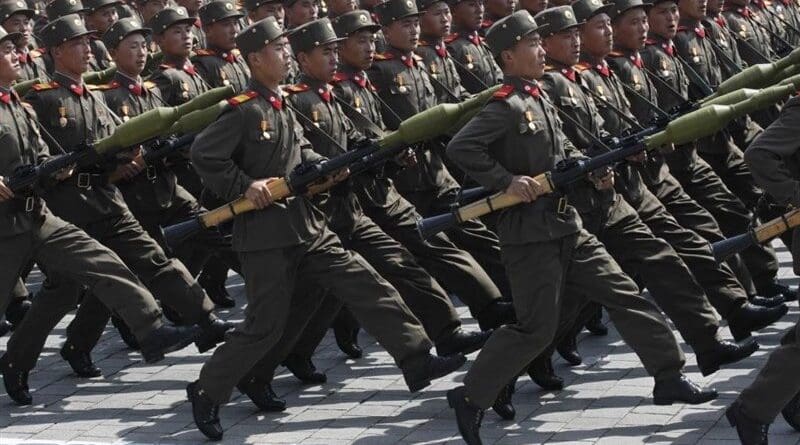
North Korea’s Leap From Isolation To The Battlefield – OpEd
The Ukraine-Russia Conflict has become the most prominent military confrontation of the 21st century, which has stretch far beyond Europe’s borders even reaching as far as North Korea. It has now become a real-time training ground for the North Korean military. The presence of its troops on the Ukrainian battlefield marks an unprecedented shift in the global security landscape, raising urgent questions about the transformation of warfare, the evolution of the Korean People’s Army (KPA), and the implications for East Asian security in particular and global security in general.
Around 11,000 to 15,000 North Korean soldiers have reportedly been deployed in support of Russian forces, marking the largest foreign deployment of North Korean troops since the Korean War. Majority of troops are from the elite Storm Corps, known for their training in infiltration, sabotage, and close-quarters combat. Initially inexperienced in modern warfare, these troops reportedly suffered heavy casualties, some estimates suggest that over 4,000 were injured or killed, with nearly one-third of the initial deployment lost in the early weeks alone.
Ukrainian commanders observed a dramatic shift in North Korean tactics and surprising speed of adaptation. Soldiers who began the conflict relying on outdated, frontal-assault strategies rapidly learned to operate drones, utilize electronic warfare techniques, and adjust formations to minimize losses. Within months, the North Koreans went from relying on rigid, Soviet-era military doctrine to deploying flexible small-unit tactics modelled after Russian Wagner units and adapted to Ukraine’s modern battlefield. Tactical lessons in command decentralization, drone integration, and battlefield mobility could dramatically enhance the KPA’s effectiveness in future engagements. The deployment also offers an opportunity for Pyongyang’s officer corps estimated at over 500 personnel stationed in Russian command centres to understand the tempo, logistics, and joint operations needed for large-scale modern war.
This transformation is more than anecdotal, Ukrainian reports describe North Korean soldiers using innovative battlefield tactics, for instance baiting drones with one soldier while the others track and shoot it down makes battlefield creativity. Their operations generally lacked armoured support and relied on infantry shock tactics small units advancing across mined terrain under fire, often without concern for regrouping or withdrawal. Discipline has raised eyebrows, as troops prefer to kill themselves rather than to be captured, a grim testament to Pyongyang’s military ethos.
The Ukrainian battlefield is proving to be an unparalleled military classroom for the KPA. For decades, North Korean army as believed to be a Cold War relic—large in size but untested in high-intensity conflict. That perception is no longer valid. By participating directly in Ukraine, the KPA exposed to real-time, high-tech, combined-arms warfare. North Korea has reportedly received Russian technical assistance in areas such as satellite reconnaissance, electronic warfare, and advanced surface-to-air missile systems like the SA-22.
South Korean officials are increasingly concerned that the skills gained in Ukraine may be repurposed for future conflicts on the Korean Peninsula. North Korea’s historic lack of modern combat experience has long been viewed as a strategic weakness, but that may be changing.
The nature of this deployment has been interpreted differently across sources. Western reports suggest that many North Korean soldiers were assigned to Ukraine under coercive conditions, including limited consent, use of deployment as disciplinary action, and strict consequences for retreat or failure. These accounts often align with longstanding external assessments of North Korea’s centralized military structure and internal control mechanisms. However, North Korean state media and official statements portray the participation as voluntary and ideologically motivated.
According to Pyongyang’s narrative, the deployed soldiers are driven by the revolutionary ideals of Kim Jong Unare and view their presence on the battlefield as an extension of national duty and solidarity with an allied power. From this perspective, the deployment is both strategic and symbolic, reinforcing loyalty, discipline, and ideological alignment.
The deployment also highlights the emergence of a new military alliance. Alongside Iran’s drone and missile exports and potential Chinese logistical support, North Korea’s direct participation cements its role as a junior but aggressive partner in what could be termed a “Eurasian Axis” challenging the Western-led order. This alliance not only prolongs the Ukraine war but also sends a clear message to Washington, Seoul, and Tokyo that North Korea is not only willing to export weapons but also participate directly in ideological and proxy warfare abroad.
There are also broader lessons here, conflict zones are becoming laboratories for military innovation. Just as drones reshaped warfare in Nagorno-Karabakh and missile defence systems failed under real-world pressure in the Middle East, the participation of North Korean forces in Ukraine demonstrates how even outdated armies can be transformed rapidly. The key lesson is that doctrinal rigidity is fatal; modern war is no longer a contest of steel and numbers, but of adaptation, communication, and multi-domain integration.
North Korea’s involvement in the Ukraine conflict marks a significant shift in its military trajectory. No longer confined to theoretical deterrence or historical legacy, the KPA is now gaining practical exposure to high-intensity, modern warfare. This transformation, driven by real-time adaptation, integration with allied forces, and access to evolving battlefield technologies, may reshape the country’s future posture. Whether this experience translates into greater deterrence, regional assertiveness, or deeper participation in international conflicts, one thing is certain: Pyongyang’s role in global security dynamics can no longer be assessed in isolation from its evolving conventional capabilities. Ukraine may have opened a new chapter, not just for North Korea, but for the nature of asymmetric alliances in modern warfare.
About the authors:
- Sharjeel Afzal is a visiting research associate at Strategic Vision Institute (SVI).
- Kayla Everdeen is a freelance researcher and author.

Like what you read?
Please consider supporting Eurasia Review. Thank you for your consideration!
