
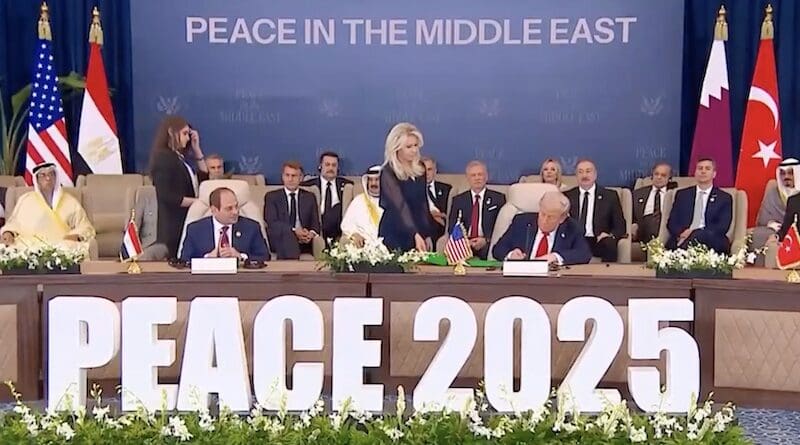
Sharm El-Sheikh Summit Vows Peace Forever – OpEd
It came as a shocking twist at the Sharm el-Sheikh Peace Summit in Egypt, when Israel and Hamas entered into the historic cease-fire agreement in a historic step towards ending one of the bloodiest and longest modern-age world wars. Egyptian President Abdel Fattah El-Sisi and US President Donald Trump embraced the coming together of more than 20 leaders of countries that were resolute in ending wars and establishing stability in the Middle East.
President Trump, signing the document of ceasefire in person, was especially targeted for thanks by hundreds of world leaders such as Pakistani Prime Minister Shehbaz Sharif, who thanked Trump for his “exemplary and visionary leadership” to bring an end to the war. Trump especially thanked Prime Minister Shehbaz and Pakistan’s Field Marshal Asim Munir, among other influential world leaders, at the gala keynote address.
Prime Minister Shehbaz, calling on the importance of the day, referred to it as “one of the greatest days in contemporary history” and extended a warm welcome to President Trump as a “man of peace” whose footsteps had ushered all the change to the world. Shehbaz further said that Pakistan had included Trump in the list of nominees for the Nobel Peace Prize because he had been prompting in settling India-Pakistan’s Kashmir war and the Gaza war. Shehbaz made history and did the unprecedented acknowledgment of the peace-making initiatives Trump had been undertaking in war zones for decades.
The Pakistani Prime Minister also expressed his gratitude to the Emir of Qatar, Turkey, Saudi Arabia, and the United Arab Emirates for playing a special role in hosting the ceasefire. He explained how risky the situation was nothing of the sort was done, things would have gone horribly wrong with India and Pakistan being nuclear powers and the history of hatred-sectarian-insanity in the Middle East.
The first truce deal is the outcome of a desperate series of weeks of diplomatic pressure, culminating at the 80th session of the United Nations General Assembly in New York. The first truce, brokered by President Trump between eight Muslim nations, was a stepping stone to the overall peace deal. The new agreement is accompanied by the introduction of hostage-for-prisoner swaps between Israeli hostages and Palestinian prisoners as a package of confidence in the overall peace process.
His strong visit also involved wide interactions with the remainder of the world’s highest leaders through extensive bilateral meetings, a telling sign of the country’s firm belief in regional peace. These leaders that he met include Azerbaijan President Ilham Aliyev and Armenia Prime Minister Nikol Pashinyan, all who welcomed the strong Gaza ceasefire—a triumphant reminder of peace amidst their former time rivalries.
Shehbaz also received Jordan’s King Abdullah II, Bahrain’s King Hamad bin Isa Al Khalifa, UN Secretary-General António Guterres, Indonesian, German, Spanish, Italian, and Saudi Arabian leadership. He received Palestinian President Mahmoud Abbas and drafted the message of Pakistan’s unflinching support for the Palestinian cause and received Islamabad’s political and moral support to the Palestinian cause.
“Humanity and justice are pillars of our stance,” Shehbaz reasserted. “Pakistan will also continue championing the cause of the Palestinians and by means of peace stop violence and attain rightful rights of the Palestinian nation.”
This round, as usual, does not ever include Israel or Hamas direct representation, both of which have refused to take part. The Israeli government of Prime Minister Benjamin Netanyahu made a release absolutely guaranteeing there were to be no Israeli representatives, and the Hamas officials once again claimed that their participation had been guided through Egyptian and Qatari intermediaries in previous negotiations.
As forceful as that, the conference conveys an extremely powerful message to the world community’s wish to stop violence and bring in eternal peace. It reminds us that multilateral diplomacy, though a matter of abiding suspicion and rivalries, can pay with life-saving dividends and leave windows of opportunity for negotiations.
The tone of Prime Minister Shehbaz echoed the optimistic but cautious sentiment of the summit. He welcomed the peace process as a “substantial step towards eternal peace in the Middle East” and extended thanks to President El-Sisi and President Trump for the vision that made possible the historic moment. He referred to the ceremony as the “closure of a genocidal chapter,” appealing to the world community to see to it that such aggressions never be repeated again.
Shehbaz also invoked Palestinian bravery and strength and promised their ownership of free Palestine on the pre-1967 lines with Al Quds Al Sharif (Jerusalem) as a capital. The speech reaffirms Pakistan’s steadfast policy on the Palestinian cause and sets putting the implementation of international law and justice to a conflict resolution on the horizon.
The conference itself, in picturesque Red Sea resort city Sharm el-Sheikh, was not only facilitated by the ceasefire agreement but also to have been attended by a visiting delegation of global leaders including British Prime Minister Keir Starmer, Italian Prime Minister Giorgia Meloni, Spanish Prime Minister Pedro Sánchez, French President Emmanuel Macron, Turkish President Recep Tayyip Erdoğan, and representatives of the European Council.
Although the path to the future is difficult—with a lot to be resolved, like final status negotiations, right of return of the refugees, security guarantees, and the political fates of Gaza and the West Bank—yet the summit is a triumph of diplomacy. It is a beginning towards future talks and a spark of hope for millions who are stuck in the fire.
Now that the world is in the international limelight, the world’s work is to rally behind this treaty and allow the ceasefire to hold and moves towards total peace. The Sharm el-Sheikh legacy will be one of lives preserved, wounds healed, and long-term peace it can usher into one of the most explosive corners of the world.

Like what you read?
Please consider supporting Eurasia Review. Thank you for your consideration!
