
Pakistan’s Nuclear Program: A Promise Of Peace, Inclusivity, And International Responsibility – OpEd
Nuclear technology has many purposes, but the main aim is to deter adversaries and to produce energy for power production; thus, Pakistan’s commitment to gender equality in this delicate domain is mainly to be commended. The commendation extended by Rafael Mariano Grossi, Director General of the International Atomic Energy Agency (IAEA), during his visit to Pakistan from February 12 to 13, 2025, cited the country’s advancement as the key to its emergence as a responsible nuclear state, an achievement seconded by Ahmed Hashim, IAEA regional representative.
This added value to the appreciation of Pakistan’s nuclear program and its campaign for women’s empowerment, further elevating the country’s status internationally and putting its commitment to prosperity and equality on record.
The South Asian security dilemma was when India and China attained nuclear capability. Pakistan’s pursuit of nuclear capability was pivotal to the deterrence of the existential threats it has been enduring from India since its 1947 independence. Pakistan’s nuclearization, though, was not for any offensive purposes but as a defensive measure for the sake of maintaining deterrence and regional stability. Such a program was to counterbalance the power equation and any aggression in the future at bay, as its goal was to maintain regional stability intact.
Pakistan has established itself even more as a peaceful nuclear nation by keeping stable peace and sustainable principles. Pakistan encourages women in science and technology by fostering gender equality and assisting women in the nuclear industry. Pakistan works cooperatively with the IAEA and the world community to deploy nuclear technology peacefully to combat climate change, health, and agriculture.
Hence, Pakistan is a peaceful and visionary nuclear state that has secured nuclear energy safety, security, and peaceful use, boosting its international status and making the world a more secure place. Pakistan’s nuclear program has won considerable international praise for its adherence to gender parity, particularly from the IAEA. Grossi praised Pakistan’s nuclear power-generating program as the world’s most incredible success story and lauded the work of the Pakistan Atomic Energy Commission (PAEC) and Pakistan Nuclear Regulatory Authority (PNRA).
Pakistan’s nuclear technological successes, notably the IAEA director general’s visit to the Institute of Nuclear Medicine & Oncology in Lahore and establishing a new radiopharmaceuticals laboratory, reflect its determination to deploy nuclear technology for peaceful goals. Pakistan has a nuclear defence policy in conformity with international law on nuclear weapons proliferation, thus establishing its defensive intent. Researchers like Dr. Munir Ahmad Khan are the best representatives of Pakistan, a responsible and innovative nuclear nation committed to peace and sustainability.
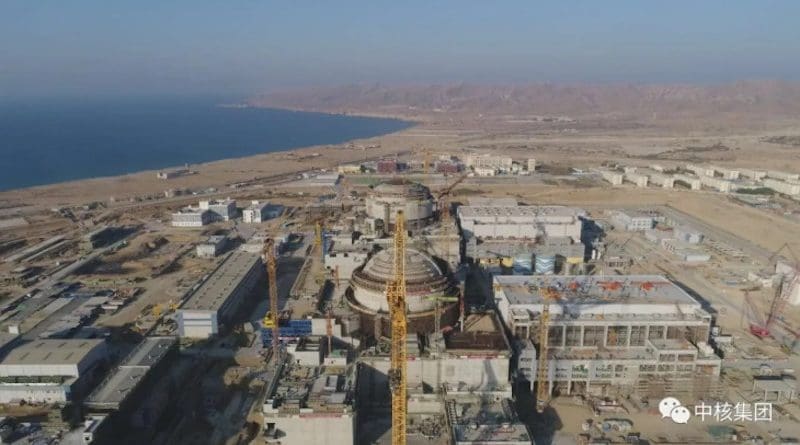
On his tour of the under-construction Chashma Power Plant Unit 5 (C-5) and visit, Director General Rafael Mariano Grossi appreciated Pakistan’s nuclear power program as the finest program in the world. Further, he commissioned a radioactive waste incinerator at the Chashma facility, testing Pakistan’s commitment to nuclear safety and compliance with the proper waste management standards. Pakistan’s staunch commitment to the safe and responsible operation of nuclear activities further underscores its global reputation as a nuclear energy leader.
As a founding member state, Pakistan, since 1957, has been a part of international nuclear decision-making and is under IAEA safeguards. Even though it has not joined the Nuclear Nonproliferation Treaty (NPT), it adopts voluntary safeguard measures and maintains international safety standards. DG Grossi’s comment also helps boost Pakistan’s image as a developed nation with trust in technical breakthroughs, gender equality, and peaceful uses of nuclear technology. Greater participation with the IAEA substantially promotes Pakistan’s international image.
As a result of the volatility of the South Asian environment, Pakistan’s nuclear deterrent is the final guarantee against existential threats, mostly from its arch-rival India. While nuclear facility is vital to ensure regional strategic stability and peace, Pakistan is a proponent of nonproliferation and disarmament. This asks for impartial international action to balance the regional security agenda. Its partnership with the IAEA and dedication to gender equality and technological growth contribute to its international image as a responsible nuclear power. By combining its security goals with devotion to peaceful applications of the atom, Pakistan helps regional and worldwide stability.

Like what you read?
Please consider supporting Eurasia Review. Thank you for your consideration!
