
A Nazi Purge Was Oppenheimer’s Gain – OpEd
Some 6 million European Jews were killed by the Nazis during the Holocaust — the mass murder of Jews, Gypsies and other groups before and during World War II. Soviet Army troops liberated the Auschwitz-Birkenau Death Camp on January 27, 1945, and the day has become known as International Holocaust Remembrance Day. An estimated 1.1 million people, mostly Jews, were killed in the Auschwitz-Birkenau death camp.
Within weeks of assuming power and creating a totalitarian police state in 1933, the Nazi regime began eliminating Jews from government positions, which included many scholars and academics. For example, at the Kaiser Wilhelm Society for the Advancement of Science, a major German research institute, the Nazis dismissed over 100 Jewish scientists.
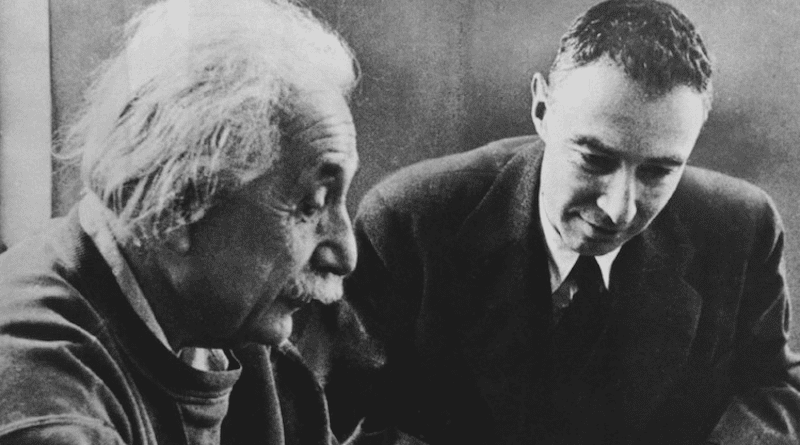
But the Nazi’s loss was Oppenheimer’s gain. Many Jewish physicists fled the anti-Semitic German regime in the early and middle 1930s — including some who saw the writing on the wall and left even before Hitler’s takeover. Albert Einstein, though not part of the Manhattan Project, left Germany in 1932. “[Hitler] limited himself by creating the purge of Jewish physicists before the Manhattan Project got started,” the Atomic Archives’ Griffith said.
Of the 18 physicists working in Germany who would later receive Nobel Prizes in physics 12 were Jewish, and Fermi’s wife was Jewish. All 13 left Germany.
The Nazis lost substantial brainpower, but still had many capable German scientists available to fill roles of the departed physicists. Yet the influx of bright minds into the US and at Los Alamos enhanced Oppenheimer’s ability greatly to deliver an unprecedented bomb that was successful on its inaugural test. It’s not only that the purge of Jewish scientists hindered the German effort, but this emigration massively supported the American effort.
To name just two: Edward Teller was a professor of physics at the University of Göttingen, Teller fled the Nazi regime in 1933 (with aid from the International Rescue Committee). One of the first scientists at Los Alamos, Teller made a number of valuable contributions to the atomic bomb’s development, and he did lots of research into an even stronger weapon: the hydrogen bomb.
Leo Szilard was a scientist at the University of Berlin who filed 29 patents. Szilard fled Germany in the spring of 1933. Szilard was quite aware of the possibilities of nuclear fission: “These might lead to large-scale production of energy and radioactive elements, unfortunately also perhaps to atomic bombs,” he wrote. The physicist played a leading role in producing the world’s first atomic chain reaction with Fermi at the secretive research reactor at the University of Chicago, though he himself didn’t join Oppenheimer at Los Alamos. For many more details see: Germany Without Jews chapter 7 “The Bomb That Went into Exile”
The Holocaust was the last and worst of many attempts to destroy the Jewish People. Most long time oppressed or massacred minority victims give up and disappear. Jews have survived because of their very strong religious commitment to hope in general and the Messianic Age in particular. One well known example is the hope of a 15 year old Jewish girl during the Holocaust: “It’s really a wonder that I haven’t dropped all my ideals, because they seem so absurd and impossible to carry out. Yet I keep them, because in spite of everything I still believe that people are really good at heart. I simply can’t build my hopes on a foundation consisting of confusion, misery, and death.
I see the world gradually being turned into a wilderness. I hear the ever approaching thunder, which will destroy us too, I can feel the sufferings of millions and yet, if I look up into the heavens, I think that it will all come right, that this cruelty too will end, and that peace and tranquility will return again. In the meantime, I must uphold my ideals, for perhaps the day will come when I shall be able to carry them out.” ~Anne Frank”

Like what you read?
Please consider supporting Eurasia Review. Thank you for your consideration!
