
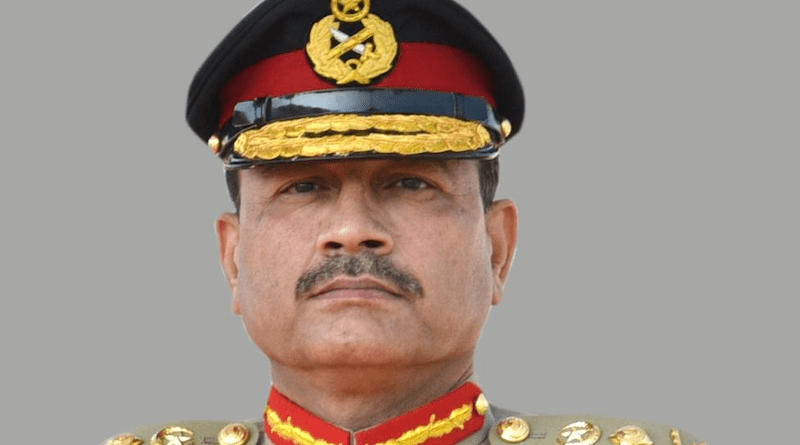
General Asim Munir’s Reckless Gambit: Leading Pakistan To Collapse From War And Terrorism – OpEd
A crumbling regime often looks to war as an option to save itself from public anger. Specially regimes where the military rules directly or indirectly behind a civilian facade. In Myanmar, Senior General Min Aung Hlaing has taken the country towards a disastrous civil war leading to loss of territorial control for the central government over large parts of the country to multiple rebel groups. In Pakistan, the army under the disastrous leadership of its current Chief General Asim Munir has undermined the civilian government and is taking the country towards both an economic collapse and a civil war type situation.
With a battered economy, armed insurgencies in Balochistan and Khyber Pakhtunkhwa, and a furious population losing faith in its military establishment, Pakistan is closer than ever to internal disintegration since the 1971 vivisection that led to the creation of Bangladesh.
To distract his countrymen from this implosion, Munir has resorted to the most dangerous tactic: provoking a military confrontation with India. As they say, war is too important a matter to left to generals. Surely not a reckless general.
The horrific attack on tourists in Pahalgam, Kashmir, on April 22, 2025—masterminded by Pakistan-backed terrorists—was no rogue operation. It was a orchestrated from Rawalpindi, under Munir’s direct and reckless watch. Twenty-six innocent lives were lost in an act designed to incite communal violence and provoke India’s retaliation.
At a time when powerful economies of China, US, Europe and the Middle East are lining up to get a fair share of the huge one billion plus Indian market, Pakistan has ended its trade relations with India. Knowing for a fact that the Sharif brothers always look to India for trading opportunities, it is not difficult to see that the trade shutdown was imposed by General Asim Munir.
As Pakistan’s isolation deepens and its domestic chaos spirals out of control, General Munir has gambled on exporting terror to manufacture nationalism at home. But this is no longer the 1990s. India’s leadership has made it clear: any attack will meet with decisive force.
Munir’s short-sighted desperation risks dragging not just Pakistan, but the entire region, into a wider conflagration. General Asim Munir’s brutal, regressive regime is dismantling Pakistan from within, using terrorism as statecraft, crushing civilian freedoms, and driving the nation toward inevitable ruin. The world must recognize Munir for what he truly is—not a guardian of Pakistan’s security, but the architect of its slow, violent self-destruction.
Balochistan Under Siege
Balochistan today stands as a haunting testament to the brutal methods of Munir’s regime. Instead of pursuing political dialogue or developmental inclusion, Munir has opted for merciless repression. Enforced disappearances, extrajudicial killings, torture, and state-sponsored terror have become the daily reality for Balochistan’s people.
Pakistan’s military leadership is not its strength but its greatest liability. It siphons off the earnings from resources in endowed regions to boost its defence budgets, so that the military leaders can live like lords. This economic deprivation , along with denial of linguistic rights , drove Bengali Muslims to revolt and the creation of independent Bangladesh in 1971. Pakistan may blame India for breaking up the country, ignoring the genocide its army unleashed on the Bengalis that led to 3 million deaths and quarter of a million rapes . So brutal was the genocide that ten million Bengalis, Hindus and Muslims alike, were forced to flee into India at a time it still depended on PL 480 food supplies from US. Then PM Indira Gandhi repeatedly asked US to create conditions for return of the huge refugee population . When that did not happen, India was forced to go to war and the result was independent Bangladesh.
Even after loosing half the country, Pakistan’s generals have not learnt their lessons. Instead of drawing from India’s playbook that prioritises reconciliation through dialogue, Pakistan’s army has repeated the brutal suppression in Balochistan.
Human rights groups allege that in the past two decades, thousands of ethnic Baloch have suffered enforced disappearences at the hands of Pakistan’s security forces—detained without due process, abducted, tortured, and often killed under the guise of countering the separatist insurgency.
The Pakistan government denies these allegations, claiming that many of the missing have either joined separatist groups or fled abroad. Some resurface after years—traumatized, broken, and irreparably scarred—but many are never seen again. Unmarked graves, scattered across Balochistan, reveal bodies so disfigured that they defy identification. Meanwhile, generations of Baloch women endure endless wait for loved ones who just don’t come back.
The Human Rights Council of Balochistan (HRCB) documented 144 cases of enforced disappearances and 46 killings in February 2025 alone. Students, teachers, shopkeepers, and laborers are abducted in broad daylight, vanishing into the military’s black sites. Some reappear, their bodies bearing unmistakable signs of torture; others simply disappear, their families condemned to a lifetime of grief.
House raids, staged encounters, and checkpoint abductions have turned daily life into a nightmare across Turbat, Gwadar, Kech, and Pasni. Munir’s forces do not even spare women and children. Entire villages live in perpetual fear—haunted by the ever-present threat of arrest, torture, or death.
Munir’s strategy is tragically short-sighted – like Yayha Khan and his lieutenants in East Pakistan in1971 . Through state terror, he has radicalized an entire generation of Baloch youth, who prefer death by fighting over getting killed in fake encounters . That has turned a low-intensity insurgency into motivated, widespread and organized resistance—targeting military convoys, Chinese investment projects, and critical state infrastructure. The China-Pakistan Economic Corridor (CPEC), once hailed as Pakistan’s economic lifeline, now exists under constant threat. Not the least because the Baloch youth resent the exploitation of the province’s considerable resources not for its development but to strengthen an army which oppresses them ruthlessly.
Rather than securing Balochistan, Munir’s brutal policies are tearing it away from Pakistan’s national fabric.
Khyber Pakhtunkhwa Falling Apart
The disaster of Munir’s policies is not confined to Balochistan. In Khyber Pakhtunkhwa (KP), too, the state’s writ is collapsing. Once a stronghold of pro-Pakistan sentiment among Pashtuns, KP is now seething with resentment and rebellion.
The Pashtun Tahafuz Movement (PTM), led by Manzoor Pashteen, began as a peaceful civil rights movement but has been met with ruthless military suppression. Instead of addressing legitimate grievances — such as military abuses, land grabs, and enforced disappearances — Munir’s army branded the PTM as traitors. This heavy-handed response has alienated Pashtun youth , who once served Pakistam army with pride, and bolstered demands for self-determination.
In recent months, tensions between police forces and the army have exploded into public view. Police in districts like Lakki-Marwat and Bannu have openly accused army units of colluding with Tehrik-e-Taliban Pakistan (TTP) militants. These officers claim they cannot combat terrorism because the terrorists are shielded by military connections. Public rallies, YouTube videos, and local protests expose a chilling reality: the army under Munir is seen not as a protector, but as a predator.
The KP Assembly recently passed a resolution demanding the court-martial of army officers interfering in politics — a direct slap at Munir and his clique. The PTI’s massive rallies across KP and Lahore underscore that political anger against the army is not going away. Instead, it is growing stronger by the day, fueling an anti-military sentiment that poses an existential threat to Pakistan’s territorial cohesion.
Munir’s policies have taken KP — once a bastion of national pride — and turned it into a powder keg of rage and rebellion.
The Afghanistan Debacle
If Munir’s domestic failures are catastrophic, his foreign policy blunders are even more disastrous. Nowhere is this clearer than in Pakistan’s collapsed relationship with Afghanistan.
After the Taliban seized power in Kabul in August 2021, Pakistan’s leaders celebrated in triumph. Yet under Asim Munir’s stewardship — first as ISI chief, now as Army Chief — this “victory” has turned into a humiliating defeat.
The Afghan Taliban, far from being Pakistan’s obedient proxies, have charted an independent path. They have refused to recognize the Durand Line as an international border, supported Pashtun nationalism, cut off trade routes, and grown closer to Iran. Cross-border skirmishes have become a bloody routine. Pakistan’s historic leverage over Kabul has evaporated.
Munir completely misread the Taliban and underestimated their nationalism. His intelligence background should have alerted him that once in power, the Taliban would prioritize Afghan nationalist sentiment over Pakistani demands. Instead, Munir doubled down on coercive tactics, including aerial bombings inside Afghan territory — actions that have backfired spectacularly, drawing condemnation and inflaming anti-Pakistan sentiment among Afghans and Pashtuns alike.
By isolating Pakistan regionally and alienating Afghanistan, Munir has undermined Pakistan’s security doctrine. Islamabad is no longer the master strategist of South Asia; it is a pariah, hemmed in by hostile neighbors and beset by internal unrest.
The Vicious Vendetta Against Imran Khan
Perhaps nothing showcases Asim Munir’s contempt for Pakistan’s future more than his vicious campaign against Imran Khan, the country’s most popular leader in decades. Khan’s ouster, imprisonment, and the systematic dismantling of his party — Pakistan Tehreek-e-Insaf (PTI) — have exposed the true face of Pakistan’s so-called guardians.
The events since May 9 have been nothing short of catastrophic. Khan’s arrest triggered an explosion of public fury. For the first time in Pakistan’s history, angry civilians stormed military properties, even the sacrosanct General Headquarters in Rawalpindi. This was not mere loyalty to a political figure — it was the eruption of decades of frustration against an army that has fed off the nation’s lifeblood while delivering only humiliation and hardship.
Munir’s response? Brutality. Thousands of PTI supporters arrested, political leaders coerced into defecting at gunpoint, dissent crushed under a boot of fear. It is a strategy ripped from the bloody playbooks of Zia-ul-Haq and Pervez Musharraf, but even more desperate.
Yet Munir fails to grasp a critical reality: the fear that once paralyzed Pakistanis is evaporating. From the tribal areas to the Punjabi heartland, the public is no longer willing to kneel before a corrupt military elite. The idea that brute force alone can suppress a nation on the brink of rebellion is a fantasy — one that Munir clings to as the ground crumbles beneath him.
Pakistan’s Economic Collapse
Pakistan today stands on the brink of complete economic and political collapse. Inflation is strangling its people, debt is unpayable, and the very lifeblood of its agricultural economy — water — is under threat. Yet, instead of focusing on rescuing the nation, the Pakistan Army and its chief, General Asim Munir, are draining government resources for military ambitions, pushing the country even closer to ruin.
Struggling under record 38.5% inflation, a contracting economy, and a dangerous 70% debt-to-GDP ratio, Pakistan is also bracing for catastrophic agricultural consequences. With water flows from India on the Indus suspended after the terror strike in Pahalgam in Indian Kashmir and 90% of food crops dependent on the Indus system, exports like wheat, rice, and cotton are already in jeopardy, worsening Pakistan’s economic nightmare.
Amidst this crisis, General Munir and the military establishment are quietly grabbing a larger share of the strained national budget. Instead of prioritizing food security or debt repayment, billions are being diverted to defense spending. Even as bankruptcy looms, the military focuses on war preparations rather than economic stabilization or famine prevention.
Historically, Pakistan’s military has prioritized its own interests over national development, leading to cycles of dictatorship, corruption, and isolation. The military that failed to keep Pakistan off the FATF’s grey list is now pushing the country toward disaster with reckless military posturing against India.
Tensions flared after the Pahalgam attack, with a surface-to-surface missile test from Karachi’s coast escalating fears. Meanwhile, Prime Minister Shehbaz Sharif appears powerless, as the National Security Committee talks retaliation without addressing the economic free fall.
Despite a $1.3 billion IMF bailout and a $1 billion climate resilience loan, Pakistan’s financial hole remains deep. With $22 billion in external debt repayments due in FY2025 and Fitch Ratings warning of dangerously high financing needs, solvency looks increasingly out of reach.
While Munir plays political games, Pakistan’s economy crumbles. Inflation suffocates families, the rupee collapses, and the stock market crashes. After India’s retaliatory measures, including suspending the Indus Waters Treaty and slashing diplomatic ties, Pakistan’s agricultural and diplomatic isolation has deepened.
The Karachi Stock Exchange plunged 2,000 points initially and continued bleeding, reflecting investor fear. Both the IMF and ADB have slashed Pakistan’s GDP growth forecasts for 2025, underscoring the grim outlook.
Unless Pakistan reins in its military adventurism and radically rethinks its priorities, collapse is not just possible — it is imminent.
Pakistan Running Out Of Friends
Pakistan today stands isolated, crumbling under the weight of its own misrule, and the chief architect of this disaster is none other than the army, led by General Asim Munir. The army has long strangled Pakistan’s political evolution, ensuring that democracy remains a façade.
China, once hailed as Pakistan’s “all-weather friend,” is tightening the noose of debt-trap diplomacy rather than offering genuine support. The so-called China-Pakistan Economic Corridor has become a financial burden, not a blessing. Beijing is now more interested in protecting its investments than bailing out a sinking ship. In fact, China eyes the huge Indian market after its trade war with Trump’s US and is seeking to normalise relations strained after the 2020 border standoff.
The United States, once a major benefactor, has distanced itself and developed a strategic partnership with India to curb Chinese influence in Asia. Saudi Arabia has turned its eyes toward a future with India, leaving Pakistan increasingly irrelevant.
General Munir’s stubborn grip on politics has left Pakistan bereft of friends or legitimacy. Even if tensions with India escalate after the Pahalgam attack of April 2025, Pakistan will find itself dangerously alone — no Arab support, no Western lifeline, and no Chinese rescue brigade.
Meanwhile, Pakistan’s economy is in freefall, with dollar reserves evaporating and sovereign bonds sliding into junk territory. Instead of reform, the generals cling to their privileges — land, money, and power — while ordinary Pakistanis suffer. Under Munir’s watch, Pakistan has shrunk to a shadow of its potential, its GDP per capita far behind India and even Bangladesh.

Like what you read?
Please consider supporting Eurasia Review. Thank you for your consideration!
