
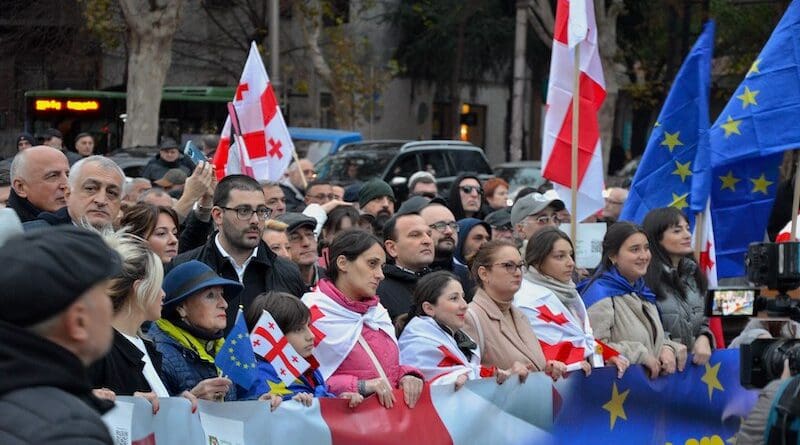
Protests In Tbilisi In The Prism Of Georgian-West Relations – OpEd
More than 320 days of continuous opposition protest in the center of Tbilisi, perhaps the longest and most unusual in form in the 32-year history of an independent Georgian state, display the previously untapped potential of civic activism. Some new political parties have emerged on the wave of the protest composed of the people who have never been in politics before.
The protests initially erupted over the opposition’s disagreement with the results of the 2024 parliamentary elections, but then escalated into a more intense and at times violent phase, following the ruling Georgian Dream (GD) party’s decision to delay Georgia’s European integration process until 2028. At times, grasping the reasoning behind the actions of protesters can prove to be difficult. They call upon opposition leaders, public figures, students, and all supporters of the pro-European agenda to unite, while at the same time showing an unwillingness to incorporate party leaders into their daily rallies. The likely lack of trustworthy new leaders, combined with extreme radicalism and the use of methods that are foreign to Georgian culture, mentality, and traditions, has resulted in a significant decrease in the number of protesters and an increase in their detractors.
The GD, which has retained power for a fourth consecutive term, steps up preventive and punitive measures to avoid further escalation of the protest. The GD claims that the protests are largely supported and orchestrated by external actors. Some Western actors, especially in the EU, have willingly or involuntarily confirmed this. On October 25, Erik Ottosson, the Chairman of the Swedish Parliament’s Committee on EU Affairs, who previously suggested that it was permissible to overthrow the government in Georgia through a revolution akin to the “Maidan,” reiterated in a video message his “unwavering support” for the ongoing protests on Rustaveli Avenue, describing it as a “beacon of hope for Georgia’s future.” The chairs of the committees on EU and European Affairs from the parliaments of Slovakia, Poland, Latvia, Luxembourg, Austria, Estonia, and Finland also participated in the video message. Additionally, several other high-ranking officials from Lithuania and Sweden expressed their support to the protest.
Earlier, Elina Valtonen, Finland’s foreign minister, who visited Georgia in her role as chair of the Organization for Security and Co-operation in Europe (OSCE) demonstratively joined the anti-government rally on Tbilisi’s main avenue, Rustaveli and publicly expressed support for protesters in front of the Georgian parliament. GD considered this step as a specially planned adversarial act. Valtonen’s planned meeting with Georgian Prime Minister Irakli Kobakhidze was cancelled. Moreover, Valtonen was fined €1,600 for “blocking the road,” a penalty that is frequently imposed on anti-government protesters. This was the first precedent of its kind in relations between Georgia and the OSCE and the European Community in general. This serves as yet another sign of a developing shift in the relationship between Georgia and the EU. Even earlier, the European Parliament, the OSCE Parliamentary Assembly, and the Parliamentary Assembly of the Council of Europe passed strongly critical resolutions regarding Georgia, which included the call for new elections. By taking this action, they effectively endorsed the requests made by the Georgian opposition along with its associated civil sector representatives and activists.
The current socio-political “equilibrium” in Georgia, often not completely grasped by the Western establishment, leads to their misunderstanding of the fundamental nature of Georgian realities.
A significant portion of the Georgian population is naturally cautious about the aid that local NGOs receive from foreign sources, irrespective of the source or intended aim of such assistance. The GD government adeptly capitalizes on these sentiments prevalent in the predominantly conservative Georgian society. Georgian western-funded NGOs have yet to refute the documented evidence aired by the pro-governmental Imedi-TV. They showed that the EU funds are still flowing to the Georgian NGOs, in evasion of the Georgian version of the US Foreign Agents Registration Act (FARA), and amendments to the grant law, according to which local NGOs can receive external grants only with the consent of state structures. Imedi-TV asserted that it had revealed a ” “detailed scheme” regarding how around one million euros allocated as a grant to the local NGO, the Georgian Center for Psychosocial and Medical Rehabilitation of Torture Victims (GCRT), intended for medical assistance and psychosocial counseling, was in fact utilized to support anti-government protests.
After the failure of the “pro-European forces,” as they are named in the West, to achieve the power change in Georgia, the EU probably decided lay out its new, perhaps the last “trump card.” The EU structures and their speakers openly warn to suspend Georgia’s visa-free travel, introduced in 2017, due to the GD’s policies, which Brussels deems unacceptable.
The GD believes that this action by the EU is aimed at assisting its allies in Georgia and encouraging greater participation in protests, with the expectation that a significant number of Georgian citizens will wish to maintain the visa-free arrangement with the EU. In contrast, recent surveys reveal that merely 22% of Georgian citizens take advantage of the benefits provided by the EU’s visa-free travel policy.
Given the country’s socioeconomic situation, even this figure appears somewhat inflated. Nonetheless, the use of the termination of the visa-free travel arrangement by Brussels as a means of exerting pressure on the country to obtain concessions has started to generate dissatisfaction among a considerable segment of the population, who view this action as unfair to Georgia. The GD authorities, for their part, are stoking these sentiments by citing infringements of the country’s sovereignty.
It’s worth noting that, amid mounting pressure from the EU, the Donald Trump administration, unlike the previous administration, has sharply reduced its criticism of the Georgian Dream’s actions. However, there have been no significant positive developments in Georgia-US relations, except for the failure in the US Senate, the MEGOBARI Act, which includes sanctions against GD representatives. The GD’s calls for a “reset of relations” remain unanswered. Most likely, the US is expecting counterproposals from the Tbilisi. Relations with the US are extremely important for Georgia, and therefore the current situation, resembling a tug-of-war, cannot last long.
Up to this point, the protests from the opposition and the pressure exerted by their Western allies have not yielded politically acceptable outcomes for them. The GD is weathering blows that are not yet strong enough to induce concessions. Personal visa and financial sanctions on a limited number of government officials and restrictions on high-level contacts are unlikely to force the authorities to comply with the West’s demands. If the GD were to do so, it would have to answer to its voters. They already have a slew of unflattering questions for the ruling party, including the recent crackdown on former GD leaders on corruption charges.
It should not be forgotten that within the EU structures and among its member states, there are those who think rationally, not based on the political narratives fed to them by the Georgian opposition and its lobbyists. The abolition of the visa-free regime and other additional punitive measures could exacerbate already growing Euroskeptic sentiments in Georgia, opening up opportunities for Russia to increase its influence. Most importantly, the EU does not yet have strong evidence that Georgia’s 2024 parliamentary elections were rigged.
Throughout the protests, from October 2024 to the present day, the opposition positioning itself as “pro-European” as well as the youth-led civic protest participants has demonstrated its political shortsightedness. On October 4, after the conclusion of the local elections, the radical wing of the opposition launched yet another unsuccessful attempt to overthrow the government through a “color revolution,” storming the presidential residence. After seizing it, they planned to build on their success and complete the dismantling of the government that same day. Imprisoned former President Mikheil Saakashvili actively provided the “revolutionary committee” with recommendations and, according to some reports, was even involved in the process, as was another former president, Salome Zourabishvili. She publicly distanced herself from this undertaking, but only after its failure. The failure of the attempt to overthrow the government plunged the current opposition into political disarray. It appears that it is beginning to lose the West’s trust, which is vital for it. Crucially, both the opposition and the newly formed civil movement have failed to present an alternative and viable choice to the Georgian voters, including protest electorate. The widely held belief that Georgian society is pro-European and seeks EU membership, has already outlived itself. In the 2024 parliamentary elections the opposition’s campaign slogan “Europe or Russia” was notably overshadowed by the GD’s slogan “Peace or War.”
Conclusion
The GD is well aware that it is unlikely to remain in power for a fifth term, as some of its leaders have hinted. The West cannot accept that there has been no change of power in Georgia for 12 years, as they are used to seeing in Western democracies. Based on this, the GD will attempt to purge the political field as much as possible of the UNM, its subsidiary and affiliated parties, and fill the vacuum with what they call a “healthy opposition.” In this way, the GD is also attempting to protect itself, to some extent, from the rise to power of forces seeking revenge against the GD through political score-settling. This is one of the reasons for the GD’s decision to ban the aforementioned parties through a lawsuit in the Constitutional Court, based on the findings of the temporary parliamentary commission charged with investigating and assessing the eight-year rule of the UNM. Should these parties be prohibited, the West is very likely to lose its longstanding political allies in Georgia. This, combined with the diminishing influence of another key supporter – Western-funded NGOs, would represent a significant setback for Western interests in Georgia. Furthermore, it is probable that, alongside the GD’s efforts to regulate the entry of new participants into the political arena, the West will also seek to introduce new players under its influence into the political landscape to establish a new foundation for itself.
The West’s unwillingness to react to or condemn the opposition’s attempt to overthrow the GD government on October 4, with some Western officials even accusing the GD itself of staging a coup, is a clear indication of the current state of Georgia-West relations. Meanwhile, the GD continues to portray the West, especially the EU, to be organizer of the failed coup, exacerbating the crisis in relations.
Unwilling to completely burn bridges with the EU and the US, which would be extremely imprudent, given Georgia’s multifaceted vulnerability, the Georgian Dream is attempting to build a so-called multi-vector policy with elements of “sovereign democracy.” With the Georgian Dream in power, the EU will be unable to achieve greater confrontation between Tbilisi and Moscow and more active support for Ukraine, as many in the West desire, given their stated goal of “inflicting a strategic defeat on Russia.” However, in the West, the Georgian Dream is often baselessly accused of rapprochement with Russia. These accusations are often based on perceptions rather than credible facts. There is no discernible trend supporting Georgia’s return to Russia’s fold.
Against the backdrop of the geopolitical standoff between the West and Russia, including in the South Caucasus, isolating Georgia and pushing it out of the Associated Trio for EU integration (Ukraine, Moldova, and Georgia) would be politically short-sighted. It would be far more beneficial to restore dialogue to find mutually acceptable solutions. The Georgian Dream has already proven its flexibility when necessary.
Without abandoning the policy of “sovereign democracy,” the GD will strive to build transactional relationships with the US and the EU, creating an institutional framework in the form of agreements on various areas of cooperation, without which relations cannot develop in principle.
The influence of Bidzina Ivanishvili, founder of the Georgian Dream party and now its honorary chair with wide functions, has and will continue to have a significant, if not decisive, role in Georgia’s domestic and foreign policy in the medium term, particularly in its relations with the West. Ivanishvili’s attitude toward the West took a negative turn when informal sanctions were imposed on a significant portion of his assets in the West. This coincided with the Georgian leadership’s refusal to participate in Western sanctions against Russia following the outbreak of the war in Ukraine and Western attempts to change the Georgian government through local pro-Western proxy groups.
Ivanishvili’s public letter before the local elections, and his speech after the Georgian Dream’s landslide victory, were permeated with anti-Western rhetoric. He accused Georgia’s partners, naturally meaning the US and the EU, of imposing values alien to the nation and taking steps detrimental to Georgia, emphasizing the Georgian Dream’s role in strengthening national independence and sovereignty. He portrayed Georgia as a target for Western attacks. In this way, Ivanishvili further reinforced Western perceptions of himself as a hindrance to Georgia’s European integration and as a sole ruler. His domestic and foreign opponents have long accused him of “state capture.”
Having consolidated power at all levels, Ivanishvili is seeking recognition from the West of current realities and an end to Georgia’s international isolation, including recognition of the results of the recent elections. Furthermore, Ivanishvili is likely seeking the lifting of informal sanctions on his assets in the West. Some might consider this to be a political bargaining with the West, which is entirely natural in the current unstable situation. Figures of Ivanishvili’s caliber, despite having taken certain risks and put his own well-being on the line, still require more or less solid guarantees from the West. Ivanishvili is not directly calling for a departure from the pro-European course. He merely speaks of the unacceptability of vassal relations with the EU and the US. His policy toward the US, the EU, China, and Russia is likely based on a sincere desire to make Georgia a truly sovereign and self-sufficient state. But there are also purely personal and business interests—reclaiming his assets and protecting his business empire from Western sanctions. Therefore, in the foreseeable future, the GD and Ivanishvili may have to adjust their current political course. On the other hand, if one acknowledges the reality of the “G-Zero” system – a highly precarious and unstable world devoid of any single power or coalition of powers able to lead on global issues and establish the global agenda, the policy of the “Georgian Dream” appears to be more than warranted.

Like what you read?
Please consider supporting Eurasia Review. Thank you for your consideration!
