
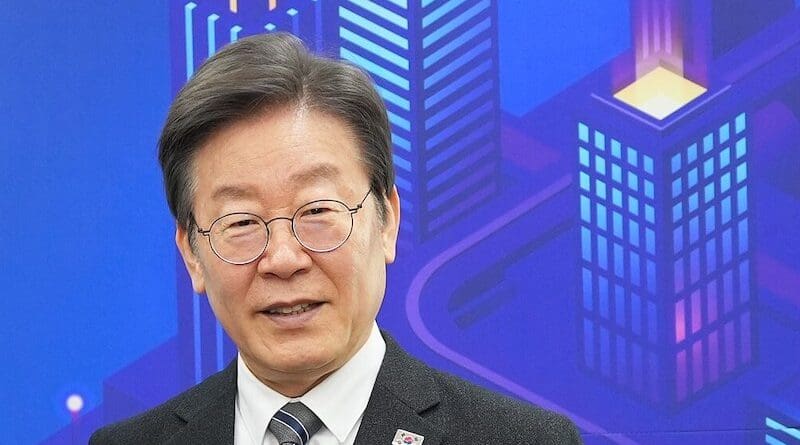
Lee Jae-Myung’s Inter-Korean Gamble: Reviving Sunshine In A Nuclear Age – OpEd
Inter-Korean relations in early 2025 are characterized by a delicate balance between détente and hostility, influenced by Pyongyang’s nuclear ambitions and Seoul’s intricate alliances. Lee Jae-myung, the leading contender in South Korea’s snap election on June 3, has revived the Sunshine Policy, which promotes dialogue and cooperation with North Korea. He aims to restore engagement following the unprecedented decline of inter-Korean trade to zero for the first time since 1989.
With estimates suggesting that North Korea could possess enough fissile material for up to ninety nuclear warheads by 2025, Lee Jae-myung’s vision seeks to revive the Sunshine Policy’s ethos of engagement. However, it must contend with a significantly transformed geopolitical landscape characterized by Pyongyang’s enhanced nuclear capabilities and strained relations with the United States, Japan, Russia, and China.
Lee has proposed a practical approach for engagement, suggesting the resumption of reunions, family aid, humanitarian and cultural exchanges, and the establishment of special economic zones in the Demilitarized Zone to promote mutual development. He stresses the importance of trilateral coordination with Washington and Tokyo, advocating for security guarantees through parallel dialogue while scaling back provocative drills like Freedom Shield to foster trust. His chief adviser contends that a measured suspension of certain joint exercises could facilitate incremental denuclearization talks and lead to reciprocal sanctions relief. Lee’s platform also features joint infrastructure projects, including rail and energy links, reminiscent of the economic foundations of the early 2000s. Additionally, the policy incorporates modernized monitoring and verification mechanisms to ensure compliance and minimize the risk of sudden policy reversals.
North Korea’s nuclear capabilities at sea have significantly heightened security concerns. In April 2025, state media announced the launch of the Choe Hyon-class 5,000-ton destroyer, designed to carry nuclear-capable ballistic and cruise missiles. This development signals Pyongyang’s ambitions to expand its naval reach. Additionally, experts estimate that North Korea has enough fissile material for up to ninety warheads and has conducted over a dozen tests of ballistic missiles, including solid-fueled ICBMs and hypersonic missiles, since 2024. Furthermore, Russia’s assistance in missile technology has raised additional concerns about the proliferation of submarine-launched ballistic missiles (SLBMs). These developments make conventional deterrence precarious, highlighting the challenging task Lee faces in advocating for denuclearization as a prerequisite for deeper engagement.
Amid these threats, the United States and South Korea reaffirmed their alliance through extensive military drills. From March 10 to 20, 2025, Exercise Freedom Shield 19000 mobilized South Korean troops and engaged in multi-domain operations, including strategic B-1 bomber flights. During these drills, Patriot Advanced Capability-3 interceptors deployed at Camp Humphreys demonstrated the alliance’s layered defense posture. Lee has publicly reaffirmed the “iron-clad” U.S. security commitment and advocated for a phased return of wartime Operational Control (OPCON) to Seoul, reflecting his desire for greater sovereign control. Public debate over the financial burden of joint exercises and concerns about sovereignty highlight the delicate balance Lee must maintain between deterrence and domestic accountability.
Lee’s strategy must also address broader regional dynamics. In 2025, Japan approved a record defense budget of ¥8.7 trillion (approximately $55 billion) to enhance its strike-back and missile defense capabilities in response to threats from North Korea and China. NATO Secretary-General Mark Rutte recently accused Russia of supplying North Korea with advanced missile technology in exchange for combat support in Ukraine, underscoring Moscow’s role in strengthening Pyongyang’s strategic programs. Meanwhile, South Korea is facing challenges from the U.S. trade war, as both countries impose tariffs exceeding 100 percent on each other’s goods, jeopardizing Seoul’s export-dependent economy. Lee must reconcile engagement with objectives, address the associated imperatives, and coordinate the realities of great-power competition.
South Korea’s economy plays a significant role in Lee’s strategy. In 2024, exports rose by 8.2 percent, reaching a record $683 billion, driven primarily by semiconductors. However, the economy contracted by 0.3 percent in the first quarter of 2025. Rating agency Fitch has revised its growth forecast for South Korea in 2025 down to 1 percent, highlighting the urgent need to stabilize trade while also pursuing inter-Korean engagement.
Implementing this vision requires overcoming significant obstacles: North Korea’s strategic reliance on deterrence, the presence of nuclear weapons, and comprehensive UN sanctions that restrict economic and political engagement, as well as domestic divisions in Seoul. Confidence-building measures must be reciprocal, such as monitored suspensions of long-range missile tests in exchange for targeted sanctions relief and humanitarian aid corridors.
However, Pyongyang has historically rejected incentives that do not involve denuclearization, security guarantees, and substantial concessions. Conservative factions in South Korea often criticize any concessions as acts of appeasement. Opportunities do exist: joint infrastructure ventures could leverage Seoul’s advanced technology in areas such as rail, energy, and agricultural trade, which could also address humanitarian needs. The feasibility of Lee’s approach ultimately depends on his ability to effectively synchronize diplomacy, multilateral efforts, and domestic consensus.
In conclusion, Lee Jae-myung envisions bridging decades of division by integrating conditional economic engagement with strategic safeguards. By reviving the principles of the Sunshine Policy, he seeks to lower barriers to dialogue through confidence-building measures, which could facilitate denuclearization talks. His emphasis on trilateral cooperation with the United States and Japan aims to balance engagement efforts with credible deterrence in response to an increasingly assertive North Korean regime. However, the success of this approach depends on Pyongyang’s willingness to reciprocate and the stability of South Korea’s domestic politics. If these elements align—targeted infrastructure, partnerships, and humanitarian initiatives—they could provide tangible relief and gradually build trust. However, without this alignment, Lee’s visionary blueprint may struggle to go beyond its aspirational status and achieve a sustainable resolution to the conflict on the Korean Peninsula.
The opinions expressed in this article are the author’s own.
References
- Kim, S. S. (Ed.). (2004). Inter-Korean Relations: Problems and Prospects. Palgrave Macmillan.
- Chubb, D. L. (2014). Contentious Activism and Inter-Korean Relations. Columbia University Press.
- Lim, D. (2012). Peacemaker: Twenty Years of Inter-Korean Relations and the North Korean Nuclear Issue. Stanford University Press.

Like what you read?
Please consider supporting Eurasia Review. Thank you for your consideration!
