
The Horn Of Africa States: The Impact Of Trump Tariffs, Challenges And Opportunities – OpEd
Trade policies and tariffs are some of the main tools the Trump administration uses to reduce trade deficits and encourage and/or protect American industries. The United States used the same tools to protect its agriculture and industry during the Great Depression in the 1930s, but this only led to retaliatory tariffs from other countries. The earlier Trump administration did not succeed to change the course of world trade despite the tariffs it imposed then. There is no indication it will succeed this time either in improving its trade imbalances, but it will certainly be disruptive.
However, one must note that it is one of the tools of governments to influence trade responding to trade imbalances, and the USA is no different in this regard. Governments sometimes use tariffs to raise revenues and most often to protect some industries. But tariffs can have intended or unintended consequences. Generally, despite some brief immediate gains, broader economic growth is negatively affected by the imposition of tariffs, as the cost of imports increase, which often sparks retaliatory measures by other trading partners. There is always a tit-for-tat process which benefits neither party. This time, it is one country against the whole world!
We examine in this article if and how the Trump tariffs will affect Africa and more specifically the Horn of Africa States region, and the challenges and opportunities therein for the great continent and the region in particular. The tariffs on imported steel and aluminum products from countries like South Africa may be affected, while indirectly tariffs on targeted Chinese products may affect African economies reliant on large imports from China. Since China appears to be the main target of the USA tariffs, raw material imports of China from Africa may also be reduced, as its economy gets impacted.
The African Growth and Opportunity Act (AGOA) enacted in year 2000 has been a key pillar of US Africa trade relations with the continent for years now. It allows eligible countries duty-free access to the U.S. market. This involves some 1800 products on and above the 5,000 products that are eligible for free access under the Generalized System of Preferences program.
All the countries of the continent will be affected. Lesotho’s textile industry would be hit by a tariff of 50% import tax, with Libya at 31%, Madagascar at 47%, Botswana at 37%, Mauritius at 40%, and South Africa at 30%, while the countries of Ethiopia, Kenya and Ghana will face a 10% tariff tax. Those with the 10% tariffs are said to be where the USA does have a positive trade balance. Does this portend the end of AGOA? No one knows, but certainly, this is food for thought for the continent, especially its Sub-Saharan region, which was the beneficiary of the AGOA.
Many countries have benefitted from the AGOA, most notably Lesotho, the small South African country, which exports most of its textile production to the United States. The bigger economies of Nigeria and South Africa have also benefitted from the program.
Products that have found their way into the US market through AGOA included not only textiles, but also cocoa products, wine and even crude oil.
As of last year, 2024, thirty-two countries from Sub-Saharan Africa were eligible. In 2023, the two-way trade between Africa and the USA under AGOA reached US$ 47.5 billion with the US exporting US$ 18.2 billion to and importing US$ 29.3 billion from the continent (BBC Report on April 4th, 2025).
While some countries would definitely suffer from the tariffs, the continent, in general, may only move its global trade to other regions of the world including China, India, and Europe as key potential partners. Intra-African trade may also increase with countries providing products to each other from within the continent, through the new African Continental Free Trade Area (AFCFTA), which aims to reducing on relying on foreign markets. It is certainly a call for diversification and non-reliance on only one country as a trade partner.
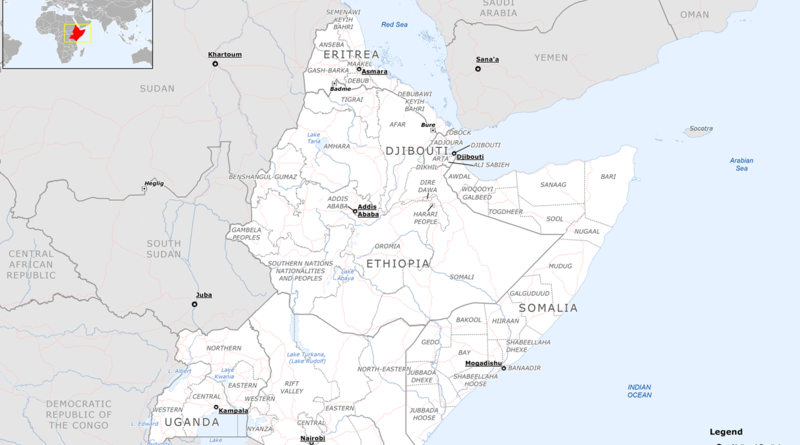
The Horn of Africa States is, as usual, caught in a crossfire. It has neither control nor a preventive process to shield itself from the chaos in the upcoming economic storms. The price of goods will generally rise which will affect its already crippled economies. Ethiopia, the largest economy in the region will now face the 10% US tariffs and since Somalia mostly imports its livelihoods in terms of food, building materials, cars, machineries, pharmaceuticals, clothing and everything else, it will have to pay higher for every item imported. This not a hypothetical issue but a reality in place.
The region depends on other countries to take care of it through aid and other processes, which will definitely be reduced because of the looming trade war among the countries that were supplying the aid, namely the Americas and the European countries. This would have an impact on the populations of the region who mostly rely on humanitarian aid, as their governments fail them every day.
This may exacerbate the continuing conflicts in the region, which would, no doubt, increase the region’s already precariously dangerous political situations as both food prices rise and jobs dry up and fighting among politicians and government wars with terror groups and mercenaries increase.
It is most unfortunate that the leaders of the region are more involved in their own survival through any means and that they do not and would not attend to the needs of their populations. For some leaders it appears to be already too late and too little for anything to be done about their fate, which appears to have been sealed by their own mistakes over the past several years.
The civil wars blazing in the region do not portend well for the region. This is aggravated by the continuous unwarranted call of Ethiopia to have access to a sea and its denial to accepting its landlocked state. It could have worked with all the countries of the region in peace, but it has only antagonized each and every one of them. This is not with respect to the governments of the region which may be close to Ethiopia for their own survival processes but it is the population antagonisms that this is recreating again!
The Horn of Africa States region is geostrategically located on the southern banks of the major Indian Ocean/Suez canal waterway. The continuing disruptions of this waterway caused by troubled Yemen on the other side would have negative impact on the region as competing trading blocks vie over their presence in the region – the United States and China and even Arabia of the Gulf, Iran, India and Russia.
The region does not only face an economic and trade issue, but some of the countries of the region do face an existential challenge. Ethiopia is in a terrible civil war which is about to break the country into its multitude of nations, while Somalia faces terror groups that appear to have re-invigorated themselves. Eritrea is wary of an Ethiopia which is looking at breaking into the sea through force or otherwise, as a means of assuring itself of its survival as a state and Djibouti, the smallest country in the region, is looking at all these treacherously surrounding countries, with trepidation.
The tariffs of the Trump administration are only a part of the forces that will impact the region and only act as a further pressure on an already negatively affected region, barely able to survive through the bad leaderships, it has thrown up over the past few decades. It is difficult to see the region shaping its narratives, which appears to be in the hands of others, in distant lands.

Like what you read?
Please consider supporting Eurasia Review. Thank you for your consideration!
