
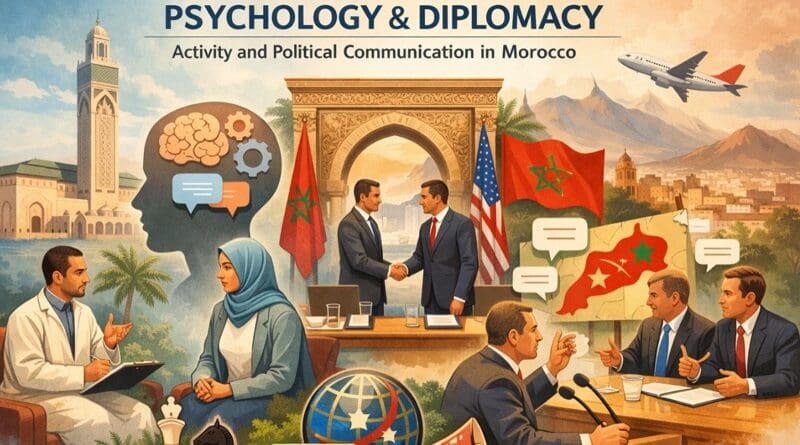
Psychology And Diplomacy: Activity And Political Communication In Morocco – Analysis
This article examines the intersections of psychology, diplomacy, and political communication within the Moroccan context, exploring how psychological frameworks inform diplomatic strategies, shape political discourse, and underpin the construction of national and royal authority. Drawing on political psychology, communication theory, and diplomatic studies, the analysis situates Morocco within broader debates about authoritarian resilience, monarchical legitimacy, and state-society relations in the Arab world. The article argues that Morocco’s distinctive model of governance relies on a sophisticated interplay of symbolic capital, emotional appeals, and strategic ambiguity that renders psychological analysis essential for understanding Moroccan foreign policy behaviour and domestic political communication. Particular attention is given to the Hassan II and Mohammed VI eras, to Morocco’s bilateral and multilateral diplomacy, and to the communicative construction of the ‘Commander of the Faithful’ identity as a psychosocially stabilising institution.
1. Introduction
Political psychology and diplomatic studies have long occupied adjacent intellectual territories, yet their systematic integration remains an underexplored scholarly endeavour, particularly in non-Western contexts. In the case of Morocco, a constitutional monarchy that has navigated decolonisation, Cold War rivalries, regional turbulence, and the convulsions of the Arab Spring with remarkable institutional continuity, the psychological dimensions of statecraft deserve sustained analytical attention. Moroccan governance draws deeply on affective structures—loyalty, reverence, fear, and pride—that condition both elite behaviour and mass political attitudes. These affective structures, in turn, shape the communicative repertoires of diplomats, royal spokespersons, government ministers, and state-aligned media in ways that cannot be fully captured by purely rationalist or realist frameworks (Hammoudi, 1997; Sater, 2010).
The study of political communication in Morocco must grapple with a distinctive institutional architecture in which the monarchy occupies a position of supreme symbolic authority, channelled through the institution of the Commander of the Faithful (Amir al-Mu’minin) and reinforced through annual rituals, royal speeches, and carefully staged public appearances. Understanding how this authority is communicated—internally to Moroccan citizens and externally to international partners—requires engagement with psychological concepts including social identity theory, the psychology of leadership, framing effects, and emotional regulation in diplomatic contexts (Leveau, 1985; Vermeren, 2002).
This article proceeds in several stages. Following a theoretical framework situating political psychology within diplomatic analysis, it examines the historical formation of Moroccan political communication under the late King Hassan II, whose reign was characterised by acute psychological management of political elites and populations alike. It then analyses the communicative renovation introduced by Mohammed VI, focusing on the rhetoric of development, human rights, and Islamic moderation. The article subsequently addresses Moroccan diplomacy at the bilateral and multilateral levels, attending to the psychological dimensions of negotiation, coalition-building, and identity projection. A dedicated section analyses the Western Sahara conflict as a case study in psychological framing and narrative contestation. The article concludes by reflecting on the broader implications for scholarship at the intersection of psychology, communication, and international relations in the Global South.
2. Theoretical Framework: Political Psychology and Diplomatic Communication
Political psychology as a discipline emerged from the confluence of psychoanalytic theory, social psychology, and the study of political behaviour. The foundational contributions of Harold Lasswell (1930), who applied psychoanalytic categories to the analysis of political elites, established a tradition of examining how unconscious drives, ego defences, and character structures shape political action. Subsequent developments in cognitive psychology, particularly research on motivated reasoning, attribution bias, and heuristic decision-making, enriched this tradition by providing empirically testable propositions about how political actors process information and formulate judgements (Jervis, 1976; Tetlock, 2005).
Within the study of diplomacy, psychological considerations surface at multiple levels of analysis. At the individual level, leadership psychology examines how the personalities, belief systems, and cognitive styles of heads of state and senior diplomats shape foreign policy choices (Hermann, 1980; Post, 2003). At the group level, small-group dynamics—including phenomena such as groupthink, in-group bias, and organisational culture—affect the quality and direction of diplomatic decision-making (Janis, 1982). At the systemic level, the mutual perceptions, threat assessments, and identity constructions of states condition the relational dynamics of international politics (Wendt, 1999; Mercer, 1995).
Political communication, understood as the strategic deployment of symbols, narratives, and rhetorical resources to shape political attitudes and mobilise audiences, intersects with these psychological considerations in important ways. Framing theory, deriving from the sociological work of Erving Goffman (1974) and elaborated in political science by scholars such as Entman (1993) and Benford and Snow (2000), holds that the way political issues are defined, contextualised, and attributed determines how audiences understand and respond to them. Agenda-setting research demonstrates that media and political elites exercise significant power in determining which issues attain salience in public consciousness (McCombs and Shaw, 1972). Priming theory extends this insight by showing that the concepts made accessible through communication influence the standards citizens apply when evaluating political actors (Iyengar and Kinder, 1987).
In the Moroccan case, these theoretical resources must be adapted to a context characterised by limited press freedom, strong royal prerogative in agenda-setting, and a political culture shaped by Islam, Amazigh traditions, and the legacy of French and Spanish colonialism. The sociology of Moroccan authority, as analysed by Hammoudi (1997) in his influential work on the master-disciple relation, highlights the centrality of hierarchical submission, symbolic deference, and charismatic legitimation in structuring political relationships. These dynamics have direct implications for how political messages are constructed, disseminated, and received in Morocco.
3. Historical Formation: Hassan II and the Psychology of Power
The reign of King Hassan II (1961–1999) constitutes a foundational reference point for understanding the psychological dimensions of Moroccan political authority. Hassan II came to power in the aftermath of independence from French and Spanish colonial rule and in the context of intense competition between the monarchy and nationalist political parties, particularly the Istiqlal Party. His management of this competition exhibited a sophisticated understanding of elite psychology and collective anxieties that enabled the monarchy to consolidate a position of dominance that successive governments and opposition movements proved unable to effectively challenge (Dalle, 2001; Waterbury, 1970).
The Years of Lead (Années de Plomb), spanning roughly from the late 1960s to the early 1990s, were characterised by systematic repression of political opponents, enforced disappearances, and the use of secret detention centres such as Derb Moulay Cherif in Casablanca and the Derb Sidi Bernoussi facility. Psychologically, this period can be understood through the lens of authoritarian state terror, which operates not merely through physical coercion but through the manufacture of uncertainty, self-censorship, and pervasive informational control (Slymovics, 2005). The arbitrariness of repression—its unpredictable application across social strata—served to generalise fear, dissolve horizontal solidarity among potential opponents, and reinforce vertical dependency relationships between subjects and the royal authority.
At the same time, Hassan II was a masterful practitioner of symbolic politics. His religious legitimacy as Commander of the Faithful—grounded in Sharifian descent, Alawi dynasty lineage, and scholarly endorsement—provided a psychosocially powerful basis for monarchical authority that transcended purely coercive foundations. The annual rituals of Allegiance (Bay’a) ceremonies, in which tribal leaders, politicians, and religious scholars publicly pledged loyalty to the King, served as performative enactments of sovereignty that reinforced the perceived naturalness and inevitability of royal authority (Maghraoui, 2001). These ceremonies functioned as collective psychological rituals that reproduced the hierarchical order through embodied practice, emotion, and publicly visible submission.
Hassan II’s diplomatic communication was similarly marked by psychological acuity. His management of the Green March of 1975—the mobilisation of 350,000 Moroccan civilians to enter the Spanish-held Western Sahara—represents one of the most audacious uses of mass political psychology in the history of post-colonial Africa. By framing the march in explicitly religious and nationalist terms, invoking both the sacred duty of recovering the ‘Moroccan Sahara’ and the personal leadership of the King as divinely guided sovereign, Hassan II simultaneously generated a powerful patriotic consensus, marginalised domestic opposition, and confronted Spain with a fait accompli that its weakened Francoist regime could not effectively contest (Hodges, 1983; Zoubir and Benabdallah-Gambier, 2004). The psychological brilliance of the manoeuvre lay in its transformation of what might have been a conventional military operation into a quasi-sacred pilgrimage, laden with emotive religious symbolism and saturated with nationalist affect.
Communication under Hassan II was tightly controlled, with the state broadcasting apparatus—Radio Maroc and the two television channels—functioning as instruments of royal legitimation rather than independent information sources. The King himself was a gifted communicator who used his annual Throne Speech, interviews with foreign media, and personal diplomatic encounters to project an image of enlightened moderation, strategic pragmatism, and indispensable regional leadership. His ability to maintain simultaneously warm relations with Israel (while publicly championing the Palestinian cause), with France and the United States (while asserting Moroccan sovereignty), and with Gulf monarchies (while cultivating a reputation for liberal-leaning reformism) reflected a sophisticated capacity for strategic ambiguity that can be understood in psychological terms as the skilful management of cognitive dissonance among multiple audiences (Vermeren, 2002).
4. Mohammed VI and the Renovation of Political Communication
The accession of Mohammed VI in July 1999 was accompanied by widespread popular expectation of political reform, encapsulated in the early adoption of the epithet ‘King of the Poor’ (Roi des pauvres) and a series of early symbolic gestures, including the dismissal of Interior Minister Driss Basri, long associated with the repressive apparatus of the Years of Lead. Mohammed VI’s communication strategy from the outset has been characterised by the deployment of a younger, more technocratic, and more internationally oriented image, designed to appeal simultaneously to a domestic population with significant youth bulge and high urbanisation rates and to Western partners whose confidence and investment Morocco sought to attract (Maghraoui, 2001; Sater, 2010).
The Equity and Reconciliation Commission (Instance Équité et Réconciliation, IER), established in 2004, represents a paradigmatic example of the psychological dimensions of transitional politics in Morocco. Modelled partly on the South African Truth and Reconciliation Commission, the IER provided a structured mechanism for the acknowledgement of past human rights abuses without assigning individual criminal responsibility to the state or the monarchy. Psychologically, this approach served multiple functions: it offered a degree of symbolic reparation to victims and their families; it managed the potentially destabilising emotions of collective grievance by channelling them into an institutionalised process; and it allowed the monarchy to claim the moral authority of self-renewal without conceding the political liability of full accountability (Slyomovics, 2005; Belhaj, 2009). The IER hearings, broadcast live on Moroccan television, represented an unprecedented deployment of public emotional communication in the Moroccan political context, and their psychological impact on national self-understanding deserves more scholarly attention than it has hitherto received.
The communicative strategy of Mohammed VI has also drawn heavily on the discourse of Islamic moderation and interfaith dialogue, positioning Morocco as a bulwark against Salafi-jihadist radicalisation and as a credible interlocutor between the Islamic world and the West. The reform of the religious field following the Casablanca bombings of May 2003—including the restructuring of the Mourchidines and Mourchidates (male and female religious guides) programme and the renovation of the Dar al-Hadith al-Hassaniya in Rabat—reflects a strategic understanding that ideological competition for the religious imaginary of Moroccan Muslims constitutes a domain of political communication with immediate security implications. Morocco’s subsequent export of its ‘religious security’ model to sub-Saharan Africa, through training programmes for imams and the establishment of Mohammed VI Foundation mosques in West and Central Africa, represents a sophisticated exercise in soft power diplomacy grounded in psychological and communicative calculations (Zeghal, 2008; Perras, 2019).
The 2011 Arab Spring presented the most serious communicative challenge yet faced by Mohammed VI’s reign. The February 20 Movement, inspired by the Tunisian and Egyptian uprisings, mobilised tens of thousands of Moroccans in cities across the kingdom, demanding political reform, anti-corruption measures, and constitutional change. The monarchy’s response exemplified the psychology of managed liberalisation: a rapid constitutional revision process, announced in a royal speech, was conducted and ratified by referendum in record time, offering meaningful institutional reforms (including the election of the Prime Minister from the party winning parliamentary elections) while preserving the essential prerogatives of royal authority in security, religious affairs, and strategic decisions. Psychologically, the speed and comprehensiveness of the response denied the protest movement the narrative of an unresponsive autocracy, pre-empted radicalisation, and fragmented coalition-building among opposition groups (Cavatorta and Dalmasso, 2013; Vairel, 2014).
5. Moroccan Diplomatic Psychology: Bilateral and Multilateral Dimensions
Morocco’s diplomatic positioning reflects a nuanced understanding of psychological leverage, relational capital, and strategic identity that warrants sustained analysis. Geographically situated at the intersection of Africa, Europe, and the Arab world, Morocco has cultivated a foreign policy identity that draws on multiple overlapping affiliations—Arab, Amazigh, African, and Mediterranean—depending on the interlocutor and the strategic context. This identity flexibility is not merely pragmatic opportunism but reflects a deeper psychological architecture of the Moroccan state, which conceives of itself as simultaneously a bridge and a buffer: between Europe and Africa, between Islam and the West, between tradition and modernity (Maghraoui, 2001; Laroui, 1977).
The Franco-Moroccan relationship provides a revealing case study in the psychology of postcolonial diplomatic intimacy. France remains Morocco’s principal trading partner, largest source of foreign direct investment, and primary interlocutor in European political affairs. The relationship is characterised by what might be described as a structural emotional ambivalence: France’s colonial history in Morocco generates persistent tensions over sovereignty, cultural influence, and the treatment of Moroccan-origin communities in France, while simultaneously producing dense webs of economic interdependence, elite interpersonal ties, and shared institutional frameworks (Saaf, 2001). The management of this ambivalence requires diplomatic actors on both sides to navigate complex psychological terrain, deploying reassurance, flattery, occasional assertiveness, and strategic reminders of mutual dependency in a relational choreography that defies simple categorisation as either subordination or equality.
The crisis of 2021–2022 in relations between Morocco and Spain, triggered by the Spanish government’s reception of Western Sahara Polisario Front leader Brahim Ghali for medical treatment, offers a vivid illustration of how psychological and communicative considerations shape diplomatic behaviour. Morocco’s response—which included a temporary suspension of border controls facilitating an unprecedented crossing by thousands of migrants into the Spanish enclave of Ceuta—has been widely interpreted as a deliberate deployment of migration pressure as a coercive diplomatic instrument. From a political psychology perspective, this manoeuvre can be understood as an application of what Thomas Schelling (1960) termed ‘compellence’: the use of costly signals to communicate resolve and alter the behaviour of an adversary. The choice of migration as the instrument of pressure was psychologically calibrated to exploit European political anxieties about irregular migration, thereby maximising the communicative impact of the Moroccan signal (Veguilla del Moral, 2022).
Morocco’s relationship with the United States has been shaped by a long-standing security partnership rooted in Cold War strategic calculations and deepened through collaboration on counter-terrorism following the September 2001 attacks. The communication of this partnership involves the management of significant normative tensions: the United States’ formal commitment to self-determination in the Western Sahara conflict sits uneasily with its de facto support for Moroccan administrative control of the territory, particularly since the Trump administration’s December 2020 recognition of Moroccan sovereignty in exchange for Moroccan normalisation of relations with Israel. Psychologically, Morocco’s management of American interlocutors has relied heavily on the deployment of the ‘moderate Muslim ally’ frame, positioning Morocco as an indispensable partner in the fight against extremism and as a model of Islamic governance compatible with democratic values (Zoubir and White, 2016).
At the multilateral level, Morocco’s engagement with the African Union (AU) has been marked by a complex interplay of aspiration, resentment, and strategic recalibration. Morocco’s withdrawal from the Organisation of African Unity in 1984, following the admission of the Sahrawi Arab Democratic Republic (SADR), and its return to the African Union in 2017, reflects a dramatic psychological and strategic repositioning: from an Africa-skeptical posture that prioritised Euro-Atlantic partnerships to an assertive African identity that seeks to leverage Morocco’s position as one of the continent’s leading economies and donors. The launch of the African Atlantic States initiative and the advocacy of the Atlantic-Sahel corridor connectivity project are examples of how Morocco’s multilateral diplomacy now deploys a psychological narrative of African solidarity and South-South cooperation to consolidate continental influence (Abderrahim, 2019).
6. Western Sahara: Psychological Framing and Narrative Contestation
The Western Sahara conflict, now in its fifth decade, represents the single most important and psychologically resonant issue in Moroccan domestic and foreign policy. For the Moroccan state, the recovery of the ‘Southern Provinces’ is framed not merely as a political or legal matter but as a question of national integrity with deep emotional and identity valence. Official Moroccan communication consistently deploys a narrative of historical continuity—emphasising pre-colonial political and spiritual ties between the Saharan tribes and the Alawi sultanate—and of developmental benevolence, presenting Morocco’s administration of the territory as a source of economic progress and social welfare for the Sahrawi population (Shelley, 2004; Jensen, 2005).
The psychological power of the Moroccan national narrative on Western Sahara derives in part from its embedding within the broader emotional structure of post-colonial nationalism. The loss of territory—whether through colonialism, partition, or foreign-backed separatism—constitutes a psychologically potent wound in nationalist consciousness that political leaders can activate to generate solidarity and rally populations against perceived external threats. Hassan II’s Green March mobilised precisely this psychological dynamic, and subsequent Moroccan governments have maintained the emotional salience of the issue through regular commemorations, educational curricula, and symbolic investments in the territory’s infrastructure and cultural life (Mundy and Zunes, 2010).
Against this, the Polisario Front and its principal state sponsor Algeria have advanced an alternative narrative grounded in the principles of self-determination and decolonisation, framing the Sahrawi people as a colonised population entitled under international law to determine their own political future. The psychological architecture of this counter-narrative draws on the globally resonant emotional repertoire of anti-colonial struggle: the refugee camp (Tindouf), the suffering of a dispersed population, and the solidarity of international law. This framing has proven persuasive within the African Union (which recognises the SADR as a member state), among a number of Latin American countries, and in international human rights organisations, though it has struggled to generate decisive pressure on Western states whose strategic interests align with Morocco (Shelley, 2004).
The Autonomy Plan proposed by Morocco in 2007, which offers the Western Sahara region broad self-governance within the framework of Moroccan sovereignty, represents an attempt to reframe the conflict in terms that acknowledge Sahrawi identity and aspirations while foreclosing the option of full independence. Psychologically, the autonomy offer functions as a face-saving mechanism for both parties: it allows Morocco to present itself as a constructive and flexible negotiating partner while maintaining the core principle of territorial integrity, and it potentially offers the Polisario leadership a pathway to political relevance within a post-conflict Moroccan framework. The United States and France have endorsed the autonomy plan as ‘serious and credible,’ lending it significant international legitimacy, though the Polisario’s rejection of anything short of a self-determination referendum remains the central obstacle to a negotiated settlement (United Nations Security Council, 2007; Zoubir and Benabdallah-Gambier, 2004).
The communication strategies deployed in this conflict illustrate broader psychological principles about narrative framing in protracted conflicts. Research in conflict psychology suggests that the depth of emotional commitment to identity-laden territorial disputes makes purely interest-based negotiation insufficient; durable settlements require processes that acknowledge the psychological needs of identity recognition, historical justice, and future security on all sides (Kelman, 2006; Bar-Tal, 2013). Morocco’s diplomatic communication on Western Sahara has increasingly sought to address these psychological dimensions, incorporating discourses of cultural recognition (through the formal recognition of Hassani cultural heritage), economic development (through major infrastructure investments in Laayoune and Dakhla), and political inclusion (through the election of regional councils under the advanced regionalisation plan).
7. The Commander of the Faithful: Psychosocial Functions of Religious Authority in Diplomatic Communication
The institution of the Commander of the Faithful occupies a unique position in Moroccan political psychology, serving as a mechanism of internal legitimation and as a resource for external diplomatic positioning. Domestically, the title situates the King within a lineage of Islamic political authority that predates the nation-state and claims a transcendent source of legitimacy beyond electoral mandate or constitutional provision. This religious authority operates psychologically by activating the powerful emotional associations of faith, sacred obligation, and community belonging that structure the meaning-making frameworks of the vast majority of Moroccan citizens (Maghraoui, 2001; Zeghal, 2008).
The annual Throne Speech and the Ramadan lectures (Drous Hassaniyya) are the primary communicative vehicles through which the Commander of the Faithful function is performed and maintained. The Drous Hassaniyya, held each evening during Ramadan in the royal palace and attended by senior religious scholars, government officials, and diplomatic representatives, exemplify the fusion of religious authority, political power, and international communication. Scholars are invited from across the Muslim world—Sub-Saharan Africa, Southeast Asia, the Arab world—to present research and engage in dialogue under the patronage of the King. The event serves simultaneously as a display of Moroccan religious learning and cosmopolitanism, as a platform for the articulation of Morocco’s vision of moderate Islam, and as a diplomatic forum in which relations with Muslim-majority states are cultivated through the medium of shared religious discourse (Zeghal, 2008).
Internationally, the Commander of the Faithful title has been deployed as a diplomatic resource in Morocco’s engagement with sub-Saharan African states with significant Muslim populations. The Mohammed VI Foundation for African Ulama, established in 2015, provides a structured institutional vehicle for extending Moroccan religious influence across West and Central Africa, training local imams in the Maliki legal tradition and the principles of moderate, Sufi-informed Moroccan Islam. This religious diplomacy has both a genuine normative dimension—reflecting a Moroccan self-understanding as custodian of a tolerant Islamic tradition—and a strategic dimension: by cultivating Islamic networks across Africa, Morocco generates political goodwill, enhances its soft power, and positions itself as an indispensable partner for states seeking to counter violent extremism (Boukhars, 2016; Perras, 2019).
The psychological effectiveness of religious diplomatic communication derives from its capacity to activate deep emotional and identity commitments that purely material or interest-based appeals cannot match. Social identity theory (Tajfel and Turner, 1979) suggests that individuals derive significant self-esteem and meaning from their identification with valued social groups, including religious communities. By positioning Morocco as a guardian of authentic and dignified Islamic practice, the Commander of the Faithful communication strategy invites African and international Muslim audiences to identify with Morocco as a reference point for their own religious self-understanding, thereby generating affective bonds that translate into political sympathy and diplomatic cooperation.
8. Media, Digital Communication, and the Psychology of Political Framing
The transformation of Moroccan political communication under the combined impact of satellite television, social media, and digital journalism has introduced new psychological dynamics that both challenge and adapt the established modes of royal and governmental communication. The proliferation of Al Jazeera Arabic from the late 1990s broke the Moroccan state’s effective monopoly on news framing for Arabic-speaking audiences, exposing Moroccan viewers to alternative perspectives on domestic politics, the Western Sahara conflict, and regional affairs that diverged substantially from official narratives (Sakr, 2007). The satellite television revolution was followed by the rapid diffusion of internet access, mobile telephony, and social media platforms—particularly Facebook and YouTube—that created new spaces for political expression, civic organisation, and counter-narrative construction.
The Hirak Rif protest movement of 2016–2017, which mobilised extensive popular demonstrations in the northern Rif region following the death of fish seller Mouhcine Fikri in a garbage truck, demonstrated the capacity of social media to rapidly amplify local grievances into national and international political issues. The movement’s communicative strategy—deploying emotionally powerful video content, hashtag mobilisation, and the personal charisma of its leader Nasser Zefzafi—reflected a sophisticated, if organic, understanding of psychological persuasion in digital media environments. The Moroccan authorities’ eventual response, which included the arrest and imprisonment of Zefzafi and other movement leaders on charges including threatening state security, illustrated the persistent asymmetry between state communicative resources and those of civil society actors, even in an era of digital empowerment (Desrues, 2018).
Official Moroccan political communication has adapted to the digital environment through the development of sophisticated social media presences for the royal palace, government ministries, and state-aligned media organisations. The Royal Palace’s communication office manages active presences across multiple platforms, deploying carefully curated images, videos, and statements designed to project an image of engaged, modern, and developmentally focused leadership. The psychological strategy underlying this communication is consistent with research on parasocial relationships—the emotional bonds that audiences form with media figures they encounter regularly but never personally—which suggests that frequent, personalised digital communication can generate genuine feelings of proximity, trust, and loyalty among audiences (Horton and Wohl, 1956; Giles, 2002).
The management of negative information and reputational challenges in the digital environment presents distinctive psychological challenges for Moroccan political communication. The periodic surveillance scandals—most notably the 2021 revelations that Morocco was alleged to have used the NSO Group’s Pegasus spyware to target foreign journalists, political figures, and human rights activists—have required diplomatic damage management of considerable sophistication, involving categorical denials, counter-narratives of victimhood, and mobilisation of state-aligned media to redirect audience attention. The psychological mechanisms of motivated reasoning and source credibility play important roles in determining how these competing narratives are received by different audience segments, with pre-existing attitudes toward the Moroccan state serving as strong priors that shape information processing (Nyhan and Reifler, 2010).
9. Negotiation Psychology and Moroccan Diplomatic Practice
The study of negotiation psychology offers important insights into Moroccan diplomatic practice, particularly in contexts involving bilateral disputes and multilateral coalition-building. Research on negotiation has demonstrated the significance of psychological factors including anchoring effects, reactive devaluation, loss aversion, and the management of face and dignity concerns in determining negotiation processes and outcomes (Mnookin et al., 2000; Bazerman and Neale, 1992). In the Moroccan diplomatic context, these dynamics manifest in distinctive ways that reflect both the specific institutional culture of Moroccan foreign policy and broader patterns of Arab diplomatic communication.
The concept of wajh (face, honour, reputation) plays a central role in structuring diplomatic interactions in the Moroccan and broader Arab context. Research on face concerns in negotiation suggests that parties will often accept worse material outcomes in order to preserve or repair their dignity, and that negotiators who ignore face dynamics risk triggering defensive reactions that derail substantive progress (Ting-Toomey, 1988; Brown, 1968). Moroccan diplomatic communication frequently deploys gestures of respect, hospitality, and acknowledgement of Moroccan sovereignty and historical dignity that serve to address the face concerns of the Moroccan side while creating reciprocal obligations of consideration in interlocutors. The elaborate protocol of royal receptions, the symbolic significance of direct telephone calls between heads of state, and the communicative weight attached to the public framing of bilateral relationships all reflect this sensitivity to the psychology of honour and recognition.
Morocco’s negotiation behaviour in the context of the Western Sahara talks, conducted under United Nations auspices through the format of personal envoys and round-table discussions, illustrates the complex interplay between genuine diplomatic engagement and strategic delay. The psychology of protracted conflict negotiation suggests that parties often remain at the table not because they expect immediate agreement but because withdrawal would impose international reputational costs, foreclose future options, and risk delegitimising their position in the eyes of key third parties (Zartman, 1989; Stedman, 1991). Morocco’s participation in successive rounds of negotiations—Manhasset (2007–2008), Geneva (2018–2019)—while maintaining substantive positions far from those of the Polisario reflects this strategic logic of engaged intransigence, calculated to project reasonableness while defending core interests.
The psychological concept of BATNA (Best Alternative to a Negotiated Agreement), developed by Fisher and Ury (1981) in their foundational work on principled negotiation, provides a useful lens for understanding Moroccan diplomatic behaviour. Morocco’s BATNA in the Western Sahara talks—continuation of administrative control in the absence of a settlement—is substantially stronger than that of the Polisario, whose BATNA of continued refugee camp life and diminishing international attention grows progressively less attractive. This asymmetry of alternatives gives Morocco considerable psychological leverage in negotiations, enabling it to negotiate without urgency and to reject proposals it deems insufficiently favourable without fear of catastrophic consequences.
10. Conclusions
This article has argued that psychological frameworks are indispensable for understanding the political communication and diplomatic practice of the Moroccan state. The monarchy’s remarkable institutional durability across seven decades of independence owes much to its sophisticated management of the psychological dimensions of legitimation, including the religious authority of the Commander of the Faithful, the performative rituals of allegiance and solidarity, the emotional mobilisation of nationalist sentiment on the Western Sahara question, and the strategic renovation of the royal image in response to changing societal expectations.
The diplomatic dimension of Moroccan political psychology is equally rich and multifaceted. Morocco’s foreign policy deploys the psychological resources of religious authority, strategic ambiguity, and identity flexibility to navigate a complex geopolitical environment, building partnerships with Western powers, African states, and Gulf monarchies simultaneously, while managing the abrasive tensions generated by the Western Sahara conflict, migration diplomacy, and the management of postcolonial relationships with France and Spain.
The digital transformation of political communication has introduced new psychological dynamics that challenge existing modes of Moroccan political management, empowering civil society actors and alternative voices while simultaneously providing the state with new tools of surveillance, narrative management, and parasocial relationship construction. The long-term implications of this transformation for Moroccan political psychology—including the potential for growing generational divergence between a young, digitally connected population and a political elite shaped by older patterns of hierarchical communication—merit sustained scholarly attention.
More broadly, the Moroccan case illustrates the importance of taking psychological and communicative dimensions seriously in the study of non-Western diplomacy and political communication. Too often, comparative diplomatic studies remain anchored in rationalist frameworks that treat interests as given and communication as merely epiphenomenal. The Moroccan evidence suggests that the construction of interests, the maintenance of legitimacy, and the management of international relationships are deeply psychological processes, saturated with emotion, symbolism, identity, and the complex dynamics of human persuasion and social influence. Advancing scholarship in this area requires greater interdisciplinary collaboration between political psychologists, communication scholars, area studies specialists, and diplomatic historians, informed by the rich empirical materials that the Moroccan case makes available.
Bibliography
- Abderrahim, T. (2019). Morocco’s African Policy: Between Ambition and Reality. Journal of North African Studies, 24(3), 415–432.
- Bar-Tal, D. (2013). Intractable Conflicts: Socio-Psychological Foundations and Dynamics. Cambridge: Cambridge University Press.
- Bazerman, M. H. and Neale, M. A. (1992). Negotiating Rationally. New York: Free Press.
- Belhaj, A. (2009). La dimension islamique dans la politique étrangère du Maroc. Louvain-la-Neuve: Academia-Bruylant.
- Benford, R. D. and Snow, D. A. (2000). Framing Processes and Social Movements: An Overview and Assessment. Annual Review of Sociology, 26(1), 611–639.
- Boukhars, A. (2016). The Raging Fire of North Africa. Carnegie Endowment for International Peace Working Paper. Washington, DC: Carnegie Endowment.
- Brown, B. R. (1968). The Effects of Need to Maintain Face on Interpersonal Bargaining. Journal of Experimental Social Psychology, 4(1), 107–122.
- Cavatorta, F. and Dalmasso, E. (2013). Liberal Outcomes through Undemocratic Means: The Reform of the Code de Statut Personnel in Morocco. Journal of Modern African Studies, 51(1), 65–87.
- Dalle, I. (2001). Les trois rois: La monarchie marocaine de l’indépendance à nos jours. Paris: Fayard.
- Desrues, T. (2018). Le Hirak du Rif, une contestation populaire inédite. L’Année du Maghreb, 19, 183–204.
- Entman, R. M. (1993). Framing: Toward Clarification of a Fractured Paradigm. Journal of Communication, 43(4), 51–58.
- Fisher, R. and Ury, W. (1981). Getting to Yes: Negotiating Agreement Without Giving In. Boston: Houghton Mifflin.
- Giles, D. (2002). Parasocial Interaction: A Review of the Literature and a Model for Future Research. Media Psychology, 4(3), 279–305.
- Goffman, E. (1974). Frame Analysis: An Essay on the Organization of Experience. New York: Harper and Row.
- Hammoudi, A. (1997). Master and Disciple: The Cultural Foundations of Moroccan Authoritarianism. Chicago: University of Chicago Press.
- Hermann, M. G. (1980). Explaining Foreign Policy Behavior Using the Personal Characteristics of Political Leaders. International Studies Quarterly, 24(1), 7–46.
- Hodges, T. (1983). Western Sahara: The Roots of a Desert War. Westport, CT: Lawrence Hill.
- Horton, D. and Wohl, R. R. (1956). Mass Communication and Para-Social Interaction: Observations on Intimacy at a Distance. Psychiatry, 19(3), 215–229.
- Iyengar, S. and Kinder, D. R. (1987). News That Matters: Television and American Opinion. Chicago: University of Chicago Press.
- Janis, I. L. (1982). Groupthink: Psychological Studies of Policy Decisions and Fiascoes. 2nd ed. Boston: Houghton Mifflin.
- Jensen, E. (2005). Western Sahara: Anatomy of a Stalemate. Boulder, CO: Lynne Rienner.
- Jervis, R. (1976). Perception and Misperception in International Politics. Princeton: Princeton University Press.
- Kelman, H. C. (2006). Interests, Relationships, Identities: Three Central Concepts for an Alternative Approach to the Resolution of Protracted Conflicts. Annual Review of Psychology, 57, 1–26.
- Laroui, A. (1977). The History of the Maghrib: An Interpretive Essay. Princeton: Princeton University Press.
- Lasswell, H. D. (1930). Psychopathology and Politics. Chicago: University of Chicago Press.
- Leveau, R. (1985). Le fellah marocain défenseur du trône. Paris: Presses de Sciences Po.
- Maghraoui, A. M. (2001). Political Authority in Crisis: Mohammed VI’s Morocco. Middle East Report, 31(218), 12–17.
- McCombs, M. E. and Shaw, D. L. (1972). The Agenda-Setting Function of Mass Media. Public Opinion Quarterly, 36(2), 176–187.
- Mercer, J. (1995). Anarchy and Identity. International Organization, 49(2), 229–252.
- Mnookin, R., Peppet, S. and Tulumello, A. (2000). Beyond Winning: Negotiating to Create Value in Deals and Disputes. Cambridge, MA: Harvard University Press.
- Mundy, J. and Zunes, S. (2010). Western Sahara: War, Nationalism and Conflict Irresolution. Syracuse: Syracuse University Press.
- Nyhan, B. and Reifler, J. (2010). When Corrections Fail: The Persistence of Political Misperceptions. Political Behavior, 32(2), 303–330.
- Perras, A. (2019). Morocco’s Religious Diplomacy in Africa: Strategic Soft Power or Genuine Mission? African Affairs, 118(471), 291–312.
- Post, J. M. (2003). The Psychological Assessment of Political Leaders. Ann Arbor: University of Michigan Press.
- Saaf, A. (2001). Le Maroc et l’Europe: Questions d’appartenance. Casablanca: Editions Toubkal.
- Sakr, N. (2007). Arab Television Today. London: I. B. Tauris.
- Sater, J. N. (2010). Morocco: Challenges to Tradition and Modernity. London: Routledge.
- Schelling, T. C. (1960). The Strategy of Conflict. Cambridge, MA: Harvard University Press.
- Shelley, T. (2004). Endgame in the Western Sahara: What Future for Africa’s Last Colony? London: Zed Books.
- Slymovics, S. (2005). The Performance of Human Rights in Morocco. Philadelphia: University of Pennsylvania Press.
- Stedman, S. J. (1991). Peacemaking in Civil Wars: International Mediation in Zimbabwe, 1974–1980. Boulder, CO: Lynne Rienner.
- Tajfel, H. and Turner, J. C. (1979). An Integrative Theory of Intergroup Conflict. In W. G. Austin and S. Worchel (eds.), The Social Psychology of Intergroup Relations. Monterey, CA: Brooks/Cole, pp. 33–47.
- Tetlock, P. E. (2005). Expert Political Judgment: How Good Is It? How Can We Know? Princeton: Princeton University Press.
- Ting-Toomey, S. (1988). Intercultural Conflict Styles: A Face-Negotiation Theory. In Y. Y. Kim and W. Gudykunst (eds.), Theories in Intercultural Communication. Newbury Park, CA: Sage, pp. 213–235.
- United Nations Security Council (2007). Report of the Secretary-General on the Situation Concerning Western Sahara. Document S/2007/202. New York: United Nations.
- Vairel, F. (2014). Politique et mouvements sociaux au Maroc: La révolution désamorcée? Paris: Presses de Sciences Po.
- Veguilla del Moral, V. (2022). Migration as a Bargaining Chip: Morocco’s Diplomatic Strategy and the Ceuta Crisis. Mediterranean Politics, 27(4), 587–608.
- Vermeren, P. (2002). Le Maroc en transition. Paris: La Découverte.
- Waterbury, J. (1970). The Commander of the Faithful: The Moroccan Political Elite. New York: Columbia University Press.
- Wendt, A. (1999). Social Theory of International Politics. Cambridge: Cambridge University Press.
- Zartman, I. W. (1989). Ripe for Resolution: Conflict and Intervention in Africa. 2nd ed. Oxford: Oxford University Press.
- Zeghal, M. (2008). Islamism in Morocco: Religion, Authoritarianism and Electoral Politics. Princeton: Markus Wiener.
- Zoubir, Y. H. and Benabdallah-Gambier, K. (2004). The United States and the North African Imbroglio: Balancing Interests in Algeria, Morocco and the Western Sahara. Mediterranean Politics, 9(2), 181–202.
- Zoubir, Y. H. and White, G. (2016). North African Politics: Change and Continuity. London: Routledge.

Like what you read?
Please consider supporting Eurasia Review. Thank you for your consideration!
