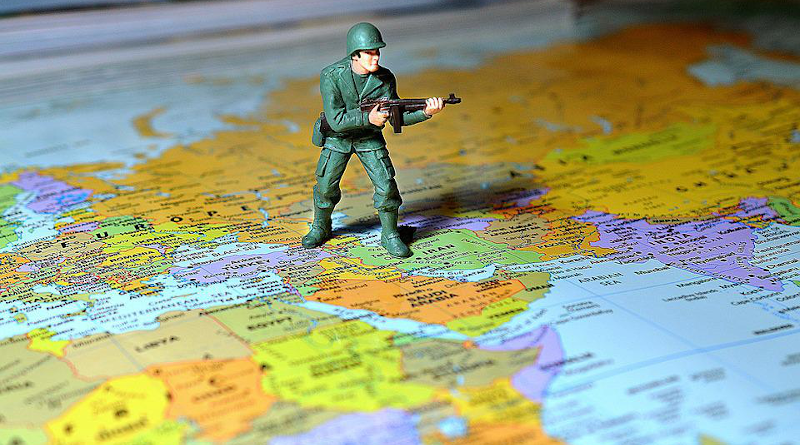
The Deadly Eruption Of The Middle East Volcano – Analysis
On October 7, 2023, Hamas launched an attack against Israel from the Gaza Strip. The Hebrew state retaliated by bombing the enclave, before sending in its soldiers to destroy the Islamist organization. From October 8, 2023 Lebanese Hezbollah retaliated in “support” of Gaza, firing rockets almost daily into northern Israel, to which the IDF responded. Since September 2024, the Israeli army has also embarked on an intense bombing campaign in Beirut and the east of the country, as well as in the south, where a ground offensive took place. The Middle East volcano is in a deadly eruption with no sight to its end. (1)
Definition: “Near East” or “Middle East
The Middle East comprises Egypt and the West Asian states; and area around the eastern Mediterranean from Turkey to North Africa and east to Iran. It is the site of ancient civilizations such as Phoenicia, Babylon and Egypt; cradle of the Abrahamic religions: Judaism, Christianity and Islam. (2)
The Middle East is defined primarily by geopolitics, not geography. It is an area whose center and borders vary according to the world’s dominant power. (3)
The terms Near East, Middle East (4) and Far East refer to three links in a chain that stretches from west to east, across the Asian continent. In principle, these terms are not interchangeable, as they have specific meanings.
Actually, they are Eurocentric terms derived from the English: “Near East”, “Middle East” and “Far East”. (5) The invention of these notions at the end of the 19th century (around 1890), probably by the British India Office, is the result of Europe’s (especially Great Britain’s and France’s) stranglehold on the whole of Asia, since the notions of “near”, “middle” and “far” are distinguished according to Europe. The three regions thus carved up in the West each appear to be centred on a key country: Turkey for the Near East, Persia or Iran for the Middle East, and China for the Far East.
The difference between the terms Near East and Middle East corresponds to both centering and framing. Whereas the Near East is centered on the Lebanese-Israeli region, the Middle East is centered on the Persian Gulf. In terms of framing, the Near East occupies a restricted space, while the Middle East corresponds to a larger area. The Far East, on the other hand, is further away from Europe (hence the adjective “extreme”), and occupies an even larger area (China, Japan and the former Indochina).
On the actual origin of the term “Middle East” Commisceo Global writes: (6)
“The Middle Eastern region was particularly important to the British during this period in history as it served as a buffer region in the defence of British interests in India.
The terms made sense when they were first coined, and they helped to designate locations from a Eurocentric perspective.
The term ‘Middle East’ then evolved to become common verbal currency in 1902 when Alfred Thayer Mahan, a USA naval officer and historian, used the term in an article to describe the land between Arabia and India.
After the collapse of the Ottoman Empire as a result of WWI and other geopolitical events, the term ‘Middle East’ became established, widely used by people both within and outside the region.
Many argue, however, that since the term is Eurocentric and only valid from a Western perspective, it should be replaced with a term that is more appropriate.
Jerwaharlal Nehru (the first Prime Minister in India), for example, argued that the term should be replaced with ‘West Asia’. His suggestion continues to receive a great deal of support and many academics.
“Middle East” is problematic because it is, undeniably, a Western term reflecting a Western perspective.”
Before the First World War, the distinction between the Near East and the Middle East was the norm. After the disappearance of the Ottoman Empire, the closely related term “Near East” seemed inadequate to Americans, who began to use “Near and Middle East”, an expression that appeared as early as 1920 in articles in the New York Times. As a result, the term “Near East” seemed unnecessary and was gradually replaced by “Middle East” around 1957, which included Egypt, Turkey, Iraq, Persia, Syria, Lebanon, Jordan, Israel, Saudi Arabia, the Gulf Emirates, Kuwait, Bahrain, Qatar and Yemen. (7)
In this regard, Hany Soliman says that the term “Middle East” is an invention of the Europeans: (8)
“In Orientalism, Edward Said argues that the “Orient” was a western invention made to be exploited by the Europeans. For the Europeans, “the world is made of two unequal halves, Orient and Occident” and the “relationship between Orient and Occident is the relationship of power, of domination, of varying degrees of a complex hegemony.” The East for European/Western historians, scholars, researchers, leaders, artists, merchants and traders, was a “career”, as stated by Benjamin Disraeli.”
This argument is clear if we trace the development of the geo-political concept of the East. For a long time, the East for the Europeans was the Muslim lands that are flooded with milk and honey; the lands of One thousand and one nights; that of the great capitals of Jerusalem, Damascus, Baghdad and Cairo and their hidden treasures. (9)
In fact, the distinction between Near East and Middle East now seems more of a European notion, especially in French, whereas Anglo-American incorporates both notions. In short, the Near East no longer exists in English, thanks to the Americans. To simplify, we can say that we speak French when we distinguish the two terms; we speak English when we eliminate the Near East in favor of the Middle East. In fact, it’s more complex, because you have to take into account other languages that sometimes have their own breakdown. (10)
For example, Spanish and Portuguese also oppose “Oriente Próximo” (Near East) to “Oriente Medio” (Middle East); so does Catalan with “Orient Pròxim” and “Pròxim Orient”. For its part, Italian uses the expression “Grande Medio Oriente” (the “Greater Middle East”), including both notions. In German, a distinction is made between “Nahen Osten” (Near East), “Mittleren Osten” (Middle East) and “Fernen Osten” (Far East), as in French.
However, since the definition of the terms “Proche-Orient” and “Moyen-Orient” is relative, the meanings vary from country to country, and are generally different from the English terms. In German, the term “Proche-Orient” (“Nahen Osten”) is still widely used – today the term “Mittleren Osten” is increasingly common, albeit with a different meaning in press texts translated from English sources – as well as in Russian “Ближний Восток” (“Blizhniy Vostok”), Bulgarian “Близкият изток” (“Blizkiya Iztok”), Polish “Bliski Wschód”, Slovenian “bližnjem vzhodu” or Croatian “Bliski istok” – which means “Near East” in all five Slavic languages – remains the only appropriate term for the region.
Consequently, in French as in other languages, Turkey, Cyprus, Syria, Lebanon, Israel, Palestine and Egypt are in the Near East. All other countries to the east are in the Middle East, which includes Iraq, Iran, Afghanistan and the entire Arabian Peninsula (Saudi Arabia, Yemen, etc.). (11)
In short, English uses the term “Middle East” in much the same way as French, but with the addition of Pakistan to the Near East. In all cases, the words Near East and Middle East cover countries in Western Asia.
In short, in French, “Proche-Orient” is distinguished from “Moyen-Orient”, whereas in English, “Middle East” is preferred to “Near East”. In Europe, the British used “Near East” for a long time, but like the Americans, they eventually replaced “Near East” with “Middle East”. French, like many other languages, has not aligned itself with English. (12)
Perhaps due to the influence of the Western press, the Arabic equivalent of Middle East (الشرقالأوسط ash-Sharq al-Awsat) has become common usage in the traditional Arabic press and contains the same meaning as the term Middle East. In short, the Near East presents a smaller part than the Middle East, which covers a larger area, but surpassed by the Far East. Nevertheless, the use of three terms is more precise than just two.
The countries of the Near East are home to three types of peoples, (13) or rather three main language groups that have developed over the centuries:
1. Iranian (or Indo-Iranian) speakers;
2. Turkic (or Altaic) speakers;
3. Semitic languages, including Arabic and Hebrew.
Of these, Turks (Turkmen, Azeris or Azerbaijanis, Uzbeks, Tajiks, etc.), Arabs (Egyptians, Syrians, etc.) and Persians (Iranians, Kurds, Pashtuns, Baluchis, etc.) form the largest ethnic groups in this vast region (14) of over seven million square kilometers. (15)
The oldest peoples are the Iranians, including the Persians, who gradually established themselves during the 2nd millennium B.C., followed by the Hebrews (6th century B.C.), the Turks (1000 A.D.) and, later, the Arabs (around 650).
Among the vanished peoples of the Near East are the Sumerians, Phoenicians, Babylonians, Assyrians, Akkadians, Egyptians and others.
The Near East region is associated with the term “Fertile Crescent” (Arabic: الهلال الخصيب), referring to the ancient regions of Mesopotamia and the Levant. This territory includes the present-day states of Kuwait, Syria, Cyprus, Lebanon, Palestine and Israel, as well as parts of Egypt, Jordan, Iraq and southeastern Turkey. In fact, the Fertile Crescent refers to a geographical area irrigated by the Jordan, Euphrates, Tigris and Nile rivers. It stretches across the fertile alluvial plains of the Near East, where Neolithic agriculture is thought to have originated. (16)
This geographical entity of some 400,000 to 500,000 km² owes its name to the shape it displays on a map, the arc formed resembling a crescent. Some 40 to 50 million people are thought to live here.
The term “Fertile Crescent” is said to have been coined by archaeologist James Henry Breasted (1865-1935) of the University of Chicago.
Geographically, the Middle East is an interface between the continents of Europe, Africa and Asia, including the countries between Egypt to the west, Iran to the east, Turkey to the north and the Arabian Peninsula to the south. The region was subject to Ottoman and then European influence, before the process of decolonization (17) and the Cold War enabled the Americans and Soviets to extend their influence, and regional players to emancipate themselves by using oil revenues and energy weapons to influence international decisions. The issue of water (18) is an aggravating factor in conflicts in the region: rivers such as the Nile, Tigris, Euphrates and Jordan are shared by several countries, and access to water is necessary for agriculture in arid zones. (19)
Regional dimensions of the conflict
The departure of the British from Palestine, administered under a League of Nations mandate since 1923, set in motion a crisis situation that remains unresolved to this day. Faced with the actions of the Haganah and Irgun, (20) two Jewish paramilitary organizations, the British handed over their mandate to the UN in February 1947. Despite the UN’s proposal of a partition plan for Palestine, armed confrontations increased. On May 14, 1948, without waiting for the UN partition, David Ben Gourion proclaimed the creation of the State of Israel. (21)
The Israeli-Arab wars pitted Israel against its Arab neighbors between 1948 and 1973. As soon as Israel became independent, the armies of Egypt, Iraq, Jordan and Syria attacked the country in 1948. A swift Israeli victory was accompanied by the departure of 700,000 Palestinian Arabs who fled the fighting. The first Palestinian refugee camps were set up in the West Bank, conquered by Jordan, and in the Gaza Strip, occupied by Egypt. This first war was followed by two others: the Six-Day War in 1967 and the Yom Kippur War in 1973, both of which were won by Israel. Peace agreements (22) were signed between Israel and Egypt following the 1978 Camp David Accords, then with Jordan in 1994. Yet tensions remained high with Syria, Lebanon and other Arab states in the region, and conflicts with the Palestinian population increased. (23)
The Arab-Israeli conflict is the name given to the tense relations between the State of Israel and the surrounding Arab states. (24) This conflict occupies a major place in the geopolitics of the Middle East, accompanied by a number of issues such as territorial, religious, political and social instability. It was followed by the Israeli-Palestinian conflict, which pitted Palestinians against Israelis. It also includes a strong religious dimension, due to the diversity of territories following the dismemberment of the Ottoman Empire and the encouragement of the British to create a Jewish national home, leading to settlers moving into Palestine. (25)
The regional dimension of the Israeli-Arab conflict encompasses the strained relations between Israel and its neighboring Arab states since the establishment of Israel in 1948. Key events that shaped this conflict include the 1948-1949 Arab-Israeli War, the Six-Day War in 1967, and the Yom Kippur War in 1973. The conflict is not only a territorial dispute but also tied to national liberation movements and broader geopolitical tensions in the Middle East. (26)
The regional dimension of the Middle Eastern conflict involves various local and international actors, reflecting a complex interplay of geopolitical interests and historical tensions. Persistent regional conflicts, often described as “fixed abscesses,” are influenced by both internal dynamics and external pressures from other states and international entities. The potential for these conflicts to escalate regionally is significant, especially if they prolong, leading to broader instability in the region. (27)
For Philippe Droz-Vincent, The Americans are largely responsible for the current destabilization of the region: (28)
“The Middle East is witnessing during recent years a deepening of the dynamics of conflict and is displaying the stirrings of a chaotic and bleak future in Iraq, Palestine and Lebanon, as well as in the handling of the intricate Iranian nuclear file. The regional security system is under stress and is sometimes verging on total collapse. The explanation lies mainly in the side effects of the many American failures at reconstructing the Middle East since September 11th, 2001.”
The recent escalation of violence in the Middle East, particularly the Israel-Palestine conflict, has had significant repercussions throughout the region and beyond. Tensions flared dramatically in October 2024, especially with the exchange of rockets between Israel and Lebanon, marking an open conflict. The broader conflict is deeply intertwined with historical disputes dating back to the establishment of Israel in 1948, and involves various regional rivalries, including tensions between Iran and Israel. (29)
The ongoing violence in the Middle East, particularly the Israel-Palestine conflict, has profound effects on neighboring countries. Jordan hosts a significant number of Palestinian refugees. Continued violence leads to increased refugee flows, straining resources and social services. Jordanian borders have become more vulnerable, requiring increased security measures to prevent spillover violence. (30)
The conflict often sees militant groups like Hezbollah (31) in Lebanon become more active, causing tension with Israel and risks of escalation. Lebanon, already facing economic difficulties, feels the impact of regional instability, affecting trade and tourism.
Egypt manages the Gaza border, facing challenges in controlling smuggling and militant movements. Egypt often mediates ceasefires, playing a crucial role in trying to stabilize the situation while dealing with its own internal security issues related to militant groups.
The conflict adds complexity to Syria’s ongoing civil war, with various factions potentially using the situation to further their agendas. The refugee crisis in Syria worsens, with displaced individuals seeking safety in other countries.
Iran’s backing of groups like Hamas and Hezbollah intensifies regional tensions, drawing in other nations and exacerbating conflicts.The situation allows Iran to leverage influence in the region, leading to proxy wars and heightened military engagements. (32)
Neighboring countries often find themselves caught between domestic public sentiments, which may support the Palestinian cause, and their geopolitical alliances with Western nations, particularly the United States.
The conflict leads to increased humanitarian needs in the region, with neighboring countries often providing assistance, but facing limits due to their own economic challenges.Overall regional instability can deter investment and economic growth, affecting all neighboring countries.
The Israel-Palestine conflict has a ripple effect on the stability, security, and humanitarian conditions of surrounding nations. Continued efforts for a peaceful resolution are crucial to mitigate these impacts.
The Palestinian predicament
The Palestinian question, (33) or the issue of Palestine, has been a complex and unresolved conflict for over a century. It primarily revolves around the aspirations of the Palestinian people for statehood and self-determination, alongside the historical and ongoing claims of the Jewish people to the same territory. The situation has led to significant displacement and conflict, notably illustrated by events such as the expulsion of over half the Palestinian Arab population during various conflicts. Efforts to resolve the issue have faced numerous challenges, and the situation continues to evolve with political, social, and humanitarian implications. (34)
The Palestinian question refers to the ongoing conflict and struggle of the Palestinian people for self-determination, statehood, and rights in the face of Israeli occupation and settlement expansion. This issue has persisted for over a century, with significant historical events leading to the displacement of many Palestinians and the division of territory between Israel, Jordan, and Egypt. The complexities involve national identity, historical grievances, and geopolitical dynamics, making it a challenging issue to resolve.
The Palestinian question is a complex subject encompassing historical, political, social and religious aspects. It has its roots in the conflict between Jewish and Arab nationalism in the late 19th and early 20th centuries, during the rise of Zionism and Arab nationalist aspirations.
After the First World War, Palestine became a British Mandate. The Balfour Declaration of 1917 supported the establishment of a “Jewish national home” in Palestine, raising tensions with the local Arab population. (35)
Israel’s declaration of independence led to the first Arab-Israeli war and the displacement of hundreds of thousands of Palestinians, known as the Nakba النكبة, (catastrophe). (36) After the 1967 war, Israel occupied the West Bank, Gaza and East Jerusalem, areas claimed by the Palestinians. (37)
Jerusalem is a sacred city for Jews, Christians and Muslims, its status is one of the most sensitive issues in the conflict.
Millions of Palestinians live in refugee camps in the West Bank, Gaza Strip and neighboring countries. Israel’s settlement policy in the West Bank is contested by the international community and seen as an obstacle to peace.
The Oslo Accords (1993) (38) established a Palestinian authority and mutual recognition, but hopes for peace have not been realized. Various initiatives, including those of the United States and the UN, have been proposed, but few have led to a lasting solution.
The Palestinian question is therefore deeply rooted in historical injustices and struggles for the right to self-determination. The prospects for a solution – often evoked in the form of a two-state solution (39) – continue to be the subject of passionate debate.
The decades-long Israeli-Palestinian conflict has intensified dramatically since October 7, 2023, when Hamas launched a major attack against Israel. This offensive led to a large-scale military response from Israel in the Gaza Strip, exacerbating an already tense situation.
The attacks of October 7, 2023 resulted in the deaths of over 1,200 Israeli citizens, including 37 children, and around 7,500 wounded. As of December 26, 2024, 101 people, including 2 children, were still being held hostage.
In over a year of conflict, an estimated 45,338 Gaza people have been killed, including more than 14,100 children, and 107,764 wounded, including more than 23,420 children. Some 1.9 million people have been repeatedly displaced, seeking refuge in precarious conditions.
Gaza Strip is facing an unprecedented humanitarian crisis, with destroyed infrastructure, limited access to drinking water, food and medical care. Diplomatic efforts to bring about a lasting ceasefire have not yet been successful, despite proposals for peace plans from international players. (40)
UNICEF has pointed out that Gaza’s children have endured unimaginable horrors: (41)
“The war in the Gaza Strip is taking a catastrophic toll on children. At least14,000 children have reportedly been killed, according to the latest estimate by the Palestinian Ministry of Health; thousands more have been injured. There are no safe spaces. All of Gaza’s children have been exposed to the traumatic experiences of war, the consequences of which will last a lifetime.
Around 1.9 million people – about 9 in 10 of Gaza’s population – are estimated to have been internally displaced. Half of them children. They do not have enough access to water, food, fuel and medicine. Their homes have been destroyed; their families torn apart. Many children have been displaced multiple times, and have lost homes, parents and loved ones. They need to be protected, along with the remaining services that they rely on, including medical facilities and shelter.”
Diplomatic initiatives, notably by former Israeli and Palestinian officials, have been proposed to end hostilities and establish a lasting peace based on the 1967 borders, with reciprocal territorial adjustments and a special status for Jerusalem. Despite these efforts, Western and Arab diplomacy are struggling to influence the course of events, and the situation remains extremely volatile.
In short, the Israeli-Palestinian conflict remains a complex, deep-rooted crisis, with devastating humanitarian repercussions and prospects for resolution still uncertain.
Role of Iran
What drives Teheran’s Middle East policy? More than just support for Palestine, the Islamic Republic’s primary aim is to oppose a reordering of the region dictated by Israel and the United States, which would marginalize it at a time when it is trying to reconcile with the Gulf states.
Iran plays a multifaceted role in the Israeli-Palestinian conflict, primarily supporting groups opposed to Israel, such as Hamas and Hezbollah. It provides military, financial, and ideological backing to these organizations, viewing the conflict as part of a broader struggle against Israel and Western influence in the region. Although Iran denies direct involvement in specific attacks, such as the recent attack by Hamas, its support for Palestinian factions has been instrumental in shaping their capacities and strategies. Additionally, Iran positions itself as a leader in the anti-Israel axis in the Middle East.
Hamas, the Palestinian militant group governing Gaza, maintains a complex and strategic relationship with Iran, largely based on shared anti-Israel sentiments and mutual interests, despite occasional tensions due to political differences. (42)
Iran provides significant military aid, funding, and training to Hamas. This support has helped Hamas bolster its military capabilities, particularly in rocket technology and military strategy. Both Hamas and Iran share a commitment to opposing Israel. Iran views its support for Hamas as part of a broader resistance against Western influence and Zionism in the region.
While Hamas has its roots in Sunni Islamism, Iran is primarily Shiite. Despite these sectarian differences, they have forged a pragmatic alliance based on their shared goals. There have been periods of strain, particularly during the Syrian Civil War. Hamas initially sided with Sunni groups against the Assad regime, which Iran supports. However, relations have improved since Hamas’s political realignment and its need for support against Israel. Through its support for Hamas, Iran aims to extend its influence in the Palestinian territories and the Arab world, positioning itself as a leader in the anti-Israel and anti-Western coalition. Overall, while Hamas receives substantial support from Iran, the relationship is shaped by broader geopolitical dynamics and internal organizational strategies.
Iran plays a central role because Hamas is part of what the Iranians call “the axis of resistance”. This is a network of armed organizations (modelled on the Iranian Pasdaran (43) ) currently positioned in countries such as Yemen, Iraq, Syria and Lebanon, as well as in the Palestinian territories. Led by Iran, this “axis of resistance” is united in the idea of resisting and defending, militarily, if necessary, the Palestinian cause against Israel. As Hamas is an important member of this axis, Teheran is clearly involved in this conflict. (44)
In this regard, Alain Dieckhoff writes: (45)
“Over the course of the 2000s, Iran has increasingly asserted itself as an essential regional power. While its priority remains the Gulf, it has never neglected either its eastern flank (Afghanistan, Pakistan) or its western flank, which opens onto the Arab world. Nevertheless, between the establishment of the Islamic Republic in 1979 and the overthrow of Saddam Hussein in 2003, its geopolitical influence in the Arab East was hampered by the confrontation with neighboring Iraq. The lifting of the Iraqi mortgage subsequently greatly facilitated Iran’s westward push.”
The main objective of this “axis of resistance” is the radical defense of the Palestinian cause, but also the establishment of a balance of power with Israel. Iran has never recognized the existence of the State of Israel, which it calls “the Zionist regime” rather than “Israel”. Ideologically, the Palestinian cause is at the heart of the Islamic Republic of Iran’s ideology, so much so that Imam Khomeini’s first speeches in the 1960s already accused the Shah of maintaining relations with Washington and Tel Aviv. Given that the most radical parties have been in power in Iran since 2020-2021, this cause is obviously a priority for the current leaders of the Islamic Republic.
The Lebanese Hezbollah is the spearhead and most effective element of this “axis of resistance”. Since Iran knew that Hezbollah would be on the front line from the moment the Hamas attack was announced, Iranian leaders were obliged to coordinate and discuss with Hassan Nasrallah. A central element for Iran, the Iranians had, for example, asked Hezbollah to intervene in Syria to help Bashar Al-Assad, in Iraq to fight against the Islamic State, or in Yemen to help the Houthis in their war against the Saudi-led coalition. (46)
In military terms, Iran’s leaders also refer to this “axis of resistance” as giving them “strategic depth”, meaning that it provides Iran with a deterrent against the risk of an attack on its territory by Israel or the United States, the message being that such an attack would trigger a regional conflagration. (47)
Iran plays a significant and multifaceted role in the tensions across the Middle East, influencing various regional conflicts through its political, military, and ideological efforts. Iran provides financial, military, and logistical support to several militant groups, such as:
- Hezbollah in Lebanon ;
- Hamas and Islamic Jihad in the Palestinian territories;
- Various Shia militias in Iraq and Syria; and
- Houthis in Yemen.
These groups often act in alignment with Iran’s interests, contributing to its influence in the region. Iran is one of Israel’s staunchest opponents, advocating for the Palestinian cause and actively opposing Israeli actions. This animosity drives much of its regional policy and fuels broader sectarian and geopolitical tensions. (48)
Iran’s ambitions challenge the interests of other regional powers, particularly Saudi Arabia and the United States. This rivalry often manifests in conflicts such as:
- The Yemen conflict, where Iran supports the Houthi rebels against a Saudi-led coalition.
- Iraq, where Iran exerts influence over the Shia-dominated government and militias.
Iran’s nuclear program has raised alarms internationally, with fears that it could lead to the development of nuclear weapons. This issue not only heightens tensions with Israel but also involves global powers, complicating diplomatic relations and spurring arms races in the region.
Iran has cultivated alliances with various governments and factions, promoting the idea of a “Shia Crescent” stretching from Iran through Iraq and Syria to Lebanon. This coalition challenges Sunni-majority countries, fostering sectarian divisions and conflicts.
International sanctions aimed at curbing Iran’s nuclear ambitions have impacted its economy but have also pushed it to strengthen ties with other allies, particularly Russia and China, which can further destabilize the region.
Iran’s role in Middle Eastern tensions is a complex blend of supporting proxy groups, opposing Israel, engaging in geopolitical rivalries, and pursuing nuclear capabilities. Its actions are pivotal in shaping the security dynamics of the region, often leading to prolonged conflicts and instability.
Risk of all-out war
In a chaotic Middle East, the date of October 7, 2023 marks a major turning point that could lead to a conflagration of the entire zone. The war in Gaza comes at a time when the strategic autonomy of several regional powers is asserting itself, and the geopolitical balance is shifting in favor of Russia and China. Netanyahu, still supported by the extreme religious right, is playing on the perpetuation of the war to retain power, while more than two-thirds of the population want him to leave. (49)
By launching a hail of missiles on Israel on Tuesday October 1, 2024 in retaliation for the elimination of Hezbollah leader Hassan Nasrallah, Iran has pushed the region a little further into a state of fear of all-out, even global, war.
With his sense of impunity and omnipotence, Benyamin Netanyahu was convinced that the Iranians would not retaliate against the elimination, on Friday September 27, 2024 of Hassan Nasrallah, the leader of Hezbollah, their most important intermediary and supporter in Lebanon. And, strangely enough, Western leaders had the same analysis. After all, Iran had already failed to react to the elimination of Hamas political leader Ismail Haniyeh by an Israeli strike in July 2024. Proof that Teheran preferred to avoid endangering its nuclear sites by provoking Israel in its turn. But for the mullahs, the humiliation was too great. Not to retaliate would be tantamount to abdicating before the might of Israel, and they were already accused in the Shiite world of having abandoned Hezbollah. And so much the worse if, in retaliation, this provoked Israeli bombing raids on the facilities that are preparing Teheran’s access to the bomb. Hence Ayatollah Khamenei’s decision to launch a barrage of missiles against Israel on October 1, 2024. Most of these were intercepted by the Hebrew state and its allies, both American and Jordanian. (50)
Tsahal’s response was swift. And so it is that, dragged into a mad spiral by inconsistent leaders, the region is heading for all-out war, a war that could well become global if all these leaders don’t quickly come to their senses, agreeing to put their hubris aside. For many weeks now, the American leaders, Israel’s sponsors, have been warning Benyamin Netanyahu against his military headlong rush. They had even launched – with France in particular – negotiations for a ceasefire in Gaza, but also in Lebanon. To no avail. After intensive bombardments, Tsahal began commando incursions into southern Lebanon to complete the destruction of Hezbollah installations threatening northern Israel. Netanyahu no longer hears anything or anyone. And it doesn’t matter if Biden is humiliated, it will favor his friend Trump. A few days before the commemoration of the October 7 attack, he wanted to restore his image in the eyes of the Israelis and, at the same time, establish a “new order” (the name given by Tsahal to the operation in Lebanon) in the region. A purely military order. Without any long-term vision.
The risk of a total war in the Middle East is currently heightened due to escalating tensions, particularly between Israel and Hezbollah. Reports indicate that military strikes were increasing along their border, and there were significant humanitarian concerns, with over a million people displaced in Lebanon alone. European officials have warned that the situation is precarious, suggesting that the region is on the brink of a broader conflict.
Experts have highlighted the potential for a large-scale conflict, especially in light of recent escalations involving Israel and Hamas. The situation is complex, influenced by various political, economic, and social factors that could lead to broader military confrontations.
The risk of total war in the Middle East remains significant due to various factors, including geopolitical tensions, historical conflicts, and the involvement of external powers. Recent assessments highlight concerns over significant costs, especially for countries like Lebanon, which may suffer severe consequences from potential military actions, including targeted strikes on vital infrastructure. The changing dynamics in the region, particularly influenced by U.S. energy independence, also play a crucial role in shaping the future security landscape.
Escalation after escalation, counter-riposte after counter-riposte, Israel is tending dangerously towards a logic of all-out war, not just in Gaza, but against all its enemies in the Middle East. The immediate risk is all the greater in that Haniyeh’s assassination in Teheran was accompanied, within hours of each other, by that of a senior member of the Lebanese Hezbollah, Fouad Chokr, in an Israeli raid on a building in a densely populated district of Beirut.
On the Israeli war against Hamas and Hezbollah, robin Wright writes: (51)
“By 2024, 10 conflicts flared across the region. Israel faced two frontlines in the south against Hamas and in the north against Hezbollah. Both were members of the so-called “Axis of Resistance,” a network of Shiite movements armed, trained, and financially supported by Iran. Tensions also played out between Israel and the wider Arab world. In Iraq and Syria, other Iranian-backed militias attacked US forces deployed to help contain the remnants of ISIS after the Islamic State collapsed in 2019. Yemen was involved in three wars—a civil war at home, a regional confrontation with Saudi Arabia, and attacks on international shipping in the Red Sea. The undercurrent in all these conflicts was the escalating tensions between the United States and Iran. The following is the background on all ten conflicts.’’
The elimination of Haniyeh, head of the Hamas political bureau based in Qatar, confirms the idea, if any were needed, that it is out of the question for Netanyahu’s far-right government to negotiate anything with the Palestinians. The symbolism is powerful: he was assassinated at his residence in Teheran as he had just taken part in the inauguration of the new “moderate” President Masoud Pezeshkian, elected at the beginning of July 2024, in the presence of other representatives of the “axis of resistance” to Israel.
Haniyeh played an important role in the military development of Hamas, in collaboration with Iran, and took his orders from the hard-line leader of Gaza, Yahya Sinouar, considered to be the mastermind of the massacres committed in Israel on October 7, 2023. But he was also considered a pragmatist within the Palestinian armed movement, everything being relative. The fact is that he was at the heart of efforts to end hostilities in the Gaza Strip. He was killed just as negotiators from the United States, Israel, Qatar and Egypt were about to meet in an attempt to relaunch talks on an elusive ceasefire.
For the Americans, this double assassination torpedoes their efforts to contain regional tensions and achieve a ceasefire in Gaza – while providing the Israelis with the weapons they need to crush Hamas and the Gazans. Admitting his impotence or seeking to wash his hands of it, it’s hard to say, US Secretary of State Antony Blinken made it known that the United States had not been informed of the operation in Teheran. For months now, Israeli officials have been publicly toying with the idea of open war with Hezbollah. It’s a long-held belief in the ranks of the Tsahal that they could put an end to Hezbollah once and for all, if only they were given the authorization to do so. (52) The assassination of the influential Fouad Chokr, a man said to have played a central role in the bombing that killed 241 US Marines in Beirut in 1983, serves as a stopgap in this sense.
Complex and protracted conflict
The Arab-Israeli conflict (53) is the name given to the tense relations between the State of Israel and the surrounding Arab states since the creation of Israel on May 14, 1948. It has culminated in seven armed conflicts: the 1948 War, the 1956 Suez War, the 1967 Six-Day War, the 1967 War of Attrition, the 1973 Ramadan/Yom Kippur War, the 1982 First Lebanon War, and the 2006 Second Lebanon War.
This conflict occupies a major place in the geopolitics of the Middle East, where several issues accompany it: the instability of the region, Israel’s control of the holy sites of Jerusalem (the sacred city of the three monotheisms), Israeli settlements on the West Bank and the Golan Heights, and Israel’s control of the Lake Tiberias basin (an important drinking water resource). (54)
The Israel-Hamas war, also known as the Israel-Gaza war, is an asymmetrical conflict pitting Israel against Hamas, a Palestinian Islamist politico-military organization, and other Palestinian armed groups. It began with Hamas’s attack on Israel on October 7, 2023, and continued with Israel’s bombardment of the Gaza Strip, followed by the invasion of this Palestinian territory. The fifth direct conflict between Israel and Gaza, the war is part of the broader Israeli-Palestinian conflict, or even the Arab-Israeli conflict. (55)
Since 2007, Israel and Hamas, as well as other Palestinian militant groups based in Gaza, have engaged in conflicts, including four wars in 2008-2009, 2012, 2014 and 2021. These conflicts have killed around 6,400 Palestinians and 300 Israelis. The Middle East War has emerged as one of the most complex and protracted conflicts in modern history, significantly shaping geopolitical relations and societal structures within and beyond the region. (56) From its historical roots to contemporary manifestations, this multifaceted struggle encompasses a variety of actors, interests, and ideologies, each contributing to a tapestry of conflict marked by religious, ethnic, and political dimensions. Central to understanding the intricacies of the Middle East War is the recognition of the collision between established nation-states and competing nationalist movements, often exacerbated by foreign intervention and colonial legacies. (57) As tensions escalate and peace efforts falter, the ramifications of this conflict resonate on a global scale, affecting international diplomacy, economic stability, and humanitarian conditions. Thus, an exploration of the Middle East War not only elucidates its immediate impacts on the region but also reveals broader implications for global peace and security. (58)
The risk of total war in the Middle East has escalated significantly due to recent military actions and rhetoric. Reports indicate that Israel has conducted extensive airstrikes, targeting approximately 1,600 locations in southern Lebanon, which has resulted in a high number of casualties. This situation contributes to a growing concern among international leaders about the potential for broader conflict that could involve multiple nations in the region.
The ongoing conflicts in the Middle East are deeply rooted in historical, political, and social complexities. Wars such as the Six-Day War in 1967 and the more recent conflicts in Gaza exemplify a cycle of violence that often arises from unresolved territorial disputes, national identity, and external influences. These factors contribute to a persistent state of tension and sporadic escalations in hostilities, making it difficult to resolve longstanding grievances and achieve lasting peace.
Indeed, the historical context of wars in the Middle East reflects a complex interplay of ethnic, religious, and geopolitical factors that have shaped regional dynamics for centuries. (59) The significance of these conflicts transcends mere territorial disputes, as they often stem from deep-rooted historical grievances and cultural identities. For instance, the legacy of colonialism in the region has created artificial borders that frequently disregard the sociopolitical fabric of local populations, leading to prolonged disputes and violence. Since the 1990s, the notion of liberal warfare has sparked considerable debate, with some scholars likening these interventions to a modern iteration of the Crusades, highlighting how secular motivations intertwine with historical religious narratives. (60) Such wars not only reshape the national landscapes of the Middle East but also reverberate through global politics, unveiling the intricate layers of allegiance and enmity that characterize this strategic crossroads of the world.
Causes of Conflict
The persistent conflicts in the Middle East arise from a complex interplay of historical grievances, ethnic divisions, and geopolitical interests, all of which contribute to a volatile atmosphere. Central to these disputes are territorial and resource-based confrontations, often rooted in colonial legacies that have exacerbated ethnic tensions. For instance, the longstanding Israeli-Palestinian conflict (61) exemplifies how differing nationalist aspirations can lead to violent confrontations, as highlighted by various media portrayals.
Such coverage can influence public perception, with outlets like Kompas.com emphasizing Israels military responses to attacks, thereby framing the narrative in a way that evokes sympathy for one side while marginalizing the grievances of the other. Moreover, the historical context of Eurocentrism, where Western powers sought to manipulate regional dynamics for their benefit, has left a legacy of mistrust and division that fuels contemporary disputes. (62) Understanding these intertwined causes is crucial for addressing the underlying issues that perpetuate conflict in the region.
The Israeli-Palestinian conflict has its origins in rivalries over the occupation of the territory of Palestine, which were exacerbated by the rise of nationalist movements at the end of the 19th century.
At the end of the 19th century, as Arab nationalism was taking shape, Zionism, pioneered by Theodore Herzl, advocated the creation of a state for the Jewish people. The movement’s political tendencies considered that the Land of Israel rightfully belonged to the Jews: Palestine was Eretz Israel, “Promised Land for the Jews”.
The Middle East was then under the domination of the Ottoman Empire, but European influence was strong. In the First World War, the Ottoman Empire followed Germany into the conflict. For their part, the French and British divided up areas of influence under the Sykes-Picot Agreement of 1916. (63) The following year, with the Balfour Declaration, Great Britain supported the establishment of a Jewish national home in Palestine, heralding the start of Arab protests.
The Ottoman Empire was dismantled after 1918, and the League of Nations gave mandates to France and Great Britain to administer the Middle Eastern territories. Palestine fell to the British, but no Jewish state was created. However, the violence suffered by European Jews in the 1930s led to further migration to Palestine.
The Second World War changed all that. After the Nazi capitulation, the United Nations drew up a partition plan for Palestine, with the creation of a Jewish state, an Arab state and international status for the city of Jerusalem. 1948 marks the nakba (“catastrophe”) for the Palestinian people: the proclamation of the State of Israel by David Ben Gourion and the first Arab-Israeli war, which forces the Palestinians into mass exile. This event marked the beginning of the long Israeli-Palestinian conflict.
Major Wars and Their Impact
Underlying the persistent wars in the Middle East are multifaceted political, religious, and economic factors that intertwine to exacerbate conflict. Politically, the Arab Spring highlighted deep-seated grievances against autocratic regimes, leading to upheavals that often resulted in power vacuums and civil wars, particularly in Syria and Libya. (64) Concurrently, religious dynamics play a significant role, with Iran’s expansionist policies promoting Shiite militias across the region, further polarizing sectarian divides and complicating state–militia relationships. (65) Economically, the struggle for resources—exacerbated by global reliance on oil—fuels rivalries among regional powers, complicating diplomatic efforts. The intersection of these factors creates an environment ripe for conflict, as nations prioritize short-term security concerns over long-term stability. Understanding how these elements interact is crucial for addressing the region’s ongoing turmoil and crafting viable pathways toward peace. (66)
The Arab-Israeli conflict began in 1948, in the land of Palestine previously under British mandate. (67) Thirty years after the Balfour Declaration, in which the British government “favourably considered the establishment in Palestine of a National Home for the Jewish people”, and at a time when Western opinion was discovering the Nazi genocide of the Jews of Europe, the United Nations General Assembly adopted Resolution 181 on November 29, 1947, which provided for a Jewish state on 56% of the land of Palestine and an Arab state on the remaining 44%. (68)
By May 14, 1948, the day of Israel’s “declaration of independence”, Jewish forces had already expelled almost four hundred thousand Palestinians from the territory planned for the Jewish state, and occupied the majority of its Arab towns. (69)
Arab troops entered Palestine on May 15, 1948 – the first Arab-Israeli war. It was followed by the wars of 1956 and 1967, the Israeli-Egyptian peace agreement (1978), Israeli offensives and wars in Lebanon (1978, 1982, 1996, 2006), the Israeli-Jordanian peace agreement (1994), and the Arab peace proposal of 2002, rejected by Israel. (70)
The impact of major wars in the Middle East extends beyond mere territorial disputes, deeply influencing socio-economic structures and political dynamics within the region. For instance, post-conflict nations often require substantial economic aid to stabilize and rebuild, but the effectiveness of this aid is frequently contentious. (71) Research indicates that conventional wisdom surrounding aid effectiveness in post-conflict scenarios may be flawed; analyses show that the relationship between aid and growth is tenuous, with results varying significantly based on the specific context of the civil conflict. (72) Moreover, the emphasis on conflict prevention strategies has been shown to yield better long-term benefits than reactive measures post-conflict. (73) Consequently, understanding the nuanced effects of economic assistance and conflict prevention sheds light on the broader repercussions of warfare in the Middle East, revealing the intricate interplay between military conflict and socio-economic recovery. (74)
Since the second half of the 20th century, the causality of conflicts in the Middle East has widened, resulting in multiple wars in the region, each with a different interpretation.
Middle East, land of conflicts
The Middle East is a land of conflicts involving a plurality of players on a local, regional and global scale, and several of its countries, such as Yemen, are sinking into an alarming situation. Subsoil riches, ideological issues, Arab-Israeli tensions, the assertion of religious identities and the interference of foreign powers are among the many causes of these situations.
The Arab-Israeli War and the Gulf War serve as pivotal conflicts that have significantly influenced the stability of the Middle East. (75) The Arab-Israeli conflict, deeply rooted in territorial disputes and national identities, has perpetuated cycles of violence that destabilize relations between Jewish and Arab populations, thereby fostering an environment of distrust and hostility. This conflict’s repercussions extend beyond Israel and the Palestinian territories, exacerbating tensions in neighboring states, particularly in Syria and Lebanon, where hostilities have been further fueled by the Palestinian question. (76) Similarly, the Gulf War marked a significant realignment of power in the region, as it intensified U.S. military presence and interventions, contributing to anti-American sentiment and fostering extremism. (77) Consequently, these conflicts not only shape the immediate political landscape but also have long-lasting implications for regional stability, contributing to a persistent climate of insecurity and conflict that challenges peace efforts. (78)
The protracted conflicts in the Middle East have profound and far-reaching implications for global politics and the pursuit of lasting peace. (79) These wars have not only destabilized the region but also prompted a reconfiguration of international alliances and power dynamics, as external actors grapple with the consequences of their involvement. The fluctuating influence of regional powers, coupled with the rise of non-state actors, has made traditional diplomacy increasingly complex. As nations strive to navigate the intertwined issues of terrorism, refugee crises, and sectarian violence, a more collaborative and holistic approach to conflict resolution becomes paramount. The often fragmented and short-sighted peace efforts in the past underscore the necessity for inclusive dialogue and the recognition of diverse interests. Ultimately, understanding the ongoing implications of these conflicts is crucial for fostering sustainable international relations and developing effective strategies for future peace initiatives in a volatile landscape. (80)
Is there a solution for the Palestinian question?
The “two-state solution” is widely regarded as the most viable way to resolve the Palestinian question. This concept proposes the creation of two distinct states in the historic region of Palestine: An Israeli state and a Palestinian state, coexisting side by side within secure and recognized borders. (81)
This proposal has its origins in United Nations Resolution 181 of 1947, which recommended the division of Mandatory Palestine into two states. Although this plan was initially rejected by Arab leaders, the idea has persisted and been reiterated in various peace initiatives over the decades. In 2002, for example, the Arab Peace Initiative proposed the normalization of relations between Arab countries and Israel in exchange for a complete withdrawal from the territories occupied since 1967 and the creation of an independent Palestinian state. (82)
The international community, including the European Union, continues to support this solution. In January 2024, Josep Borrell, the European Union’s High Representative for Foreign Affairs and Security Policy, reaffirmed that there is no viable alternative to the two-state solution to ensure lasting peace in the Middle East. (83)
However, the implementation of this solution faces several major obstacles:
- Expansion of Israeli settlements: Continued construction of settlements in the West Bank and East Jerusalem jeopardizes the territorial continuity necessary for a viable Palestinian state.
- Palestinian political division: Dissension between Hamas, which controls the Gaza Strip, and the Palestinian Authority in the West Bank complicates the formation of a unified Palestinian entity.
- Security issues: Israel’s security concerns, particularly with regard to terrorist attacks, influence its position on the creation of a Palestinian state.
Despite these challenges, many experts and political players believe that the two-state solution remains the best option for achieving lasting peace between Israelis and Palestinians. It would enable both peoples to realize their national aspirations and live in security and dignity. (84)
The significance of October 7 for Palestinians
The armed wing of Hamas, the Islamic movement that rules the Gaza Strip, launched a new military operation against Israel on Saturday October 7, 2023, dubbed the “Flood of Al-Aqsa”, the day after the 50th anniversary of the Ramadan/Yom Kippur War. (85)
The Ezzedine al-Qassam Brigades have fired “more than 5,000 rockets” towards Israel since this October 7 morning, according to one of its commanders, Mohammad Deif, who intends to “put an end to all the crimes of the Israeli occupation”.
On October 7, fifty years to the day after the outbreak of the Ramadan/Yom Kippur War, in the midst of the Jewish festival of Simh’at Torah, which closes the week-long festival of the sheds, Sukkot, the Palestinian group Hamas invaded Israeli territory in the Gaza envelope by land, sea and air, carrying out murderous raids that day targeting men, women and children in the kibbutzim, the ravers of the Nova festival in Reim, killing more than 1,200 people. The date was obviously no coincidence. An “anniversary” date, a cruel wink, a “commemoration” date for Hamas, the Palestinian branch of the Egyptian Muslim Brotherhood, of a surprise attack that played on memory and military history.
For the moment, Hamas has not justified the timing of this attack. But there’s nothing insignificant about it. In the first place, the launch of this offensive comes in the wake of the 50th anniversary of the Ramadan/Yom Kippur War, which took place between October 6 and 25, 1973. It pitted a coalition of Arab countries against each other, led by Egypt in the south and Syria in the north.
The surprise attack came at the height of the Jewish holiday of Yom Kippur, the Day of Atonement. Egypt had taken Israel by surprise at the Suez Canal, while Syria and its Arab allies passed through the Golan Heights, still occupied by Israel.
Israel was not expecting an attack at the time, and soldiers in Israeli-occupied territories were on leave for Yom Kippur. A ceasefire was finally signed on October 25, 1973 under pressure from the United States and the Soviet Union, with the military victory going to Israel, despite heavy losses at the start of the conflict.
The 50th anniversary of this war was recently commemorated by the Israeli army’s Chief of Staff, Herzi Halevi, before a military audience, reports the Israel-based television channel I24 News. “We must respond to all statements made by our enemies, whether in words or deeds,” he said at the time. According to him, Israel “knows how to mobilize all its resources, put aside differences and attack”, just as it did in 1973, when Tsahal led a counter-offensive. (86)
The 50th anniversary of the Ramadan/Yom Kippur War is not the only symbol associated with this date, although it seems to be the most important. Saturday also marks the end of the Jewish holiday of Sukkot in Israel. The country was at a standstill, as tourists and pilgrims flocked to the country during the school vacations.
The attack also took place on Friday night. This corresponds to the Jewish religion’s traditional day of rest, Shabbat, which begins on Friday evening before sunset and ends at nightfall on Saturday evening, a time devoted to sharing with family and friends.
Israeli officials believe that this was a deliberate strategy on Hamas’ part: they wanted to be absolutely intransigent so that hostilities would continue, with the aim of setting the Near and Middle East ablaze. To do so, it was counting on the excitement of feelings of outrage and desecration, and on the religious fraternity that is all the more sensitive in times of holy prayer. Mention should also be made of the expression of vengeful or eradicator sentiments within certain religious Zionist bangs of the Israeli army, as well as within the Netanyahu government, which use Muslim religious symbolism to humiliate or crush the Palestinians, in a logic of retaliation (the Jewish prayer in a Gaza Mosque, or the bombing of mosques to the sound of Jewish prayers). We can also cite Benyamin Netanyahu’s references to “Amalek and the Kittim”, (87) noting that this is a national mythology shared by secularists and clerics alike, but steeped in religion because it dates back to pre-secular times.
Is the Nakba the painful Palestinian Shoah?
The Nakba, which means “catastrophe” in Arabic, refers to the mass exodus and displacement of Palestinians in 1948 during the establishment of the State of Israel. It resulted in the forced flight or exile of several hundred thousand Palestinian Arabs, stemming from the conflict arising from the partitioning of the region after the British mandate and the end of World War II. The term was first used in this context by historian Constantin Zureiq in 1948. It was then gradually associated with the exodus of the Arab population from Palestine in 1948-1949, rather than with the war itself. Today, there is a broad consensus among historians of all nationalities that these departures were largely forced. However, the episode (and the term itself) is extremely divisive in Israeli politics, and remains an issue of memory between Palestinians and Israelis.
Some Palestinians draw parallels between the Nakba and the Holocaust (Shoah), viewing the Nakba as a profound catastrophe for their people, akin to the tragedies experienced during the Holocaust. This metaphor is particularly resonant within Palestinian identity and historical narratives, although such comparisons can be controversial and are debated in broader discourses related to history and memory.
In 2011, the Israeli parliament enacted the “Nakba Law”, which, among other things, authorized the Minister of Finance to stop subsidizing institutions commemorating the Nakba. For most Jews in Israel, it would even be a non-event. The far-right Tirzu group, for example, believes that the Palestinians are not a people. Following in the footsteps of the Lebanese historian Walid Khalidi, two Jewish Israeli researchers, Benny Morris and Ilan Pappe, have documented the Nakba since the end of the twentieth century from Israel’s national archives, while it existed mainly in the traumatized memories of Palestinian refugees, since the research carried out by Palestinian authors was not deemed “legitimate”.
The Shoah and the Nakba (88) are two disasters linked in time: one, considered immeasurable, is the product of the most extreme racism in Western Europe; the other, the product of late colonialism (formalized with the Balfour Declaration in 1917), is in part a consequence of the former, and continues to this day. Although perfectly studied, the Holocaust and the Nakba, these two traumas in Jewish and Palestinian history, are more often than not in ignorance of each other, or even in mutual denial, explicit or otherwise, of their reality. In reality, they should be approached under the sign of a shared painful memory.
On the other hand, in the Arab world, the Holocaust is little understood in its singular dimension, when it is not simply denied (on the other hand, it is little known that among the voices that have most vigorously denounced Holocaust deniers are Arab intellectuals such as Mahmoud Darwich, Adonis, Elias Khoury, Mohamed Berrada and, of course, Edward Saïd). As a result, the dominant discourses of both serve only to reinforce exclusive identities within both groups in a post-colonial context.
While the Shoah is a thing of the past, the Nakba is still lived out on a daily basis in Jewish settlers’ never-ending claim to the land.
The concept stating that “the price of European sin regarding the Shoah is duly paid by the Palestinian people” reflects a perspective that critiques how historical injustices against Jews during the Holocaust have influenced modern geopolitics, specifically the Israeli-Palestinian conflict. This notion suggests that the establishment of Israel post-World War II, partly as a refuge for Jews fleeing persecution, has led to victimization and displacement of the Palestinian population. Critics argue that this historical context has resulted in ongoing conflicts and injustices faced by Palestinians, at times labeled as colonial or genocidal actions by the Israeli government. It’s important to note that this topic is deeply complex and widely debated; perspectives vary greatly based on historical interpretation, political beliefs, and personal experiences.
One of the major demands of the Palestinians in their conflict with Israel is grafted onto this question of remembrance: the “right of return”. For Palestinians who were forced to leave in 1948-1949 (but also during subsequent wars, such as the 1967 war), and for their descendants, this would mean being able to return to live in their former homes and recover their property. (89) Although the right of return was recognized by the UN in 1948, successive Israeli governments have always categorically refused this prospect. Today, it potentially concerns over 5.5 million people.
Israeli Arabs” (or ‘Israeli Palestinians’) currently make up 20% of the population of the State of Israel. The structural discrimination from which they have long suffered is now much less significant, but for a large proportion of them a sense of second-class citizenship persists. The adoption in 2018 of a fundamental (constitutional) law proclaiming Israel a “nation-state of the Jewish people” rather than a “Jewish and democratic state” has heightened the concerns of the Arab minority.
The two-state solution
Peace in the Israeli-Palestinian conflict (90) was already elusive before the Hamas attack of October 7 and Israel’s military response. Today, it seems almost impossible. But it is clearer than ever: in the end, a negotiation aimed at establishing a secure Israeli state alongside a secure Palestinian state.
Today, after the failure of the last negotiation process, which was set to end on April 29, 2014 by the US Secretary of State, the achievement of this goal seems further away than ever. All the more so since during all these periods of negotiations, the State of Israel has pursued its policy of occupation of Palestinian land. Despite the time that John Kerry has devoted to this issue, the fundamental recognition of the 1967 borders, in accordance with UN Resolution 242, has been repeatedly postponed by Israel. Its objective is clearly to challenge this scheme by imposing its presence and control beyond this “green line” in order to create an irreversible situation.
In this unspoken war of occupation, the State of Israel seems to be winning victory after victory, in full view and knowledge of the international community, which is unable, or unwilling, to force Israel to comply with international law. Yet the illegality of its conduct is flagrant particularly with regard to Article 49 of the IVth Geneva Convention ratified by Israel in 1951, which prohibits “the occupying power from transferring civilian population into the territory it occupies”. (91)
Assured of its impunity, the Israeli government has even multiplied its acts of provocation and contempt of the Palestinian Authority. And by imposing heavy economic reprisals on the Palestinian Authority following its application to join some fifteen international treaties in April 2014: a freeze on taxes collected by Israel on behalf Palestinians (80 million euros per month, two-thirds of its revenue), and a cap on bank deposits. These latest hostile measures could provoke a financial and political crisis on the Palestinian side, with unforeseeable consequences in the current context of tension.
Under the influence of the ethno-nationalist ideology propagated in particular by the settlers, two new demands by the Israeli government, triggering strong national and international reactions and international reactions:
– The international redefinition of the State of Israel as a Jewish state.
– A legal distinction between Arab Israeli citizens of the Christian and Muslim faiths.
Considered by Palestinians, from within and without and outside, as unacceptable provocations that further undermine the chances of achieving a just and lasting peace, these orientations are also condemned by Jews in the Diaspora and by Christian churches. (92)
The plan to recognize Israel as “nation-state of the Jewish people” is strongly criticised from the association “Une autre voix juive”. Speaking on behalf of an important current of opinion of citizens “who recognize a Jewish identity and who deny Israel the right to speak on their behalf”, they wrote on February 22, 2014 to the U.S. ambassador asking him not to accept this demand which would “establish on a legal and permanent basis the discrimination between Israeli citizens”, but would also “have the consequence of endless anti-Semitism”.
The authors consider that:
“The current demands of the leaders of the of the State of Israel breaks with the Declaration of Independence, which alone made it possible for Israel to be established in the concert of nations and to be recognized as a member of the UN, to whose resolutions Israel,at its creation, declared itself bound.”
As for the second initiative, included in a draft law of February 24, 2014, it is unanimously rejected by Palestinian Israeli citizens, who represent 20% of Israel’s population, the PLO and Christian churches denounce this strategy of dividing Palestinians and Israel’s citizens on ethnic and religious bases.
Faced with these increasingly aggressive offensives by the Israeli government, the Palestinian Authority, already in a weak position in the highly asymmetrical balance of power between occupier and occupied, has less and less room for manoeuvre. The physical and political divisions of the Palestinian people, between the citizens of the besieged micro-territory of Gaza governed by Hamas, and the residents of the occupied territories of the West Bank under the very limited power of the Palestinian Authority, have only aggravated the imbalance of power.
The project to create a Palestinian state alongside Israel is currently the subject of much debate. For some, it’s too late, given the fragmentation of their territory by settlements, making the establishment of a viable state. For others, the demand for a sovereign state remains indispensable and historically inescapable for their people, who have the right to statehood for the first time in its history.
The disastrous consequences for both peoples of the continuation of this logic of occupation and colonization are more obvious than ever. Against the grain of law, morality and history, the policy pursued by the Israeli government is leading to catastrophe in the eyes of a powerless international community.
In Israel, clear-sighted men and women are aware of this deadly drift and are beginning to make their voices heard. The voices of these “resistance fighters” – intellectuals, artists who became aware of the inhumanity of the occupation during their military service in the territories, activists in associations, are still few and far between.
According to opinion polls the majority of the Israeli population does not support colonization. But they prefer to ignore it. All the more so Israel’s Jews don’t go to the occupied territories, and they, too, live locked behind the wall that hides from them a reality they don’t know and don’t want to know. “The wall has closed off our lives,” says a young Israeli who notes with bitterness that the single-minded focus on security issues prevents people from seeing the problems around them and that the media and politicians maintain a climate of fear. “Existential fear is part of our heritage,” stresses historian Idith Zertal, ”but it is systematically developed as a means of silencing all questions. We are always the image of persecuted victims, even though it is in our name today that our state is occupying and persecutes another people”. She adds, “How, with our history, could we have come to this? For Israel is occupied by occupation, mentally, intellectually, morally”. (95)
In Palestine, the majority of the Palestinian people are suffering, but are not resigned. Their attachment to their land and their conviction that international law is on their side nurture their capacity for “resilience”. Today, all Palestinian civil society organizations support the non-violent boycott strategy initiated by the (Boycott, Divestment, Sanctions) launched in 2005 to public opinion in all nations.
Despite the fragmentation of civil society in Israel and Palestine, and the considerable obstacles between Palestinians and Israelis, many organizations opt for non-violent resistance to the logic of occupation, colonization and discrimination, and refuse to submit to fait accompli. Alongside the Palestinians, Israeli activists, still few in number dare to cross all the physical and psychological barriers that separate the two peoples.
Signs of hope for the future do exist: they are to be found and supported in the peaceful resistance fighters who are today fighting against the tide, in Israel and in Palestine.
B’tselem: defending human rights in the Occupied Territories
The Israeli association B’Tselem (which in Hebrew means “in the image of…”, synonymous with human dignity), has become one of Israel’s most important human rights organizations. It shares with the Palestinian organization Al-Haq, similar objectives in defending human rights in the Occupied Territories. B’Tselem considers that its responsibility as a civil society player is to address its own government and society, with a dual objective:
- To advocate a change in Israeli policy in the occupied territories, and to ensure that the state respects its obligations under international law and the human rights of those over whom it exercises control.
- Inform and educate Israeli public opinion and political decision-makers so that no one can say “I didn’t know”.
B’Tselem is recognized for the seriousness of its investigative work, informing the public and lobbying Israeli and international authorities. Its positions have earned it recent attacks from the government and the military, who know that their actions are subject to constant vigilance. Today, while continuing its work of documentation and public denunciation of the daily violations that affect every aspect of the rights of occupied Palestinians, the association is committed to demonstrating the systemic violations of Palestinian rights caused by the logic of occupation and colonization.
Its report published in 2013, “Acting the Landlord,” (96) addresses the landlord, deals comprehensively with one of the most serious long-term violations committed by by the State of Israel in the territories it occupies: massive investment in the development of the settlements, accompanied by the blocking economic and social development of the Palestinians and the constant threat of destruction of their homes and possessions.
In addition to this violation of the right to live on their land, there are many other forms of discrimination between Palestinians and settlers. The most scandalous examples concern access to the vital resource of water, unlimited in the settlements but reduced to a minimum for Palestinians, as well as the functioning justice system.
The inhabitants of the Palestinian territories are under Israeli military control in most of the West Bank. They are subject to a system of military justice, while their neighbors in the settlements are governed by civil justice. If a conflict breaks out between a Palestinian and a settler (even if they are for the same act, the former will be tried by a military court and the second before a civil with different results, as can be seen from the number of Palestinians detained on the slightest pretext.
Working to defend and promote rights in the context of an occupation that has lasted 47 years, is a “Sisyphean task”, admits B’Tselem which nevertheless persists relentlessly, with significant advances, particularly in the field of informing a new public through new technologies and social networks.
Jessica Montell, (97) Executive Director of B’Tselem, (98) then, and since 2017 Executive director of Hamoked, (99) recognizes that if their work is to ensure the greatest possible respect for human rights in the current circumstances “it is clear that as long as the occupation lasts, Palestinians will never be able to enjoy the full range rights”, and adds that” the erosion of Israeli democracy is inevitable with the prolongation of the occupation”.
In this context, where the denial of some and the weariness of others in the face of an ever-worsening situation risk masking unacceptable violations of the rights and dignity of an occupied people, B’Tselem is more convinced than ever that its role of tireless vigilance over the practices of the government and the army is indispensable.
For over 30 years, B’Tselem, the Israeli human rights organization, has been documenting the abuses committed by Israel’s military occupation and apartheid regime. Since its creation in 1989, the organization has been dedicated to researching and documenting Israel’s military occupation of the Palestinian territories and the associated human rights violations. Through testimonies, photographs, reports and videos, B’Tselem plays a crucial role in detailing the daily impact and abuses of the occupation, in place since 1967, on the daily lives of Palestinians. (100)
B’Tselem’s recent report highlighted the torture and ill-treatment of Palestinian prisoners held by Israel, describing Israeli prisons as a “network of torture camps”. (101) In an apartheid regime, people are treated differently according to their ethnicity. Under apartheid, not everyone receives equal treatment under the law. There is one set of laws and rules for Gazans, another for Palestinians in the West Bank, yet another for Palestinians living in East Jerusalem, and yet another set of laws for Palestinians with Israeli citizenship.
It’s true that Palestinians with Israeli citizenship have more rights than Palestinians living in the West Bank or Gaza, since they enjoy certain civil rights. But the Israeli system still contains many rules that discriminate even against Palestinians with Israeli nationality. (102)
Meanwhile, throughout the region, from the Jordan River to the sea, every Jewish person enjoys full privileges and rights, wherever they live.
Settler violence is an ongoing problem in the West Bank. Israeli Finance Minister Bezalel Smotrich has announced plans to annex the West Bank in 2025. What would be the impact of such an annexation?
Conclusion: complex conflicts and complex solutions
At the turn of the 20th century, Zionism was both a liberating movement for Jews, victims of the anti-Semitism of the Tsarist Empire, and a colonizing movement for the indigenous Arab populations of Palestine and, more broadly, for the Arab populations of the Middle East. On the Jewish side, “left-wing” Zionism disappeared after the first Arab-Israeli war of 1947-1949. After the assassination of Yizhak Rabin, the backdrop was the hegemony of “right-wing” Zionism, formalized by Netanyahu’s alliance with the neo-fascists and accentuated by the ministries entrusted to Itamar Ben Gvir and Bezalel Smotrich.
Let’s not forget that Meir Kahane, released from American prisons, settled in Israel, where he managed to get himself elected (alone) as a deputy for his party, which was banned in 1994. Netanyahu’s alliance with the Religious Zionist Party gave him 14 out of 120 deputies and two major ministries: National Security for Ben Gvir and Finance for Smotrich, who was installed as leader of the West Bank. Everything became possible… except the impossible.
The security and political consequences of the October 7, 2023 attacks mark a strategic turning point for the Middle East. Israel has embarked on a war of attrition against its enemies, potentially stretching from Gaza to Teheran, via the West Bank and Lebanon. The escalation has already begun. It is claiming tens of thousands of lives and still does not seem to be underpinned by any realistic political strategy. The key question today is how the various parties will manage this escalation in a region already marked by structural fragility and unresolved crises. The connections between all these conflicts, which echo the ambitions of the “axis of resistance”, make them increasingly inextricable. Seen as both the cause and part of the solution to the region’s ills, the United States is more than ever fixated on the Middle East, much to the satisfaction of the Russians and Chinese. In this landscape, where the worst is always possible, Europeans appear powerless and inaudible. (103)
For a long time, the Israeli-Palestinian conflict was regarded as the “mother of all conflicts” in the Middle East, (104) in that it crystallized the grievances of the Arab world against the West: the original injustice allegedly suffered by the Palestinians, and the feeling of a “double standard” on the part of the West vis-à-vis Israel and the Arab states. Decolonization and resistance to Western imperialism therefore also involved defending the Palestinian cause. (105) This understanding has changed significantly since the upheavals of 2011, the scale of jihadist violence, the Iranian nuclear issue and the rapprochement between Israel and certain Arab countries, including in the Gulf. Other sources of conflict also exist, and have tended to proliferate over the past fifteen years. The Israeli-Palestinian conflict, while retaining a strong symbolic value and a regularly deadly topicality, is no longer the only vector of conflict in the Middle East. (106)
First of all, no single regional or even international power can offer and guarantee a just and lasting peace in the region. American mediation in the Israeli-Palestinian conflict (107) no longer works because of Washington’s bias; Moscow-sponsored negotiations in Syria and Libya tend to perpetuate crises; Egyptian-mediated truces between Israel and Hamas are still precarious; the UN has failed to establish itself as a major player in conflict resolution, etc. Secondly, each conflict has its own specific dynamics and logic, which need to be addressed if the endless cycle of crises is to be halted. Finally, in view of the multiplication of conflicts in North Africa, the Levant and the Arab-Persian Gulf, and the absence of a regional security architecture, it is illusory to hope for lasting peace throughout the region. (108)
In conclusion, the complex dynamics of the Middle East War reflect a tapestry woven from historical grievances, geopolitical interests, and the voices of those directly affected by conflict. (109) As highlighted by recent studies, including an analysis of social media discourse during the 2023 escalation of the Hamas-Israel conflict, young audiences are increasingly engaged in these discussions, often exposing themselves to polarized narratives and hate speech that complicate the public’s understanding of such a multifaceted issue. (110) Additionally, historical figures like T. E. Lawrence emphasize the ongoing significance of political maneuvering in fostering alliances and shaping conflicts in the region. (111) Ultimately, the contention surrounding the Middle East War reveals the urgent need for comprehensive dialogue that acknowledges the regions rich historical context while striving for a path toward peace and stability. Only through informed conversations can future generations hope to navigate the intricacies of Middle Eastern politics and conflict. (112)
ANNEX
This complex asymmetrical conflict can (and should, for learning purposes) then be summarized in key dates.
The beginning
From 1881: start of the Zionist movement, developed in Europe under Theodor Herzl, who wanted to create a nation of Jews.
1917: the Balfour Declaration establishes a Mandatory period during which Palestine is under British control.
1939-1945: the Holocaust claims six million victims in Europe.
1947: a partition plan for Palestine is drawn up by the UN, as the United Kingdom wishes to withdraw. A 50/50 split between a Jewish state and an Arab state is established.
May 14, 1948: the Mandate in Palestine came to an end, and David ben Gurion declared Israel’s independence, founding the State of Israel.
The Israeli-Arab wars
1948-1949: first Arab-Israeli war between an Arab coalition of Lebanon, Syria, Jordan, Egypt and Iraq, which declared war on the Jewish state. Israel wins sovereignty of the Galilee and Negev, the West Bank from Jordan, and Jerusalem is divided: the west for Israel and the east for Jordan.
1956: Suez Crisis, the great victory of Nasserite nationalism. This included the nationalization of the Suez Canal in July 1956 by Egyptian President Gamal Abdel Nasser. This was detrimental to Franco-British interests, which were in agreement with Israel. They wanted to overthrow Nasser, but were opposed by the USA and the USSR. On December 22, France and the British withdrew and were replaced by the UN, which took control of the areas conquered by Israel.
1967: Six-Day War, June 5-10. Israel launches an attack on neighboring Arab countries following a blockade of their ships. This led to the capture of the West Bank and East Jerusalem, the Golan Heights from Syria, and the Gaza Strip and Sinai Peninsula from Egypt. These became known as the “Occupied Territories”. The UN required evacuation under article 442, but these territories were abundant in water, and Israel refused.
1973: Ramadan/Yom Kippur War. Arab states attack Israel, once again a victory for Israel.
Attempt at Arab-Israeli peace
1978: the Camp David Accords between Egypt and Israel, under which Egypt recognizes Israel.
1982: Israel also occupies southern Lebanon, from where pro-Iranian Shiite Hezbollah and Palestinian forces carry out frequent attacks.
1970 is considered the end of the Arab-Israeli wars. Israeli-Palestinian wars began to emerge as asymmetrical conflicts.
Israeli-Palestinian wars
Since 1964: the PLO (Palestine Liberation Organization), led by Yasser Arafat, brings together several movements such as Fatah. The PLO’s political aim is the recognition of Palestine and the creation of a Palestinian state in the occupied territories. Based in Cairo, it is a member of the Arab League and has been an observer at the UN since 1974. As the Palestinians become increasingly marginalized, tensions rise.
1987-1993: first Intifada or “stone war”, attacks on Israelis by young Palestinians.
The 1980s marked a turning point with a more marked religious aspect between Judaism and political Islam, with Hamas and the emanation of Egypt’s Muslim Brotherhood.
Attempt at Israeli-Palestinian peace
1991 Oslo process, 1993 Washington Accords: peace process. A Palestinian authority is set up in the territories outside Israeli control (handshake between Yasser Arafat and Yitzhak Rabin under the Clinton administration).
2000-2004: second Intifada (more deadly, because of Kalashnikovs).
2005: Israel agrees to demolish settlements in the Gaza Strip.
The Israeli-Palestinian crisis?
The crisis of Palestinian unity breaks down. Nationalist Fatah dominates the West Bank. Islamist Hamas dominates the Gaza Strip and fights Israel with rockets, which retaliates in 2014 by bombing Gaza.
Since 2002: Israel has been building walls to separate Israeli settlements from Palestinian towns. The “separation barrier”, built to contain terrorist attacks, freezes the political and geopolitical divide in the landscape over a distance of almost 700 km (Jacques Lévy’s “spatiocidal logic”).
The Arab-Israeli crisis?
2014-2020: renewed tensions between Israel and Arab countries.
2017: Donald Trump officially recognizes Jerusalem as Israel’s capital and sets up his embassy there.
2022: Abraham Accords, new rapprochement and renewal between Arab countries and Israel.
You can follow Professor Mohamed Chtatou on X: @Ayurinu
Endnotes:
- Parker, R. B. (1993). The Politics of Miscalculation in the Middle East. Bloomington: Indiana University Press.
- Dumont, Gérard-François. (2005). Le Moyen-Orient, espace géographique et géopolitique. Géostratégiques, 6. https://ssrn.com/abstract=2444671
- Nelson, John W. (2013). Fluid Borders, Concrete Locations: Epicenters of Cross-Cultural Interaction in the Eighteenth-Century Borderland of the Great Lakes. The Cupola: Scholarship at Gettysburg College. Retrieved from https://cupola.gettysburg.edu/cgi/viewcontent.cgi?article=1368&context=student_scholarship
- The term “Middle East” originated in the 1850s, coined by staff in the British India Office. It gained wider usage and recognition through military and political contexts, particularly by Captain Alfred Thayer Mahan in the early 20th century. By the mid-20th century, the definition expanded to a broader geographical scope including various states in the region.
- Koppes, C. R. (1976). Captain Mahan, General Gordon, and the Origins of the Term “Middle East.” Middle Eastern Studies, 12(1), 95-98. http://www.jstor.org/stable/4282584
- Commisceo Global. (2024). Why is the Middle East called the Middle East? Retrieved from https://www.commisceo-global.com/blog/why-is-the-middle-east-called-the-middle-east
- Soliman, Hany. (2022). The invention of the ‘Middle East’. Middle East Monitor. Retrieved from https://www.middleeastmonitor.com/20220124-the-invention-of-the-middle-east/
- Ibid
- Burney, S. (2012). Orientalism: The Making of the Other. Counterpoints, 417, 23-39. JSTOR, www.jstor.org/stable/42981698.
- Adelson, Roger. (1995). London and the Invention of the Middle East: Money, Power, and War, 1902–1922. New Haven, Connecticut and London, England: Yale University Press.
- Beaumont, Peter; Blake, Gerald H; & Wagstaff, J. Malcolm. (1988). The Middle East: A Geographical Study. London: David Fulton.
- Syed, Arwa. (2022). The Middle East: An Orientalist Creation. E-International Relations. Retrieved from https://www.e-ir.info/2021/02/25/the-middle-east-an-orientalist-creation/#google_vignette
- The Middle East is home to a diverse range of ethnic groups, with the largest being Arabs, who share a common linguistic heritage of Arabic. Other significant ethnic groups include Turks, Persians, Kurds, and Jews, along with smaller groups such as Druze, Berbers, and Azerbaijanis. There are dozens of other ethnicities present in the region as well.
- Harik, I. F. (1972). The Ethnic Revolution and Political Integration in the Middle East. International Journal of Middle East Studies, 3(3), 303-323. http://www.jstor.org/stable/162801
- Council on Foreign Relations. (2024). People and Society: Middle East and North Africa. Retrieved from https://education.cfr.org/learn/learning-journey/middle-east-north-africa-essentials/people-and-society-middle-east-and-north-africa#:~:text=While%20Arabs%20compose%20the%20majority,not%20necessarily%20translate%20into%20equality.
- Lewis, Bernard. (1995). The Middle East: A Brief History of the Last 2,000 Year. New York: Scribner.
- Rouhana, N. N. (2020). Decolonization as reconciliation: rethinking the national conflict paradigm in the Israeli-Palestinian conflict. In Rethinking Reconciliation and Transitional Justice After Conflict (pp. 27-46). London: Routledge.
- Libiszewski, S. (1995). Water disputes in the Jordan Basin Region and their role in the resolution of the Arab-Israeli conflict (Vol. 13). Center for Security Studies and Conflict Research, Swiss Federal Institute of Technology.
- Goldschmidt, Arthur Jr. (1999). A Concise History of the Middle East. Boulder, CO: Westview Press.
- Haganah (Hebrew: הַהֲגָנָה, lit. defense) was the main paramilitary organization of the Jewish community in Mandatory Palestine, founded in 1920 in response to anti-Jewish riots. It aimed to protect Jewish settlements and defend against Arab attacks. Irgun, on the other hand, was a more militant offshoot of Haganah, known for its use of armed struggle against British rule in Palestine, particularly during and after World War II. Both groups played significant roles in the establishment of the State of Israel.
- Galtung, J. (1971). The Middle East and the Theory of Conflict. Journal of Peace Research, 8(3/4), 173-206. http://www.jstor.org/stable/423072
- Ishamali, I.;& Ibiang, O. K. O. I. (2023). Peace agreements: Instruments of resolving conflict in Israeli-Palestinian conflict. GNOSI: An Interdisciplinary Journal of Human Theory and Praxis, 6(2), 99-116.
- Galtung, J. (1971). Op. cit.
- Peters, J.; & Newman, D. (Eds.). (2013). Routledge handbook on the Israeli-Palestinian conflict. London: Routledge.
- Darwich, M. (2021). War and conflict in the Middle East and North Africa: by Ariel I. Ahram, Cambridge, Polity Press. Mediterranean Politics, 28(1), 149-150. https://doi.org/10.1080/13629395.2021.1908496
- Heydemann, S. (2000). War, Institutions, and Social Change in the Middle East (1st ed.). Oakland, California : University of California Press. http://www.jstor.org/stable/10.1525/j.ctt1pp1cw
- Tibi, Bassam. (1998). Conflict and War in the Middle East. From Interstate War to New Security. London: Palgrave Mcmillan.
- Droz-Vincent, P. (2008). La décomposition régionale au Moyen-Orient : effets pervers du « moment américain ». A contrario, 5(1), 157-173. https://doi.org/10.3917/aco.052.0157.
- Wright, Robin. (2024). Explainer: The Roots and Realities of 10 Conflicts in the Middle East. Wilson Center. Retrieved from https://www.wilsoncenter.org/article/explainer-roots-and-realities-10-conflicts-middle-east
- Bozarslan, Hamit. (2016). Une histoire de la violence au Moyen-Orient. De la fin de l’Empire ottoman à Al-Qaida. Paris : La Découverte.
- Hezbollah is a Shiite militant group and political party based in Lebanon, established in 1982 through the unification of three Shiite political-religious groups. It is closely allied with Iran and is supported by the Islamic Revolutionary Guard Corps. Hezbollah’s involvement has extended beyond Lebanon, notably in the Syrian Civil War, where it fought alongside the Assad regime to maintain the so-called “axis of resistance against Israel.”
- Khan, A. (2021). Steps-to-War Theory and Interstate Wars in the Middle East: Is State-Sponsored Terrorism Another Escalating Step? Journal of Asian and African Studies, 56(7), 1521-1537. https://doi.org/10.1177/0021909620970573
- The “Palestinian question” refers to the ongoing political, territorial, and humanitarian issues surrounding Palestine and its people, particularly in the context of Israeli-Palestinian relations. This term encompasses various aspects including historical conflicts, the quest for statehood, rights issues, and the roles of international entities such as the United Nations. Numerous events, biographies, and documents shed light on the complexities surrounding this topic as well.
- United Nations. (2024). The Question of Palestine. Retrieved from https://www.un.org/unispal/history/
- Stork, J. (1972). Understanding the Balfour Declaration. MERIP Reports, 13, 9-13.
- The Nakba النكبة, meaning “catastrophe” in Arabic, refers to the mass displacement of Palestinians that occurred during the 1948 Arab-Israeli War, which coincided with the establishment of the State of Israel. It is a pivotal event in Palestinian history, leading to the loss of their homeland and ongoing conflict. The Nakba has profoundly shaped Palestinian identity and collective memory, influencing their political and social narratives today.
- Chtatou, Mohamed. (2023). The Palestinian Nakba – Analysis. Eurasia Review. Retrieved from https://www.eurasiareview.com/08122023-the-palestinian-nakba-analysis/
- The Oslo Accords, signed on September 13, 1993, are a pair of interim agreements between Israel and the Palestine Liberation Organization (PLO). They were intended to establish a framework for future peace negotiations and to outline mutual recognition between the two parties.
- Chtatou, Mohamed. (2023). Reflecting on The Two-State Solution – OpEd. Eurasia Review. Retrieved from https://www.eurasiareview.com/24102023-reflecting-on-the-two-state-solution-oped/
- Hary, T.; & Huggard, K. (2024). The Gaza Strip’s deepening humanitarian crisis. Brookings. Retrieved from https://www.brookings.edu/articles/the-gaza-strips-deepening-humanitarian-crisis/
- UNICEF. (2024). Children in Gaza need life-saving support. No safe place for children as humanitarian crisis. deepens. Retrieved from https://www.unicef.org/emergencies/children-gaza-need-lifesaving-support
- Dunning, Tristan. (2016). Hamas, Jihad and Popular Legitimacy: Reinterpreting Resistance in Palestine. London: Routledge.
- The Pasdaran, officially known as the Islamic Revolutionary Guard Corps (IRGC), is a paramilitary organization in Iran, established on May 5, 1979, by Ayatollah Ruhollah Khomeini. Its primary role is to protect the Islamic regime and defend it against various threats, both internal and external. The Pasdaran has multiple branches and commands, and it plays a significant role in Iran’s military and political landscape.
- Dieckhoff, A. (2022). 13. L’Iran devient-il un acteur dans le conflit israélo-palestinien ? In Israël-Palestine : une guerre sans fin ? – 2e éd. 22 questions décisives. ( p. 93 -98 ). Paris: Armand Colin. https://shs.cairn.info/israel-palestine-une-guerre-sans-fin–9782200633691-page-93?lang=fr.
- Ibid
- Khan, A.; & Zhaoying, H. (2020b). Iran-Hezbollah alliance reconsidered: What contributes to the survival of state-proxy alliance. Journal of Asian Security and International Affairs, 7(2), 101-123.
- Hooglund, E. (1995). Iranian views of the Arab-Israeli conflict. Journal of Palestine Studies, 25(1), 86-95.
- Morris, B. (1997). Israel’s Border Wars, 1949-1956: Arab Infiltration, Israeli Retaliation, and the Countdown to the Suez War. Oxford: Clarendon Press.
- Levite, A. (2011). Une guerre nucléaire aura-t-elle lieu au Moyen-Orient ? Dans Heisbourg, F. (dir.), Les armes nucléaires ont-elles un avenir ? (p. 25 -39). Odile Jacob. https://doi.org/10.3917/oj.heisb.2011.01.0025.
- Ayatollah Khamenei’s decision to launch a barrage of missiles against Israel was justified by him as a response to what he termed Israel’s crimes. He claimed the attack was “legal and legitimate,” marking it as a minimal punishment for ongoing hostilities. This move has escalated tensions, with threats of further retaliation between Iran and Israel.
- Wright, Robin. (2024). Op. cit.
- Leenders, R. (2006). How the Rebel Regained His Cause: Hizbullah & the Sixth Arab-Israeli War. MIT Electronic Journal of Middle East Studies, 6(2), 38-56.
- Peters, J.; & Newman, D. (Eds.). (2013). Routledge handbook on the Israeli-Palestinian conflict. London: Routledge.
- Reiter, Y.; & Hammer, L. (2009). Holy places in the Israeli-Palestinian conflict. Y. R. M. J. Breger (Ed.). London: Taylor & Francis.
- Lesch, D. W. (2018). The Arab-Israeli conflict: a history. Oxford: Oxford University Press.
- Lu, L.; & Thies, C. G. (2013). War, Rivalry, and State Building in the Middle East. Political Research Quarterly, 66(2), 239-253. http://www.jstor.org/stable/23563141
- Mundy, J. (2019). The Middle East is Violence: On the Limits of Comparative Approaches to the Study of Armed Conflict. Civil Wars, 21(4), 539-568. https://doi.org/10.1080/13698249.2019.1664847
- Lynch, M. (2016). The new Arab wars: uprisings and anarchy in the Middle East. New York, NY: PublicAffairs.
- Mitchell, T. (2002b). The Middle East in the past and future of social science. In: D.L. Szanton, (ed.) The politics of knowledge: area studies and the disciplines (pp. 74-118). Berkeley, CA: University of California Press.
- Hughes, David A. (2013). Liberal Warfare: A Crusade Twice Removed. International Studies Review, 15, 351–373. Retrieved from https://ueaeprints.uea.ac.uk/id/eprint/47254/1/ISR_Article.pdf
- Gendzier, I.L. (2015). Dying to forget: oil, power, Palestine, and the foundations of U.S. policy in the Middle East. New York, NY: Columbia University Press.
- Ren,Y. (2023).Root Causes of Conflict in the Middle East Analysis and Solutions to the Conflicts. Lecture Notes in Education Psychology and Public Media,28, 252-257. Retrieved from https://www.ewadirect.com/proceedings/lnep/article/view/7553/pdf
- Fitzgerald, E. P. (1994). France’s Middle Eastern Ambitions, the Sykes-Picot Negotiations, and the Oil Fields of Mosul, 1915-1918. The Journal of Modern History, 66(4), 697-725. http://www.jstor.org/stable/2125155
- Nelson, John W. (2013). Fluid Borders, Concrete Locations: Epicenters of Cross-Cultural Interaction in the Eighteenth-Century Borderland of the Great Lakes. The Cupola: Scholarship at Gettysburg College. Retrieved from https://cupola.gettysburg.edu/cgi/viewcontent.cgi?article=1368&context=student_scholarship
- V. Akhmedov, V. (2024). Iran’s sectarian policy in the Arab countries of the Middle East. Pathways to Peace and Security. Retrieved from https://www.semanticscholar.org/paper/412ee11ce9f55db3f538f1468b06026ff6aed7c9
- Avineri, S. (1978). Peacemaking: The Arab-Israeli Conflict. Foreign Aff., 57, 51.
- Cohen, H. (2015). Year zero of the Arab-Israeli conflict 1929. Waltham, Massachusetts: Brandeis University Press.
- Schneer, J. (2011). The Balfour declaration: The origins of the Arab-Israeli conflict. London: A&C Black.
- Hazin, V.; & Oliinyk, S. (2024). Thomas Edward Lawrence (Lawrence of Arabia) in the struggle of Great Britain and the Ottoman empire for the Middle East. Scientific Papers of the Kamianets-Podilskyi National Ivan Ohiienko University. History. Retrieved from https://www.semanticscholar.org/paper/28090e6006cc4db8d4ccd7ac9f1bd1bdb97ec0df
- Bailey, S. D. (2016). Four Arab-Israeli wars and the peace process. New York: Springer.
- Salamé, Ghassan. (1988). Inter-Arab Politics: The Return to Geography. In William B. Quandt (ed.), The Middle East Ten Years After Camp David. Berkeley: University of California Press.
- Suhrke, A.; Villanger, E.; & Woodward, Susan L. (2025). Economic Aid to Post-conflict Countries: A Methodological Critique of Collier and Hoeffler. Chr. Michelsen Institute Development Studies and Human Rights, WP2005:4. Retrieved from https://core.ac.uk/download/pdf/6405936.pdf
- Chalmers, Malcolm G. (2005). Spending to save: Is conflict prevention cost-effective (Working Paper 1). CICS, University of Bradford. Retrieved from https://core.ac.uk/download/5547.pdf
- Lynch, M. (2016). The new Arab wars: uprisings and anarchy in the Middle East. New York, NY: PublicAffairs.
- Anderson, S. (2017). Fractured lands: how the Arab world came apart. New York, NY: Anchor Books.
- Antoshchenko, D. (2024). SYRIAN-ISRAELI RELATIONS IN THE CONTEXT OF MODERN CRISES IN THE ARAB EAST. Sociopolitical Sciences, 2, 45-54. Retrieved from https://www.semanticscholar.org/paper/1aea12b1e7ba3a75fd89878baa365166ef2659e3
- Bacevich, A.J. (2016). America’s war for the greater Middle East: a military history. New York, NY: Random House.
- Krasnov., E. (2024). The Yemen crisis: implications for regional stability in the Middle East. Pathways to Peace and Security. Retrieved from https://www.semanticscholar.org/paper/21a209660d418f2ad4321b23b0b794a270e0abfe
- Huntington, S.P. (1993). The clash of civilizations? Foreign Affairs, 72(3), 22-49. doi:10.2307/20045621.
- Lustick, I.S. (1997). The absence of Middle Eastern great powers: political backwardness in historical perspective. International Organization, 51(4), 653-683. doi :10.1162/002081897550483.
- Chtatou, Mohamed. (2023). Will Peace Have a Chance in The Middle East? – OpEd. Eurasia Review. Retrieved from https://www.eurasiareview.com/25112023-will-peace-have-a-chance-in-the-middle-east-oped/
- Kamrava, M.; Chehab, A.; & Podeh, E. (2018). The case for Arab-Israeli normalization during conflict. The Journal for Interdisciplinary Middle Eastern Studies, 2, 47-70. Retrieved from https://www.researchgate.net/profile/Gadi-Hitman/publication/350570237_The_Case_for_Arab-Israeli_Normalization_during_Conflict/links/61895d763068c54fa5bf2e2f/The-Case-for-Arab-Israeli-Normalization-during-Conflict.pdf
- Dieckhoff, A. (2005). Europe and the Israeli-Palestinian conflict. Inroads, (16), 52-62.
- Falah, G. W. (2005). The geopolitics of ‘Enclavisation’and the demise of a two-stateSolution to the Israeli–Palestinian conflict. Third World Quarterly, 26(8), 1341-1372.
- Chtatou, Mohamed. (2024). Israel and the Great Malaise of October 7 – OpEd. Eurasia Review. Retrieved from https://www.eurasiareview.com/29042024-israel-and-the-great-malaise-of-october-7-oped/
- Aker, F. (2014). October 1973 The Arab Israeli War. First Edition. Design Pub.
- Amalek refers to a group descended from Esau’s lineage, specifically noted for being the first nation to attack the Israelites during their exodus from Egypt (Exodus 17:8-16). The Kittim, on the other hand, is often associated with Cyprus but can also represent various maritime peoples of the Mediterranean, particularly the Greeks. In some texts, the Kittim are mentioned as allies of the Amalekites and others against the Israelites.
- Bashir, B.; & Goldberg, A. (eds.). (2019). The Holocaust and the Nakba. A New Grammar of Trauma and History. Preface by Elias Khoury and afterword by Jacqueline Rose. New York, New YorK: Columbia University Press.
- Gerges, F. A. (2018). The 1967 Arab-Israeli War: US Actions and Arab Perceptions. In The Middle East and the United States (pp. 177-196). London: Routledge.
- Steinbrink, J. E., & Tricarico, S. J. (1974). The Arab-Israeli Conflict: Process, Content and Interaction. Journal of Geography, 73(7), 26-34.
- Khan, F. (1967). THE ARAB-ISRAELI WAR. Pakistan Horizon, 20(3), 259–274. http://www.jstor.org/stable/41393303
- Dershowitz, A. (2011). The case for peace: How the Arab-Israeli conflict can be resolved. Nashville, Tennessee: Turner Publishing Company.
- Like filmmaker Dror Moreh, author of the documentary The Gatekeepers, in which six former Shin Beth leaders dismantle, with impressive lucidity and authenticity, the disastrous logic of the policy pursued with the Palestinians since 1967.
- Idith Zertal is an Israeli historian and journalist, born on November 12, 1945, in Ein Shemer. She teaches modern history at the Hebrew University of Jerusalem and at the Interdisciplinary Center in Herzliya. Zertal is known for her works on Israeli history and has authored several significant publications, including “Israel’s Holocaust and the Politics of Nationhood,” which discusses the Holocaust in the context of Israeli discourse and politics.
- Zertal, Idith. (2007). Lords of the Land: The War for Israel’s Settlements in the Occupied Territories, 1967-2007. New York: Nation Books.
- The 2013 B’Tselem report titled “Acting the Landlord” examines Israel’s policies in Area C, focusing on how these policies, primarily implemented by the Civil Administration, impact the Palestinian population. The report highlights practices such as demolitions of structures, which were documented by B’Tselem, indicating a systematic approach to land management that affects Palestinian residents. Additionally, it notes that legal challenges from Palestinians typically faced dismissal in Israeli courts, underscoring the difficulties faced by the population in asserting their rights.
- Jessica Montell is a prominent figure in the Israeli human rights community, serving as Executive Director of HaMoked since 2017. She previously led B’Tselem, the Israeli Information Center for Human Rights in the Occupied Territories, for thirteen years.
- Montell, Jessica. (2017, October 30). Our Homes, Our Values. Jerusalem Post Magazine. Retrieved from https://www.btselem.org/download/201403_jpost_our_values_our_homes.pdf
- HaMoked, officially known as HaMoked: Center for the Defense of the Individual, is an Israeli non-governmental organization that focuses on protecting the human rights of Palestinians living under Israeli Occupation. Founded in 1988, the organization provides legal assistance, advocates for the rights of individuals, and works to document and combat human rights violations.
- Yaniszewski, M. (2005). [Review of My Life Is a Weapon: A Modern History of Suicide Bombing, by C. Reuter]. International Journal, 60(3), 893–895. https://doi.org/10.2307/40204085
- B’Tselem. (2024). Welcome to Hell. Retrieved from https://www.btselem.org/publications/202408_welcome_to_hell
- Byman, D. (2024). A War They Both Are Losing: Israel, Hamas and the Plight of Gaza. Survival, 66(3), 61-78. https://doi.org/10.1080/00396338.2024.2357484
- Atawneh, Ahmad M. (2009). The discourse of war in the Middle East: Analysis of media reporting. Journal of Pragmatics, 41(2), 263-278. Retrieved from https://www.sciencedirect.com/science/article/abs/pii/S0378216608001276
- Makdisi, K. (2018). Palestine and the Arab–Israeli Conflict: 100 Years of Regional Relevance and International Failure. Barcelona: Menara, 5.
- Khalidi, W. (1985). A Palestinian perspective on the Arab-Israeli conflict. Journal of Palestine Studies, 14(4), 35-48.
- Milton-Edwards B; & Peter H. (2008). Conflicts in the Middle East Since 1945. 3rd ed. London: Routledge.
- Tessler, M. (1994). A History of the Israeli-Palestinian Conflict, Second Edition. Bloomington: Indiana University Press.
- Podeh, E. (2015). Chances for peace: Missed opportunities in the Arab-Israeli conflict. Austin, TX: University of Texas Press.
- Bellin, E. (2004). The robustness of authoritarianism in the Middle East: exceptionalism in comparative perspective. Comparative Politics, 36(2), 139-157. doi :10.2307/4150140.
- González-Esteban, J. -L.; Lopez-Rico, C. M.; Morales-Pino, L.; & Sabater-Quinto, F. (2024). Intensification of Hate Speech, Based on the Conversation Generated on TikTok during the Escalation of the War in the Middle East in 2023. Social Sciences, 13(1), 49. https://doi.org/10.3390/socsci13010049
- Hazin, V.; & Oliinyk, S. (2024). Thomas Edward Lawrence (Lawrence of Arabia) in the struggle of Great Britain and the Ottoman empire for the Middle East. Scientific Papers of the Kamianets-Podilskyi National Ivan Ohiienko University. History. Retrieved from https://www.semanticscholar.org/paper/28090e6006cc4db8d4ccd7ac9f1bd1bdb97ec0df
- Tessler, M., & Grobschmidt, M. (1995). Democracy in the Arab world and the Arab-Israeli conflict. Democracy, War, and Peace in the Middle East, 135-169.
- Hughes, M. (2005). Lebanon’s Armed Forces and the Arab-Israeli War, 1948-49. Journal of Palestine Studies, 34(2), 24-41.
- Morris, B. (2008). 1948: a history of the first Arab-Israeli war. New Haven, Connecticut and London, England: Yale University Press.
- Morris, B. (2009). 1948: A History of the First Arab-Israeli War. New Haven, CT: Yale University Press.
- Lorch, N. (2009). The Arab-Israeli Wars. Frankfurt, Germany: Universitätsbibliothek Johann Christian Senckenber