
US Sanctions Target Burhan’s Islamist Allies As Quartet Push For Peace Talks – OpEd
A week before start of the opening of the 80th United Nations General Assembly (UNGA80), the US administration announced a new round of sanctions against affiliates of Abdel Fattah al-Burhan and the Sudanese Armed Forces (SAF).
These sanctions also came as calls for a ceasefire grow following the Quartet meeting in Washington. By targeting a member of the new Cabinet and Islamist militias, the US sent a strong condemnation of both the government and the conduct of the armed conflict.
This new round of sanctions isolated al-Burhan and placed PM Kamil El-Tayeb Idris at the center of the storm in New York during the UNGA80. His appointment by Transitional Sovereignty Council (TSC) in May, first since October 2021, raised concerns over Burhan’s overt attempt to pander to the international community. Idris served as Director-General of the World Intellectual Property Organization (WIPO), granting him a degree of international recognition. His links to President Omar al-Bashir and the regime remnants also led observers to claim Burhan appointed someone who did not threaten the role of his military and Islamist allies, like Al-Misbah Abuzeid Talha and Ali Ahmed Karti, to maintain a fragile balance and further consolidate his role in the Council.
By mid-July Idris had appointed ten members of his Cabinet, including Mohamed Kortkila Salih as federal governance and rural development minister, Abdullah Mohamed Daraf as justice minister, Mahasen Ali Yaqoub as industry and trade minister, and Bashir Haroun Abdel Karim Abdallah as religious affairs, endowments minister and Gebreil Ibrahim Mohamed Fediel (Gebreil) as finance minister and economic planning. A list of allies that clearly strengthened Burhan’s hand within the TSC and clearly contradicted his rapprochement with the international community.
US sanctions on Gebreil Ibrahim Mohamed Fediel allegedly were announced days following reports of a meeting between US Envoy Massad Boulos and Abdel Fattah al-Burhan. Gebreil remains “chairman of the Justice and Equality Movement (JEM), a Darfuri armed group …established early in 2003 by members of the Popular Congress Party (PCP) of Hassan al Turabi.” The JEM is also linked to Janjaweed militias, while Turabi (former leader of the National Islamic Front, later the Popular Congress Party PCP) is regarded as vital to relations with Tehran and the Islamic Revolutionary Guard Corps (IRGC). These sanctions on Gebreil appear to aim at crippling Burhan’s relations with Islamist factions that oppose both a return to civilian rule and a peace process under UN auspices.
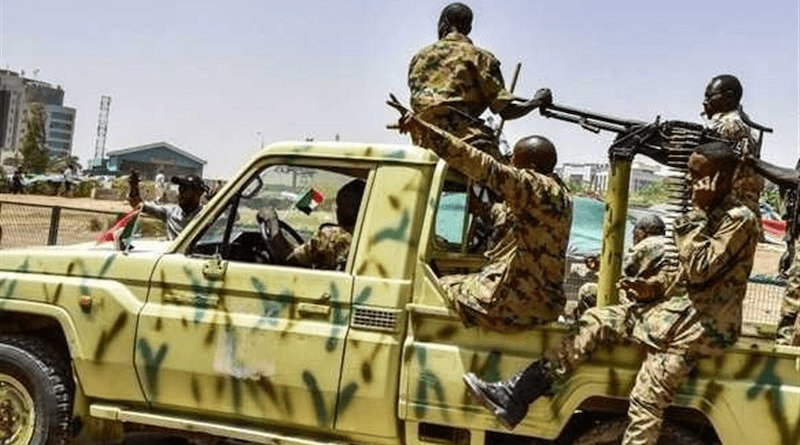
Sanctions on Al-Baraa Bin Malik Brigade (BBMB) are clear evidence of this goal to disrupt relations between Burhan and Islamists. If indeed Boulos and Burhan met in private this month, then the message will strongly resonate in Port Sudan as Burhan deeply relies on Al-Misbah Abu Zaid Talha, leader of BBMB, along front lines in the North Kordofan region and elsewhere today. These militias, along with the Sudan Shield Forces (SSF), are linked to remnants of the Muslim Brotherhood within the former ruling party, the National Congress Party (NCP). Talha’s relations within the Islamist movement run deep through actors like Mohamed Abbas Al-Labib and Ali Karti. The latter serves secretary-general of the Sudanese Islamic Movement and allegedly resides in Port Sudan and a vital source of financing for SAF. Reports point to a direct supply of (Iran) drones for BBMB facilitated by Al-Labib, Deputy General Intelligence Service (GIS) director.
While the US Treasury Department announced this round of sanctions to ‘counter regional instability and support for Iran,” the message was abundantly clear as pressure mounts for parties to agree to a ceasefire and for Burhan to join peace talks. Although the Quartet has expressed urgency for peace talks, the Somoud Coalition has called to “postpone political talks” under the African union, the Sudanese Alliance for Rights (SAR) has warned against deliberate escalation and further use of chemical weapons, echoing urgency for a peace process that also addresses the dire humanitarian crisis.

Like what you read?
Please consider supporting Eurasia Review. Thank you for your consideration!
